Everest
The Satanic VersesEverest is at once a real mountaineering objective and an almost supernatural force in Alleluia Cone’s experience. She climbs it with Sherpa Pemba, encounters visions on its slopes, and carries its image into her life in London. The mountain’s power in the narrative lies in that double character: it is a place to be reached, but also an ideal that draws her toward risk beyond the summit.
The Mountain and Its Imagined Heights
Everest enters Alleluia’s memory as a mountain already alive in her imagination. Long before she encountered it, she filled her apartment with representations in cork, plastic, tile, stone, acrylic, and brick. One was a tiny iceberg kept in the freezer, a miniature mountain made of ice. These objects register an attachment that does not depend on possession of the real summit: the mountain is present in her home because, as her own explanation has it, it is there.
The mountain also gives physical form to a larger idea of transformation. Alleluia thinks of an iceberg as water striving to become land, and of a Himalayan peak as land reaching toward sky: earth nearly changed into air. Everest becomes an image of grounded flight, a material height that seems to approach the exalted. Its attraction is therefore not simply scenic or athletic; the mountain makes metamorphosis seem tangible.
Alleluia’s Ascent and the Ice City
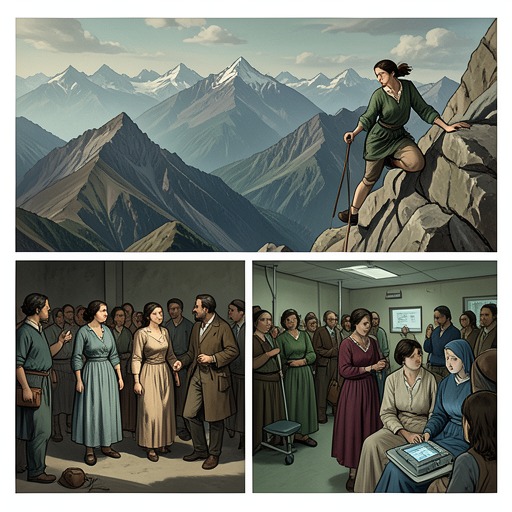
Alleluia and Pemba climb Everest and return. On the descent, while she is still at 27,000 feet, she sees a city of enormous ice spires west of Camp Six, across the Rock Band, beneath the massif of Cho Oyu. She briefly thinks of Shangri-La, but the apparition is no green valley of immortality: it is a cold, sharp metropolis. Pemba warns her to concentrate; when she looks again, the city has vanished.
The encounter folds the mountain into Alleluia’s family history. The vision sends her back in memory to a study in Bayswater, where her father, Otto Cone, had warned her against the idea that the world is a seamless continuum of elements that can all be reconciled. His account of a world in which incompatible things coexist gives the apparition a fitting frame: Everest does not resolve the boundary between the possible and impossible, but makes their collision visible to her.
Objects, Memory, and Recurring Visions
After returning to London, Alleluia tells Gibreel Farishta about visions she had kept from other living people, including the ice city and angels. During an early-morning walk along the Embankment, she sees ten icebergs moving upriver in single file. In the mist, they take the precise miniature forms of the world’s ten highest mountains, arranged in ascending order, with Everest bringing up the rear. The shapes disappear when the mist dissolves, but Alleluia insists they were there; Gibreel accepts her account rather than disputing it.
A carved wooden Everest given to her by the Sherpas of Namche Bazar makes the ascent portable. Pemba presents the detailed model as a group gift, though Alleluia recognizes that he carved it himself. It includes the icefall and Hillary Step, while the route they took is deeply scored into the wood. A message on its underside advises her not to try again. The model thus preserves both the achievement and the warning: the mountain’s route can be traced in miniature, but its danger cannot be reduced to an ornament.
The Mountain’s Double Claim
Alleluia does not tell Gibreel how deeply Pemba’s warning frightens her. She believes that setting foot on the goddess-mountain again would mean certain death, since mortals must not look upon the divine more than once. Yet the prohibition intensifies her desire. In her understanding, Everest is both transcendent and diabolic; these qualities are inseparable, so that the warning itself sharpens the mountain’s hold on her.
The ascent has already carried a cost. Physicians’ predictions that people could not survive much above 8,000 metres without breathing apparatus, and would suffer catastrophic damage and death, are set against Alleluia and Pemba’s return. She attributes their success to will and anger, forces she believes can bend natural laws for a time. But she experiences lapses of memory: she forgets the word for fish, cannot identify a toothbrush’s purpose, and briefly fails to recognize Gibreel. She hopes the impairment is temporary, while concealing another danger from him: she keeps seeing the ghost of Maurice Wilson on rooftops, beckoning her toward the solo ascent he never achieved. Everest’s decisive significance is therefore not only that Alleluia has climbed it, but that the mountain remains an invitation whose imagined next step threatens to become fatal.