Exile
The Satanic VersesExile in The Satanic Verses is more than displacement from one country to another: it is a suspension between a remembered home and a future return, with the present made difficult to inhabit. The Imam turns that suspension into a political creed, insulating himself in a London refuge while imagining his return to Desh; Hind Sufyan experiences migration as the loss of language, custom, status, and familiar surroundings; and Saladin Chamcha feels the loss of the past as a threat to the self. Together, their experiences make exile a condition of time and identity as well as geography.
Exile as a condition of waiting
The Imam’s account defines exile through a paradox: he looks forward by continually looking back. His return is not simply a possible journey home but a dream of political reversal and revolution. In the image that governs his understanding, the exile hangs suspended like a photograph, held motionless above native ground until the moment when it must move again and the earth reclaim it. The metaphor makes waiting seem both unnatural and inevitable: the exile’s present is frozen, yet it is expected to end in a return.
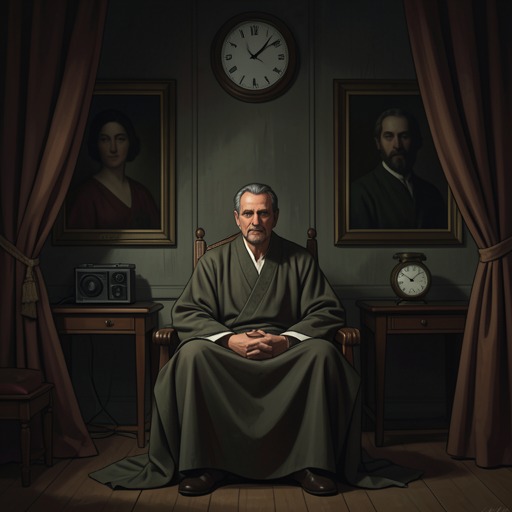
That expectation gives the Imam’s rented flat its peculiar meaning. It is a waiting room or transit space, not a home in which to establish new roots. He treats the distinction between home and foreign country as absolute, resisting any change that might make London part of his experience. On rare outings in Kensington, he is accompanied by eight young guards and fixes his attention ahead, seeking to avoid taking in the city around him. He hopes to return to Desh unsullied by the place that has given him sanctuary, as though ignorance could preserve his purity and prove that exile had not altered him.
The refuge as a surrogate homeland
The Imam’s refuge occupies floors three to five of a London mansion block, but its enclosed routines are arranged to imitate the homeland he longs for. The curtains remain drawn against foreignness and against the possibility of surveillance. His guards occupy secure apartments nearby; rifles, short-wave radios, and telephones make the flat both a domestic setting and a protected political centre. The Imam understands watchfulness as necessary for survival in exile, where hostile observers and the threat of attack are never far from his thoughts.
The apartment’s physical arrangements resist ordinary settlement. Its rooms contain hurriedly acquired, expensive furniture and files of clippings rather than books; food is brought in rather than cooked there. Even the building’s domestic inconveniences become part of its shared life: when the Imam uses the shower, those around him must avoid running water elsewhere, or they risk being scalded. The detail makes the household’s routines revolve around him, while also showing how little the refuge resembles an established home. In exile, attempts to put down roots feel to the Imam like an admission of defeat.
He compensates for the cold city by keeping the heating high and the windows shut, trying to reproduce the dry heat of Desh. Yet the moonlight that enters when he parts the curtains remains alien to him. His attachment to home is also expressed through images: postcards on the mantelpiece show a mountain, a village beneath a tree, and a mosque. Although the Imam rejects images in principle, his bedroom contains the portrait of his adversary, Empress Ayesha. The homeland is thus present as a set of selected signs and as a political struggle carried into exile, not as an ordinary landscape he can inhabit. The Imam and Empress Ayesha plot each other’s deaths from their opposing positions, binding his private longing for return to a continuing contest for power.
Migration and the loss of familiar life
Hind Sufyan’s experience in the Vilayet presents a less protected, domestic form of exile. She and her husband, Muhammad Sufyan, have moved from a modest teacher’s flat in Dhaka into a four-storey house that the family can own and rent out, helped by the success of the Shaandaar Café. The change brings material advancement, but it does not restore the world Hind has lost. Her language now feels alien in her mouth; the city and village of her youth, the waterways of home, and the courtesies and religious observances around which she organized daily life are distant or difficult to recover.
Migration also unsettles her place within the household. In the life she remembers, her husband’s respected position gave her standing; in the Vilayet, she has to work to support the family. She sees Muhammad Sufyan’s cheerfulness after losing his former vocation and status, but understands it as no remedy for her own losses. She also feels unable to comfort him, and the performance of happiness that she maintains for his sake seems counterfeit to her. Their differing responses show that relocation does not impose one shared emotional outcome even on people living in the same home.
Her fear of the city compounds that dislocation. She hears accounts of unexplained attacks and abuse, and responds by staying inside, sending others out for necessities and relying on Bengali and Hindi films and movie magazines to keep in touch with a familiar world. At home, her daughters’ refusal to speak their mother tongue, Mishal Sufyan’s changed appearance, and continual arguments become signs of a family life she cannot hold in its former shape. The narrator places her private unhappiness within a wider history of women like her, whose experiences threaten to disappear into anonymity. Exile here is not a heroic interval awaiting a triumphant return; it is an everyday erosion of language, authority, and a recognizable self.
The past, change, and the threatened self
For Saladin Chamcha, exile becomes inseparable from the fear that change cannot be reversed. After losing work and his marriage, he thinks of himself as inward and drawn toward higher things, yet caught in the mess of ordinary life. His image of being dragged down by land after the sea has given him up places displacement within a broader crisis: return to solid ground has not restored security or control.
He understands his rebirth as a second chance, but cannot experience it as uncomplicated renewal. Instead, he feels that he has been reborn into knowledge of death and the permanence of change. The past, once lost, cannot simply be recovered; he imagines himself sliding down a grey slope and urges himself to cling to yesterday. This response contrasts with the Imam’s confidence in a glorious return. For Saladin, the past is not a destination secured by political will but something he fears losing beyond retrieval.
Narrative significance
The novel sets these forms of exile beside one another without making them equivalent. The Imam converts separation into a disciplined refusal of his host city and an expectation of return. Hind Sufyan’s migration exposes losses that material success cannot compensate for, while the household’s generations adapt in ways that deepen her estrangement. Saladin Chamcha experiences displacement as a crisis of continuity, in which even a new beginning carries the knowledge that nothing can be made exactly as it was.
Across these contrasting lives, exile is measured not only by distance from a birthplace but by what can be preserved, altered, or remembered in the place of refuge. The Imam’s shut curtains and staged homeland, Hind Sufyan’s retreat into familiar films, and Saladin Chamcha’s effort to cling to yesterday are different attempts to manage that distance. None makes the present disappear: London, the Vilayet, and the changed self remain realities that must be lived in, even when belonging is uncertain.