Faith and doubt
The Satanic VersesFaith and doubt in The Satanic Verses are not simple opposites in which disbelief cancels belief. Doubt is described as an open, unsettled state, distinct from the certainty of either position. Through Gibreel Farishta’s collapse of faith, his dramatic public renunciation, and the later uncertainty around his visions, the novel asks how anyone can distinguish religious experience from psychological crisis without prematurely closing the question.
Doubt as an unsettled condition
The narrative explicitly distinguishes doubt from disbelief. Disbelief is treated as too final and closed, and therefore as another kind of certainty; doubt, by contrast, remains part of the human condition. This formulation makes uncertainty intellectually active rather than merely a failure to believe. It leaves room for conflicting explanations to persist, even when characters and observers would prefer a settled answer.
That distinction is extended to angels. The narrative imagines them once questioning God’s will and hiding beneath the Throne to pose forbidden questions. Their protest is quieted when they are assigned the role of instruments of divine will. The account contrasts their eventual submission with human beings’ capacity to doubt even what seems directly evident. Its language itself is not presented as neutral doctrine: the narrator marks the interruption as Shaitan’s devil talk. That framing complicates the passage rather than resolving it, leaving readers to consider both the force of the argument and the perspective from which it arrives.
Gibreel’s illness and loss of faith
During a near-fatal illness, Gibreel repeatedly called upon Allah and asked for a sign that would help him endure. He first interpreted his suffering as punishment, a belief that temporarily gave the pain meaning. Anger followed: he questioned why he should die despite having killed no one, and whether God represented vengeance or love. When the anger passed, he experienced what the narrative describes as emptiness and isolation. He came to feel that he was addressing thin air, and eventually no longer needed to feel that anything was there.
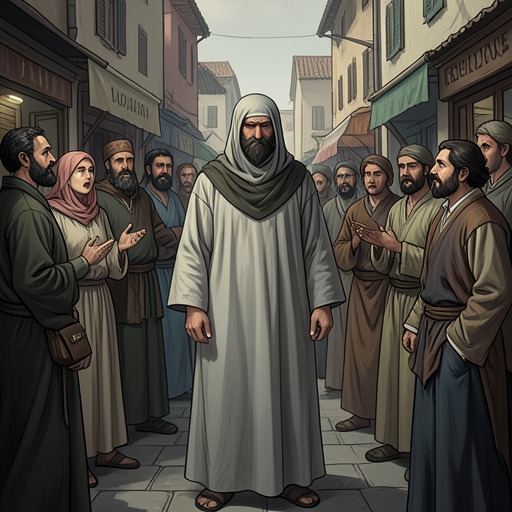
This change coincided with the illness turning and his recovery beginning. The hospital, journalists, friends, and public called the recovery an act of the Supreme; the narrative, however, emphasizes that Gibreel had changed because he had lost his faith. The contrast is crucial. A community interprets survival as confirmation of divine action, while the survivor understands his recovery through the absence of the presence he had pleaded for. Neither account simply erases the other: the same event supports public celebration and personal estrangement from God.
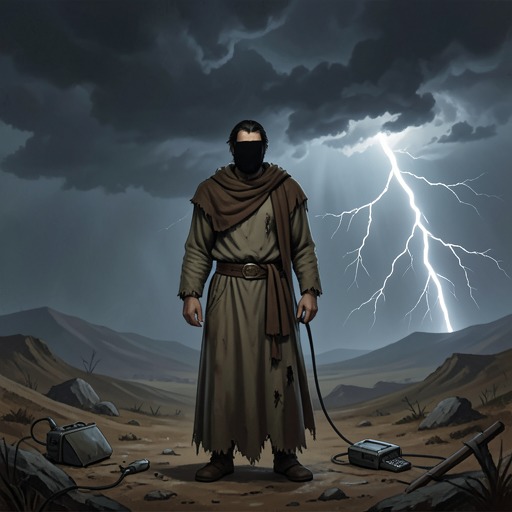
On the day he left hospital, a crowd celebrated his recovery, and he travelled under police escort before evading the pursuing vehicles. At the Taj hotel, he deliberately ate pork products, foods forbidden to him by his former faith. The act was a public test of the conviction he had reached in private: he sought to prove God’s non-existence by committing an act that, under his previous religious understanding, might invite divine punishment. No thunderbolt came. A fair-haired woman watched and laughed as he ate. The episode gives doubt a physical, conspicuous form, but it does not establish that every question has been answered; it shows Gibreel trying to make the absence of a sign serve as evidence.
Visions, diagnosis, and competing explanations
Gibreel’s later experience unsettles any easy distinction between a completed loss of faith and renewed supernatural certainty. His serial dreams continue, and he speaks Arabic verses in his sleep, although he does not know the language. Alleluia Cone writes down what he says and takes the words to the Brickhall mosque, where a mullah recognizes their meaning. For a time, Gibreel and his caregivers interpret the separation between his dreams and waking life as a sign that he is recovering. The narrative later complicates that apparent progress: the separation is also bound up with his division of himself into two entities, one of which he tries to suppress while sustaining it by treating it as someone else.
Alleluia sees Gibreel after Sisodia has returned him to her care and recognizes how deeply shaken he is. Gibreel faces his mental illness without disguising it, but fears that the state he calls his possessed or angel self may take control again. Under specialist care at Maudsley Hospital, medication dulls his senses; Alleluia looks after him and tries to help him recover. The clinical account matters because it names and treats a real crisis, but it does not, by itself, settle the status of the dreams or the angelic identity that shapes Gibreel’s experience. The novel keeps the boundary between psychological explanation and supernatural possibility in view rather than treating either as a simple verdict.
Doubt, knowledge, and judgment
That uncertainty affects how other characters understand Gibreel. When Saladin Chamcha encounters him at a party, he does not know that Gibreel is under close medical supervision, takes daily medication because of the possibility of a recurrence of paranoid schizophrenia, and has been kept away from film people after a previous rampage. Nor does Saladin know how heavily Alleluia’s role as nurse and support has burdened her. He mistakes the remote, medicated man before him for an embodiment of the good fortune Saladin believes himself to lack, while inventing an antagonistic version of Alleluia in his own imagination. His view of Gibreel is thus itself a fiction built from incomplete knowledge.
Later, Alleluia explains that Gibreel has stolen car keys and driven the wrong way along a motorway exit while invoking damnation and the vengeance of the Lord. The doctors, she says, regard possessive jealousy as a possible trigger for his illness. Saladin listens sympathetically while privately maintaining his intention to betray Gibreel’s trust. These scenes connect doubt not only to religious belief but also to the limits and motives of human judgment: characters interpret conduct without possessing the whole account, and certainty can serve envy as readily as faith. Across Gibreel’s prayer, renunciation, dreams, and treatment, the novel leaves the reader facing the same unresolved task—holding competing explanations in mind without pretending that uncertainty has already been overcome.