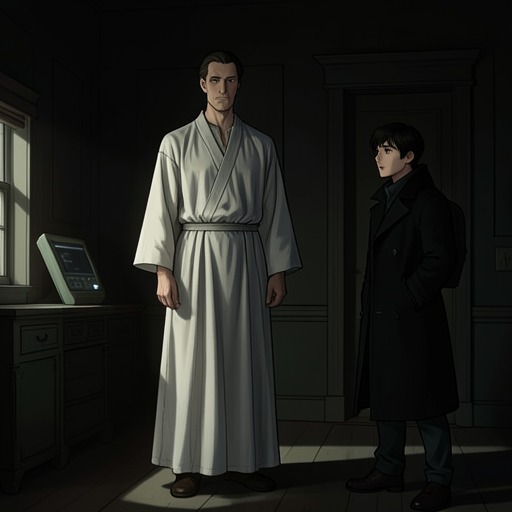
Flight AI-420 hijackers
The Satanic VersesFlight AI-420 hijackers turn the Bostan into a stage for political demands and spectacle, then keep its passengers trapped for 111 days at a desert oasis. The quartet’s shifting performance—part media-conscious bravado, part lethal resolve—makes the hijacking a study in how public images can both imitate and produce violence.
Composition, Demands, and Captivity
The hijackers are three men and one woman. The men use the stage-names Dara Singh, Buta Singh, and Man Singh; the woman is Tavleen. At first, the group seems electrically restless and trigger-happy, but their different temperaments soon become evident. The three men flaunt themselves at the snipers they imagine among the palm trees, acting out the roles of hijackers learned from films and television. Saladin Chamcha reads their posturing as an imitation of an already crude image. Tavleen, by contrast, keeps apart from their bravado; her quiet attention and apparent command of herself make her the most frightening of the four. Their demands are for an independent homeland, religious freedom, the release of political detainees, justice, ransom money, and safe passage to a country of their choice. Some passengers come to sympathize with these claims even while living under the threat of execution: the captives can recognize the hijackers’ wish to shape the world, though they remain subject to the quartet’s armed control. The political message and the spectacle are inseparable. The hijackers become stars in their own drama, while the passengers are forced into the audience and the stakes are real. The Bostan lands not at an international airport but on a vast runway built for a local sheikh’s pleasure at his desert oasis, Al-Zamzam. A six-lane highway that once drew young people out to cruise the empty landscape is now crowded with armoured cars, troop transports, and limousines bearing flags. Diplomats debate whether to storm the aircraft or concede to the hijackers, while the fate of the passengers remains suspended between those decisions. The aircraft and its captives are held there for 111 days; as the negotiations stall, the desert stillness gives way to mirages.
Isolation and the First Execution
After landing, the hijackers released all but fifty passengers, deciding that this was the largest group they could supervise. Women, children, and Sikhs were among those freed. Saladin Chamcha was the only member of the Prospero Players left aboard; perversely, he felt relief at being separated from his badly behaved colleagues. Eugene Dumsday, the creationist scientist, could not bear his continued captivity. When he shouted at the hijackers, Tavleen struck him with her rifle butt, severing the tip of his tongue. The wounded Dumsday was then released because the hijackers did not want the burden and danger of caring for him. The violence thus determined who could leave: even an injury inflicted by the captors became, in his case, a way out.
The surviving hostages settled into a routine that made captivity feel less like a passing emergency than an erased existence. Twice a day, a lone vehicle brought food and drink to the Bostan and left it on the tarmac; the hostages carried the cartons aboard while the hijackers watched from inside. There was no other contact with the outside world, and the radio fell silent. As the days lengthened in heat and isolation, passengers began seeing apparitions: a skeleton riding a camel, colored globes in the sky, or the beating of enormous wings. The hijackers, too, changed. Their first nervous outbursts gave way to gloom, and their vulnerability frightened the hostages more than their earlier displays of aggression.
On the hundred and tenth day, Tavleen ended the stalemate by selecting Jalandri, a hostage who had abandoned the turban and cut his hair. She treated this as apostasy and a betrayal of faith, and named him for execution. As she dragged him by the hair toward the open aircraft door, no one intervened; the three male hijackers turned away. Tavleen shot Jalandri in the back of the head and shut the door. Man Singh protested that the group had nowhere left to go and would now face a commando assault. Tavleen answered that martyrdom would make them like stars and the sun. Her decision revealed the division at the heart of the quartet: the men had performed the image of hijackers, but when killing became unavoidable, she alone acted.
Final Confrontation and Destruction
After Jalandri’s execution, the hijackers set the Bostan in motion again. It emerged from the desert into a winter landscape: Europe and the English coast lay beneath snow, and the aircraft circled over England while radar tracked it and radio messages asked whether it wanted permission to land. No request came. The fuel indicators fell toward empty, leaving the plane suspended between a possible landing and the quartet’s refusal to seek one.
The final rupture began when Man Singh went for Tavleen. The three men had previously argued with her over fuel and her decisions; now they stood in silence, and the passengers watched with a fatalistic detachment. Tavleen stabbed Man Singh through the stomach. As she rose, the others understood that she was carrying out her intention to the end: she held the wire joining the pins of the grenades concealed beneath her gown. Buta Singh and Dara Singh rushed at her, but she pulled it. The aircraft’s walls gave way in the explosion, and the narration overturns the expected meaning of the blast by calling it birth rather than death. The quartet’s performance of political spectacle thus ends in an act that destroys the stage itself, leaving the story poised on the possibility of transformation.
Performance, Political Identity, and Unstable Reality
The hijackers’ stage names and borrowed screen behavior resonate with Saladin Chamcha’s own history as an actor and self-fashioned migrant. The novel treats making oneself anew as a fraught act: it may look like an unnatural seizure of the Creator’s role, yet it can also be a risky struggle for survival, especially where people use disguises to counter descriptions imposed on them. That tension sharpens the distinction Saladin perceives between the men’s imitation of familiar media images and Tavleen’s more deliberate resolve. Performance here is not simply a mask concealing a settled identity; under pressure, it becomes entangled with the power to act and with the consequences others must endure.
The long captivity also unsettles the boundary between political spectacle and lived reality. The passengers’ sympathy for the demands does not dissolve their exposure to coercion, just as the hijackers’ public posture cannot keep the consequences of violence at a distance. In the desert, silence and isolation give way to mirages and visions; over England, the plane’s circling and dwindling fuel culminate in an explosion that the narration recasts as birth. That final reversal does not resolve the quartet’s contradictions. It makes their destruction at once an ending and an image of transformation, leaving the passengers’ ordeal suspended between political event and a reality that no longer feels stable.