Frank Lime
The Satanic VersesFrank Lime is the young inspector overseeing the police search of Rosa Diamond’s house, where Saladin Chamcha is arrested after surviving the destruction of the Bostan. His role is small but consequential: he voices the official rationale for the search, stands between Rosa and the immigration officers observing him, and becomes part of a scene in which suspicion overwhelms evidence before Chamcha can establish who he is.
Position and Introduction
Lime appears at Rosa’s house after an anonymous report of a suspicious person on the beach brings a large police presence to the coast. Fifty-seven uniformed constables search the beach, accompanied by thirteen dogs; officers have come from towns including Hastings, Eastbourne, and Bexhill-upon-Sea, with a group from Brighton as well. While the search spreads along the shore, five constables guard the exits to Rosa’s house and three plain-clothes immigration officers join the inquiry.
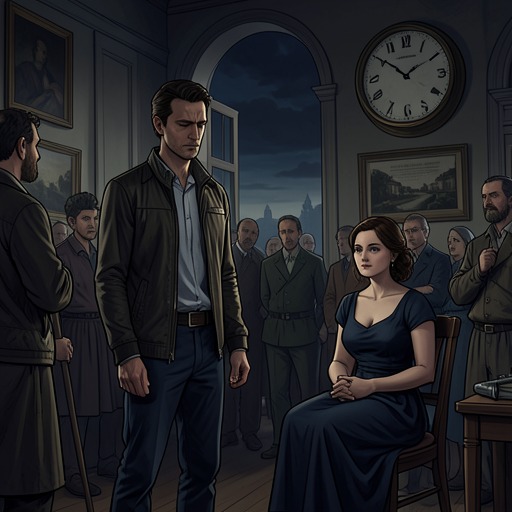
Lime stands in front of this group, shuffling his feet and rubbing his nose. The narration describes him as looking older and more bloodshot than his forty years. Rosa knows him as Frank and addresses him familiarly, even tapping his chest with her stick. But the immigration officers are watching his conduct, and he responds by drawing himself up and pulling in his chins rather than accepting her attempt to direct him. The scene thus establishes both his local familiarity with Rosa and the pressure of the larger enforcement operation around him.
The Search and Chamcha’s Arrest
Lime presents the search in the language of official procedure: allegations have been made, information received, and a warrant obtained. His explanation is formal and hesitant, a string of qualifications that gives the action a legal frame without clarifying what evidence has identified Rosa’s house as the destination. Before Rosa can finish objecting, the three immigration officers react to the sight of Chamcha in the hallway and press past her. Their confidence in him as the person they seek precedes any examination of his account.
The officers’ attention fixes on Chamcha, who is standing in his pyjamas and rubbing an eye. As the police crowd into the house, Rosa loses sight of him and cannot hear his explanation that he survived the Bostan’s destruction and came ashore. The officers mock his account of having fallen from the sky and swum to the coast. When he says he is British and has the right of abode, he cannot produce a passport or other identifying document. The resulting laughter drowns out his protests; the scene does not establish what Lime personally does to Chamcha, but it places him at the centre of the operation in which Chamcha is handcuffed and taken away.
Authority and the Limits of Proof
Rosa tries to intervene, calling on Lime to stop the officers. Her appeal does not redirect the search. Instead, one of the plain-clothes men points to Chamcha’s newly grown horns as proof of his supposed identity. Lime is present as the officers turn an unexplained bodily change into apparent confirmation of their suspicions. Chamcha follows the pointing gesture and recognizes that the horns have appeared; the arrest has therefore become bound up with a transformation that the authorities treat as incriminating evidence rather than as a reason to question what they think they know.
The episode makes Lime’s procedural authority look both real and limited. He can announce that a warrant has been obtained and take part in the search, yet the scene’s decisive judgments come from the immigration officers’ certainty and from Chamcha’s inability to produce documents. His claim to be a recognizable television actor does not persuade the police, and the search ends with him in custody rather than with his identity verified. Later, while Chamcha remains detained, he insists that his professional and membership records could confirm his identity if the computer were consulted. That later demand underscores the gap between a checkable claim and the humiliating disbelief he encounters; it does not, however, establish that Lime was present for or responsible for the later questioning.
Narrative Role and Aftermath
When Gibreel Farishta comes downstairs and Chamcha calls on him to explain what has happened, Lime asks who he is, treating him as a possible accomplice or another skydiver. Once the floodlights are switched off, a pale golden light appears to stream from behind Gibreel’s head. Lime never refers to it again; the narration says he would have denied seeing a halo. The moment places his official role alongside a phenomenon the scene makes visible but that he will not acknowledge, sharpening the contrast between what the officers witness and the account they later accept.
The arrest also begins a new stage in Chamcha’s life, but the evidence does not show Lime’s involvement in the subsequent detention or in Chamcha’s eventual release. Later, Chamcha is advised that his horns and hooves would make him an unreliable witness if he complained. Lime’s importance therefore lies less in an extended personal arc than in his place within the arrest scene: he is the named inspector whose formal language accompanies an operation where suspicion, missing papers, and an altered body determine the outcome before Chamcha can make himself believed.