Gibreel Farishta
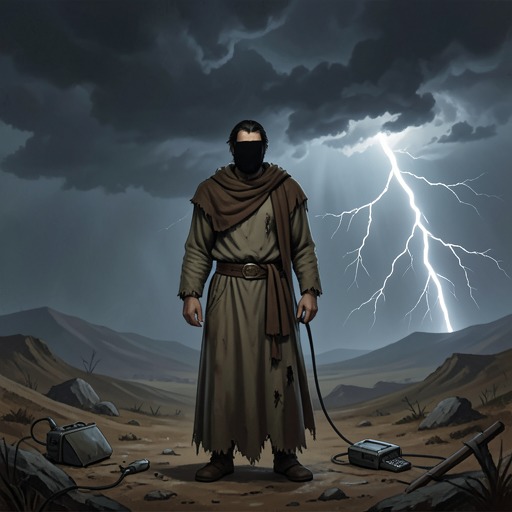
The Satanic VersesGibreel Farishta is a celebrated Indian film actor whose most recognizable roles are gods and the archangel Gibreel. His career makes him, for millions of viewers, more than a performer: the familiar face of the divine. After surviving the destruction of the Bostan, he travels to London under his birth name, Ismail Najmuddin, and becomes caught between dreams of sacred history and the demands of ordinary life. His story repeatedly unsettles the difference between a role and an identity, a vision and an event, and survival and renewal.
Identity and Stardom
Born Ismail Najmuddin in Poona during the last years of British rule, Gibreel takes a new name that invokes an angel. The change is one of several reinventions in a life shaped by performance. As a film star, he plays Krishna, appearing blue-skinned with a flute among the gopis, and Gautama, meditating beneath a studio-made bodhi tree. He also takes secular historical roles, including both the Grand Mughal and the wily minister in Akbar and Birbal. His success across religious boundaries makes him unusually acceptable to audiences of different beliefs.
For more than fifteen years, Gibreel represents a widely recognized face of the Supreme to audiences in a country where the population of the divine is imagined to be nearly as numerous as the human one. The distinction between actor and parts has, for many fans, all but disappeared. His celebrity therefore rests on a paradox: his public identity is assembled from roles, but the more convincingly he plays divine figures, the more those roles seem to claim him as their own.
His early breakthrough begins in children’s television with The Aliens Show, a science-fiction comedy whose cast and settings are transformed by computer-generated imagery and prosthetic makeup. The fictional aliens themselves change features and limbs, and each transformation brings a different accent. The show’s artificial bodies and manufactured worlds anticipate the instability that will later attach to Gibreel’s own image: in his career, as in his visions, identity is something seen, performed, and repeatedly remade.
The Flight and the Idea of Rebirth
After a period in hospital, Gibreel leaves in a wheelchair; one morning it is found empty. He boards Flight AI-420 to London as Ismail Najmuddin. The 747 is called the Bostan, after a garden of Paradise. Later, speaking to Saladin Chamcha, Gibreel describes his passage through the hospital and the plane as two partial deaths that together amount to rebirth. He presents his arrival in London as the beginning of a new life, making survival itself part of the story he tells about who he is.
That account of renewal is unsettled by what follows. Gibreel has not spoken to anyone about the dreams that began after he ate pork. In them, he is not an actor playing his namesake: he experiences himself as the archangel, present within the dream’s world as fully as the people he sees. The dreams make the journey from India to London less a clean break than a threshold across which his other identity follows him.
The narration frames the fall and its aftermath as a cause of change, while leaving the agency behind that change uncertain. Gibreel and Saladin have fallen from the sky, and the voice that describes their mutations alludes to higher powers with mischievous interest. Survival brings transformation, but the account does not settle whether these changes are supernatural, psychological, or both. Gibreel’s own conviction that he has been reborn meets a world in which the meaning of that rebirth remains in dispute.
Dreams, Revelation, and Uncertain Identity
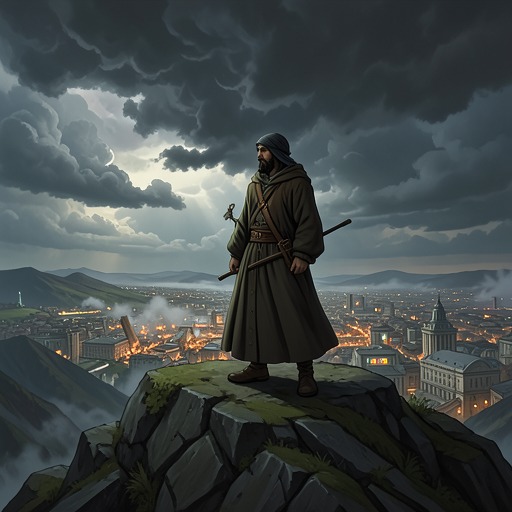
The dreams place Gibreel in the history of Mahound, sometimes as a spectator and sometimes as a moving camera. He surveys the action from above, descends among its participants, or tracks alongside them; at other times, he watches from Mount Cone as though Jahilia were a film screen. This cinematic point of view connects his work as an actor to the visions: even in dreams, he sees through the habits of a performer and a moviegoer, shifting between involvement and observation.
That distance breaks down during what Gibreel calls his listening. He feels a pain as if something were being born, and the vision reverses the apparent positions of dreamer and dreamed. Gibreel seems to emerge from Mahound, joined to him by a cord of light, while Mahound listens in a trance. The dream offers no stable answer to which man dreams the other. It instead binds Gibreel’s identity to the Prophet’s experience, making the archangel not merely a role he once performed but a presence caught inside an unresolved act of revelation.
In one episode, Mahound wakes after wrestling with Gibreel and concludes that the voice he heard was the Devil in the archangel’s guise. He identifies the verses he had recited as satanic and returns to the city intending to remove them. The scene gives Gibreel’s dream-world a consequential uncertainty: revelation may be divine or deceptive, and a voice’s authority cannot be guaranteed by the identity it appears to bear. The question resonates with Gibreel’s own condition, in which seeing himself as the archangel does not clarify whether he is receiving a vision or being overtaken by one.
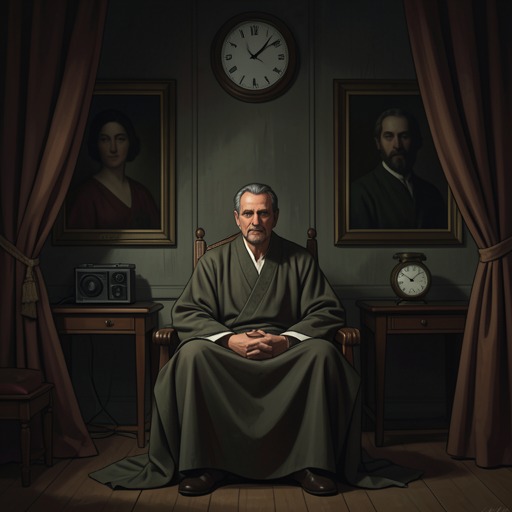
A different dream joins the Imam’s political world to a radio transmission. Bilal’s singing voice reaches a ham radio in Kensington and emerges in the dreamed-of Desh as the Imam’s speech, calling for revolution against the Empress and against history. Gibreel sees himself in the Imam’s sanctum, not in angelic form but wearing ordinary clothes inherited from Henry Diamond. The contrast between his public image as a divine figure and the unremarkable clothes of this dream-self sharpens the uncertainty surrounding his identity. Elsewhere, in a village vision reported by Ayesha, the archangel appears to her and rests beside her; she tells Sarpanch Muhammad Din that a great obligation and a great gift have come to the village. Gibreel’s image thus circulates beyond his own dreams, acquiring force in other people’s visions as well.
London, Love, and the Return to Public Life
In London, Gibreel’s experience of the waking city is repeatedly interrupted by visions. During a snowy arrival, he hurries through Victoria station searching for Rekha Merchant, his former lover, and sees her floating above a carpet, invisible to the other passengers. The apparition belongs to a past that has not stayed past. Later, when Rekha appears again in a vision, Gibreel rejects her as neither God nor God’s adversary, but an illusion. She vanishes. His refusal to accept her terms momentarily restores a boundary, though it does not end his susceptibility to visions.
His relationship with Alleluia Cone offers another possible beginning. After Saladin is taken away, Gibreel reflects on his conduct and eventually connects his sense of being directed by another will to the world behind his eyelids. He realizes that his nightmares are leaking into waking life and that he must get away if he is to begin again with Alleluia, the climber who has seen the roof of the world. The hoped-for rebirth through their relationship is therefore inseparable from his effort to escape the dreams.
The reunion does not settle that conflict. After appearing on Alleluia’s doorstep collapsed in the snow, Gibreel is taken to her home. During an angry departure, he hears what seems to be a breach between the dream-world and ordinary existence and sees God. The figure is not an abstract force but a balding, bearded man in glasses, dressed in a way Gibreel does not expect of the Almighty. The encounter leaves Alleluia alarmed and Gibreel absorbed in the apparition rather than in their relationship. The divine appearance is vivid, but its startlingly ordinary form offers no simple confirmation of what he has experienced.
Gibreel later attempts a return to cinema. Producer S. S. Sisodia arranges a comeback, and Gibreel is concealed from the audience at an Earls Court show, entering in a burqa and waiting in a dressing room marked with a black five-pointed star. His angel costume includes a device that lights bulbs behind his head to create a halo; a closed-circuit screen lets him watch the performance below. When he is about to descend in a chariot, the old division between realities returns. He cannot tell which world he will enter, and the opening line he has rehearsed seems to sound in two realities at once. He disappears from the stage. The resulting rumor that he levitated away spreads among London’s Asian communities, and shops in Brickhall, Wembley, and Brixton sell toy halos alongside rubber horns. The public turns his uncertain disappearance into competing, purchasable signs of sanctity and monstrosity.
Illness, Conflict, and Ending
Gibreel’s visions have consequences beyond the stage. His illness is eventually identified as paranoid schizophrenia, and he is kept under close medical supervision and given daily medication because of the possibility of recurrence. Alleluia tries to keep him away from film people she distrusts after his earlier disturbance, but he insists on making another attempt to re-enter what he considers his real life. The strain of caring for him is part of their conflict, even as his own insistence on freedom makes the relationship harder to sustain.
Gibreel’s public return is accompanied by failure and rumor. The Parting of the Arabian Sea performs badly; its effects are criticized as unconvincing, its lead performer as inadequate, and Gibreel’s portrayal of the archangel as self-regarding. His next film, Mahound, also fails. Reports describe him as erratic: sometimes gentle, sometimes demanding that people kneel. His career, once supported by the audience’s willingness to merge star and sacred role, now exposes the danger of that merger. The performance of divinity has become difficult to separate from his illness and from the authority he attempts to claim in person.
A public interview deepens the rupture with Saladin. Gibreel says that he was booked on the Bostan under the name Najmuddin, claims that he missed the flight, and explains that he allowed the fiction of his death to stand. Saladin, who believes he shared the fall and its aftermath with Gibreel, hears this as betrayal. His anger is sharpened by the memory of their ordeal and by the sense that Gibreel has denied what they experienced together. The competing accounts make Gibreel’s self-invention costly: the narrative of a fresh start cannot erase the shared past it contradicts.
After the fires in Brickhall, Alleluia refuses to take Gibreel back. Saladin later recognizes that others have treated her life as secondary while making decisions about forgiveness and reconciliation. Gibreel returns to Bombay hoping to escape both London and the people he has left behind, but his mental health continues to deteriorate. His work, behavior, and unresolved suspicions become the subject of rumor, while the possibility that the illness will return remains a real burden.
At the end, Gibreel sits on Changez’s bed holding an old lamp, dressed in a dirty kurta-pajama and appearing exhausted and detached. He tells Saladin that he had said he could not endure the illness if it never truly went away and kept returning. He then kills himself. The ending gives finality to the fear that has shadowed his repeated language of rebirth: survival and reinvention have not made recurrence bearable.
Narrative Role
Gibreel is at once a star, a dreamer, an apparent visionary, and a man under medical care. The novel’s shifting narrative places him inside several stories at once: he watches the history of Mahound, appears in the reported vision of Ayesha, sees visions in London, and moves through the contemporary plot with Saladin. The narrator also refuses to resolve every supernatural possibility. In one aside, the narrating voice says it once sat on Alleluia’s bed and spoke with Gibreel, but declined to clarify whether the power above or below was responsible. Gibreel’s experience is therefore not simply explained away, nor is it given an uncontested divine authority.
His career supplies the novel with a sustained image of identity as performance, but the consequences are personal rather than merely theatrical. A face that once allowed him to cross religious boundaries becomes inseparable from the roles it carries; dreams turn that public association into private uncertainty; and his attempts to return to ordinary life repeatedly encounter the sacred images and competing realities he cannot command. Gibreel’s arc does not arrive at a secure reconciliation between actor and angel, illness and revelation, or past and new life. It ends with the collapse of the hope that another beginning will, by itself, overcome what returns.