Gibreel Farishta’s grave illness, recovery, and loss of faith
The Satanic VersesGibreel Farishta’s grave illness, recovery, and loss of faith form a near-death crisis that changes both his understanding of God and the course of his life. A collapse on a film set becomes a national emergency, but medical treatment cannot explain what is happening to him. He survives; what ends is his belief. His recovery is followed not by a return to religious certainty but by a deliberately public act of disbelief, and by his first encounter with Alleluia Cone.
Collapse and Medical Crisis
While filming at Kanya Kumari, at Cape Comorin, Gibreel takes part in a fight scene staged where the western, eastern, and southern waves meet. He receives a punch on the jaw and falls backward into the surf, unconscious. At first, the production blames the stunt performer, Eustace Brown, who insists that he knows how to stage fights without harming his co-stars. The crew fires him, and the police hold him in custody. Yet the apparent explanation proves false: the punch did not cause Gibreel’s collapse.
Gibreel is flown to Breach Candy Hospital in an Air Force jet. Extensive tests yield almost nothing, while his condition worsens. He is suffering unexplained internal bleeding, and his blood count falls from its usual fifteen to 4.2. For seven days he receives transfusions and medical treatment; although there is a marginal improvement, his doctors give up hope. The illness is presented as both an urgent medical emergency and an unresolved mystery: the available tests cannot account for its severity, and the suspected on-set injury is explicitly ruled out.
A National Vigil
Gibreel’s illness becomes a public event. News bulletins and television updates carry reports of his condition, and a crowd estimated at half a million gathers on Warden Road. Police disperse the mourners with lathi-charges and tear gas, although many are already crying and wailing. The Prime Minister cancels her appointments and visits the hospital; her son, an airline pilot, sits beside Gibreel and holds his hand. Mosques and temples fill with people praying not only for the actor’s life but also for the country’s future.
The scale of the response rests on Gibreel’s public identity as a celebrated incarnation. His possible death is treated as a threat that might extend beyond one famous man: people fear that if divine retribution has fallen upon him, the rest of India may not be safe. A hospital spokesman calls the case a freak mystery and offers an act of God as a possible explanation. That interpretation belongs to the public around Gibreel, however; it does not settle what the illness means to him. The crowd’s mourning and prayer, like the spokesman’s explanation, make the crisis visible as a national question of faith as well as a medical one.
The Loss of Faith
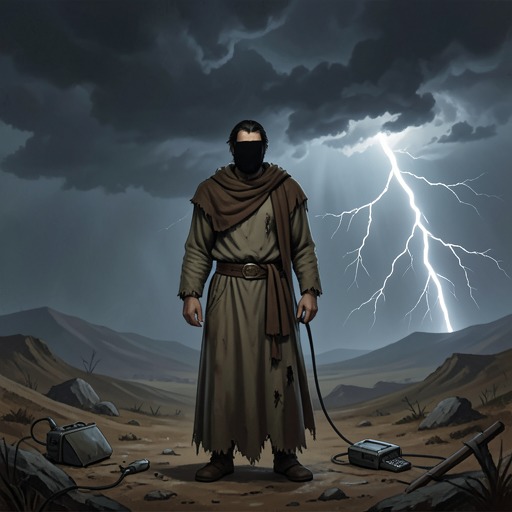
During every conscious moment of the illness, Gibreel calls upon God for help and asks for some sign that he has not been abandoned. At first, the thought that he is being punished gives him a way to endure the suffering. Then he becomes angry at the possibility of a God who inflicts punishment, before anger gives way to a deeper emptiness. He recognizes that his appeals meet no answer and that he can no longer feel a divine presence. Eventually, he finds that he no longer needs to feel one.
The change in his belief coincides with the change in his condition: on the day he stops needing a response from God, the illness shifts and his recovery begins. The account does not offer a medical explanation for this connection. Instead, it sets the unexplained recovery beside Gibreel’s inward transformation, leaving the relation between bodily survival and religious disbelief unresolved. His recovery is consequently not a restoration of the old self. Gibreel lives, but the faith that had shaped his pleas through the crisis does not return.
Recovery as a Public Test
Gibreel’s recovery is as mysterious and rapid as his illness. The hospital, journalists, and friends describe it as an act of the Supreme, and a national holiday is declared; fireworks mark the country’s celebration of his survival. On the day he leaves hospital, he passes through the crowd under police escort, gets into his Mercedes, and tells the driver to lose the vehicles following them. The evasive drive takes seven hours and fifty-one minutes. By the time it ends, Gibreel has decided what to do.
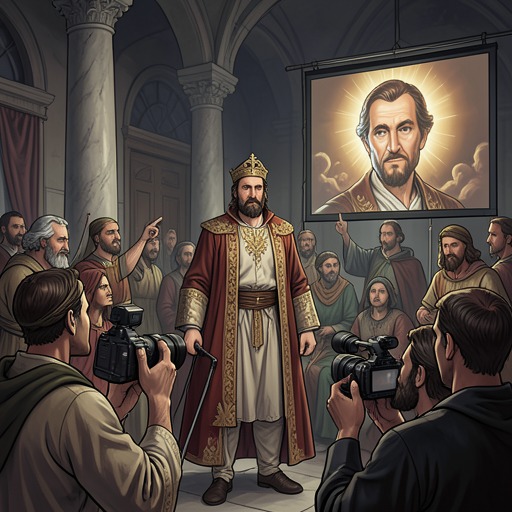
At the Taj hotel, he goes straight to the dining room and fills his plate with pork sausages, ham, and bacon. He eats in front of the photographers who have appeared around him. The act makes his changed conviction public: he treats the absence of a thunderbolt as evidence that the feared divine punishment will not come. Rather than simply announcing disbelief, he tests it against a prohibition, turning the meal into a visible challenge to the explanation that his illness and recovery were divine interventions.
A fair-haired woman watches him, laughs, and turns away before returning to tell him that the point is not the absence of a thunderbolt but that he is alive and has his life back. Gibreel later tells Rekha Merchant that her return made him fall in love with her. He is drawn to Alleluia Cone, a mountain climber known for conquering Everest, and to her challenge that survival should mean changing his life. The illness therefore ends not with a settled answer about God but with a break in Gibreel’s former certainty, an act that makes that break visible, and the opening of a new relationship.