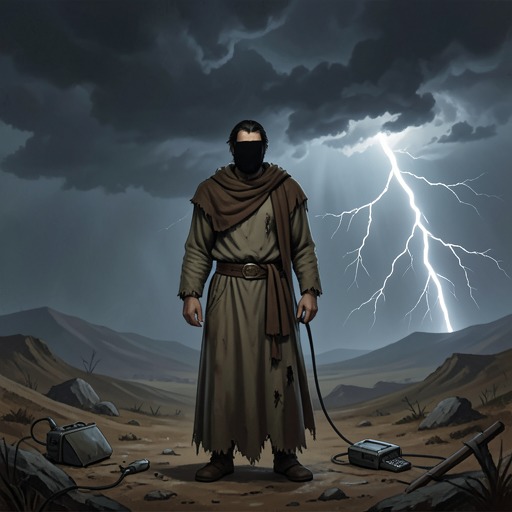
Gibreel sees God at Alleluia’s home and leaves her
The Satanic VersesGibreel Farishta’s vision of God at Alleluia Cone’s apartment coincides with the end of their relationship: a quarrel over jealousy turns, at the instant Alleluia refuses to soothe him, into an encounter that Gibreel takes as confirmation of his archangelic calling. The scene binds private separation to a new religious mission, while leaving the status of the vision—and the source of Gibreel’s certainty—unsettled.
The quarrel that precedes the vision
The immediate cause of the rupture is Alleluia’s story about Jack Brunel. After his lavish gifts failed to win her, the animator had appeared unannounced at her apartment, drunk, and stayed until three in the morning. When Alleluia returned from brushing her teeth, she found him naked on her living-room rug, arms spread as he cried, “Take me! Do what you will!” She made him dress and gently put him out; he never returned.
Alleluia tells the episode to Gibreel in an open, giggling manner. The narration leaves room for doubt about her innocence: because their relationship has lately been strained, she may be hoping, perhaps without fully admitting it, that his reaction will make the next rupture his responsibility. Gibreel responds not by accepting the story’s stated ending but by imagining that Brunel is still waiting for her call. His jealousy expands beyond the animator into a succession of imagined lovers waiting around every corner. The quarrel is thus driven by a past encounter that Alleluia says is over, but which Gibreel recasts as a continuing threat.
His accusation that Alleluia used Brunel’s story as a deliberate taunt gives the argument its humiliating edge. He screams, “You want men down on their knees,” and declares, “Me, I do not kneel.” Alleluia answers, “That’s it,” and tells him to leave. The language of kneeling makes the personal dispute momentarily echo the submission that will dominate Gibreel’s vision: he rejects being made to yield to a rival, even as the supernatural authority he encounters soon demands that he stop resisting.
The apparition in the bedroom
Clutching his toga, Gibreel goes into the bedroom to dress. His available clothes include the scarlet-lined gabardine overcoat and grey felt trilby of Don Enrique Diamond. He shouts that he is not coming back, but expects his rage to prompt Alleluia to calm him and offer a way to stay. Instead, she shrugs and walks away. At this precise point, the narration describes the boundary between the world of dreams and everyday reality breaking: Gibreel hears a sound like a bursting dam, and the spirits of dreams flood into the ordinary world. He sees God.
The vision is concrete rather than abstract. Gibreel sees a man sitting on the bed, roughly his own age, medium in height and heavily built, with a close-cropped salt-and-pepper beard. The figure is balding, appears to have dandruff, and wears glasses—details sharply at odds with the Almighty Gibreel expected. Alleluia has stopped in her tracks and watches him in genuine panic as he begins speaking to someone she cannot see. Gibreel asks the apparition who it is; it answers, “Ooparvala,” or “The Fellow Upstairs.”
Gibreel tests the apparition rather than accepting it without question. He asks whether it might instead be “Neechayvala, the Guy from Underneath?” The challenge brings an immediate display of power: clouds gather outside, wind and thunder shake the room, and trees fall in the Fields. The deity rebukes him for having doubted for so long, but refuses to settle whether it is singular or plural, pure or a union of opposites. Its nature, the vision insists, will not be resolved there. The scene therefore presents divine authority with force while preserving uncertainty about what, exactly, Gibreel has seen.
Revelation and the demand for action
The apparition says that revelation has already been sent into Gibreel’s dreams, clarifying both the deity’s nature and Gibreel’s own. It accuses him of fighting the revelation by struggling against the sleep through which, in its account, he was being awakened. The explanation connects the visions that have troubled Gibreel to a purposeful divine message, but it comes from within the encounter whose reality remains inseparable from his perception.
The deity’s rebuke also reduces the lovers’ quarrel to a distraction from a larger task. It asks whether Gibreel was taken from the skies merely to “boff and spat” with a blonde and insists that “There’s work to be done.” Gibreel answers, “I am ready,” and adds that he was going anyway. The line allows his obedience and his attempt to preserve his independence to coexist: he submits to the command, yet presents departure as his own decision. His readiness marks a change from the doubting figure addressed by the apparition, though it does not resolve whether that change is spiritual conviction or a consequence of his unstable experience.
Separation and immediate aftermath
The divine encounter does not reconcile the couple. Alleluia calls after him, “Gibreel, goddamn it, never mind the fight. Listen: I love you.” By then the apartment is otherwise empty. Gibreel says quietly that he has to go. Alleluia tells him she does not think he is well, but he answers with formal dignity that, having ordered him out, she has no jurisdiction over his health. He leaves rather than accept either her love or her concern as a reason to remain.
When Alleluia tries to follow, piercing pains seize both her feet and force her to the floor in tears. The narration compares her collapse to an actress in a masala film and to Rekha Merchant on the day Gibreel left her for the last time, linking this departure to an earlier pattern of abandonment. The pain stops Alleluia from pursuing him, making separation bodily as well as emotional; the narrative does not explain its cause here.
Outside, the storm associated with the apparition’s anger has passed. The night is clear and balmy, and the fallen trees remain as the only visible evidence of the departing being’s power. Gibreel, wearing the trilby and gabardine, feels in his money belt the shape of a paperback book and gives silent thanks for his escape. He is now certain of his archangelic status. He replaces remorse over his former doubts with a resolve to bring the ungodly metropolis back to knowledge of God through the Recitation. He feels his old self fall away and dismisses it, while choosing for the moment to retain his human scale. The departure thus carries him from a lovers’ quarrel into a self-appointed public mission, but the contrast between the ordinary clothes and the extraordinary calling keeps the transformation visibly unresolved.