Jamshed Joshi
The Satanic VersesJamshed Joshi, known to nearly everyone as Jumpy Joshi, is Saladin Chamcha’s old college friend and, after Saladin is believed to have died in the Bostan airliner explosion, becomes Pamela Chamcha’s lover. He is introduced through a revealing contrast: a man habitually anxious and uncertain in private, yet capable of startling public boldness. His story links the intimacy of a new relationship to the political daring of an earlier generation, while Saladin’s unexpected voice makes the past intrude into both.
Identity and Background
Jumpy Joshi’s nickname has overtaken his given name. His slight build, narrow shoulders, pale and sunken-eyed face, thinning black curls, and habit of running his hands through his hair give him a persistently unsettled appearance. His high, shy, self-deprecating giggle can turn hiccoughy with excitement. These qualities have helped make Jumpy the name that even new acquaintances use; Pamela is the exception, continuing to call him Jamshed. The distinction suggests a small but meaningful difference in their intimacy: the public nickname belongs to the nervous, recognizable figure, while Pamela addresses the man beneath it.
His nervousness is not merely an outward manner. When Saladin’s voice reaches him in the middle of the night, Jumpy is already in bed with Pamela, who has fallen asleep wearing a blackout mask. The call comes less than two hours after the two have begun their relationship. Saladin’s brief, cryptic message sounds like a wrong number, but it is his voice, apparently speaking from beyond the grave. Jumpy dismisses the call to Pamela, then sits awake, worrying alone and sucking his thumb for comfort, a habit he has had all his life. His private response exposes how little reassurance he can draw from his own attempt to minimize the event.
Friendship with Saladin and the 1967 Protest
Jumpy’s history with Saladin reaches back to their college years. In the summer of 1967, he bullied the twenty-year-old Saladin, who considered himself apolitical, into joining an anti-war demonstration. The protest opposed the Labour Government’s support for United States involvement in Vietnam and was planned around Prime Minister Harold Wilson’s arrival. Saladin went out of curiosity, wanting to see how intelligent people could become a crowd; Jumpy instead pushed him to take part, insisting that once in his life he should be dragged down to Jumpy’s level.
Rain soaked the demonstrators gathered in Market Square. Jumpy and Saladin were swept toward the town hall steps, where two students dressed as Russian assassins carried boxes of ink-dipped tomatoes labelled as bombs. Their mock threat and a policeman’s indulgent response give the demonstration a comic, almost theatrical edge, but the crowd’s energy turns physical when Wilson’s car arrives. Jumpy and Saladin are separated in the surge. Jumpy climbs onto the limousine bonnet and jumps on it to the rhythm of the crowd’s chant for Ho Chi Minh, denting it as Saladin yells for him to get down. Saladin’s alarm comes partly from the presence of plainclothes officers, but chiefly from embarrassment at his friend’s conspicuous defiance.
Jumpy does not retreat. He keeps leaping until he dives into the wet, welcoming crowd and disappears. He is not caught. The incident becomes one of his defining memories: a reckless-looking act that, in retrospect, he calls perhaps the most sensible thing he ever did. More than a decade later, he recalls it to Pamela as a way of recognizing the force of what she has just done. He remembers not only the danger but the feeling that the action was necessary, and tells her he knows how that feels. The recollection briefly joins his youthful political nerve to her present experience.
Pamela Chamcha and Saladin’s Return
Jumpy and Pamela come together on the night she learns that Saladin has died in the Bostan explosion. Their new relationship develops with an ease that surprises Jumpy, who has long been clumsy with women. He is especially unsettled by Saladin’s phone call: Pamela is Saladin’s wife, or perhaps now his widow, and Jumpy resents the old friend whose voice has returned at such an intimate moment. To him, Saladin’s apparent return from a watery grave seems operatic and indecent, as though it violates the ordinary terms on which he and Pamela have begun their life together.
After Pamela throws him out, Jumpy goes to Muhammad Sufyan’s Shaandaar Café on Brickhall High Street and sits over coffee, wondering whether he has been a fool. The café is nearly empty: a customer buys sweets, garment workers drink tea, and an elderly Polish woman occupies her familiar corner with food and milk, explaining that the café is the next best thing to kosher. Jumpy sits beneath a lurid, many-headed mythological painting. Muhammad Sufyan notices his low spirits and teases him about bringing bad weather indoors, against a country already full of clouds. The exchange places Jumpy’s personal uncertainty in the ordinary social life of Brickhall, where a familiar café and its proprietor offer company without resolving his predicament.
The narrative also presents a stretch of seven days in which Jumpy and Pamela share an unusually tender and intense closeness. Jumpy tells her that he has not felt so wonderful since learning to ride a bicycle at eighteen. As soon as he makes the comparison, he fears it has diminished what he means; Pamela instead receives it as a beautiful thing to say. Her response allows him, for the first time, to feel genuinely safe as someone loved, and she shares that sense of safety. Their happiness is therefore expressed not through grand declarations but through a clumsy comparison met with generosity.
Interruption and Narrative Role
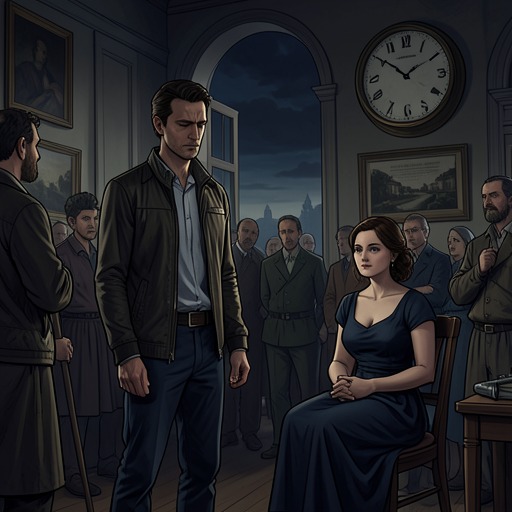
On the seventh night, a sound downstairs wakes Jumpy and Pamela. Both are frightened. Pamela says she has a hockey stick under the bed; Jumpy takes it, but she insists on accompanying him. Neither feels brave enough to use it, and they creep down the stairs together in dressing gowns, each with a hand on the stick. The passage ends when they reach the bottom and someone turns on the lights; the supplied episode does not disclose what follows. The unfinished confrontation leaves their shared security suspended at the threshold of an unknown arrival.
Jumpy’s character is shaped by the gap between anxious self-protection and sudden commitment. The man who comforts himself by sucking his thumb is also the young protester who risked arrest on a limousine, and the lover who searches for security is capable of recognizing courage in Pamela’s actions. His memories do not erase the uncertainty created by Saladin’s return, and the evidence does not settle the later course of his relationship with Pamela. Instead, his role is to make the novel’s intimate and political pasts touch: an old act of defiance becomes a language for understanding a new and fragile bond.