Kensington
The Satanic VersesKensington is both a recognizable London district and the suspended waiting place of the exiled Imam. In Gibreel Farishta’s visions, its streets lead to the Imam’s apartment; in waking political life, the district becomes a guarded enclosure from which the Imam remains fixed on return to Desh.
The Dreamed Route
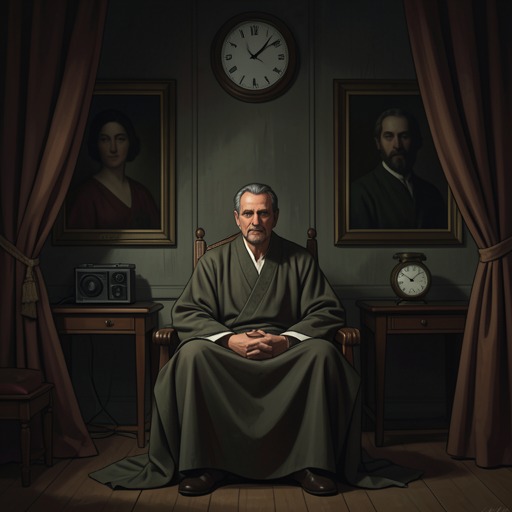
The vision carries Gibreel at speed past Barkers department store, the small grey house where Thackeray wrote Vanity Fair, a convent square, and the former residence of Talleyrand. It ends at a seven-storey corner block with green wrought-iron balconies reaching to the fourth floor. The dream then climbs the outside wall, parts the living-room curtains, and reveals the bearded, turbaned Imam sitting awake in dim yellow light. This sequence makes Kensington a mapped yet dreamlike landscape: familiar landmarks give way to an interior occupied by a figure who seems to be waiting beyond ordinary time.
The Imam’s Exile and Enclosure
The Imam’s home is a rented flat, but the apartment is more than a residence: it is a waiting room for an imagined return. Heavy golden curtains remain closed against what he regards as the contaminating presence of foreignness. When he occasionally goes out to take the air, eight young guards in sunglasses and bulging suits surround him; he folds his hands and fixes his gaze on them, intent on avoiding even the smallest impression of the city he resents. Kensington offers him sanctuary while also making him dependent on a place he regards as corrupt and humiliating. His desired return to Desh is bound to the hope that he can leave without having been changed by the place where he waited.
Surveillance and Political Life
The closed curtains also answer a practical fear: the Imam believes that hostile eyes and ears may be watching from across the street, with cameras, microphones, and even the danger of snipers. His guards occupy safe apartments above, below, and beside him, and sometimes walk Kensington’s streets disguised in shrouds and silvery beaks. The surrounding buildings therefore become part of a security system, while the district’s ordinary streets are recast as exposed territory. For the Imam, vigilance is not incidental to exile but one of its conditions.
The apartment is also connected to a political network beyond Kensington. The Imam’s son, Khalid, bows before his father and reports that Salman the Persian is on guard outside the sanctum. Bilal is at the radio transmitter, broadcasting the day’s message on an agreed frequency to Desh. From this London base, the Imam’s movement is restricted, but his message travels outward; the contrast between bodily stillness and communication across distance gives the apartment its political force.
Narrative Significance
Kensington joins the Imam’s private confinement to the larger struggle over his imagined return. Gibreel’s dream renders the route through London as a rapid passage toward a closed room, while the later account of guards, curtains, and broadcasting grounds that dream image in the Imam’s daily arrangements. The district thus holds two realities at once: an ordinary urban setting and an exile’s sealed, watchful world, oriented away from the city around him and toward the country to which he hopes to return.