Maurice Wilson
The Satanic VersesMaurice Wilson is an English mountaineering ghost whose failed 1934 attempt to climb Everest alone becomes more than an uncanny episode in Alleluia Cone’s life: he is the figure through whom her own impossible solo ambition takes shape. First encountered during her ascent with the Collingwood expedition, he returns in her later visions around London, linking the mountain’s past to a future she cannot relinquish. The novel leaves open whether he is a supernatural presence, a prophecy, or both.
The 1934 expedition and its aftermath
Wilson had prepared for a solo Everest attempt by fasting for three weeks, hoping to forge such a union between body and soul that the mountain could not divide them. He then flew in a light aircraft as high as it would take him, deliberately crash-landed in a snowfield, and set off upward. He never returned. His remains were discovered by a Chinese expedition in 1960, a fact that shadows his later appearance: Wilson himself complains to Alleluia about the expedition’s discovery and filming of his corpse.
The details of the attempt make Wilson more than a conventional mountaineering predecessor. His approach combines physical hardship, spiritual discipline, and an almost absolute wager on the will. Yet it does not bring him to the summit or back to ordinary life. The attempt ends in disappearance, and the novel gives that unfinished journey a second form through the ghost who continues to move across Everest and later beckons from London rooftops.
The apparition on Everest
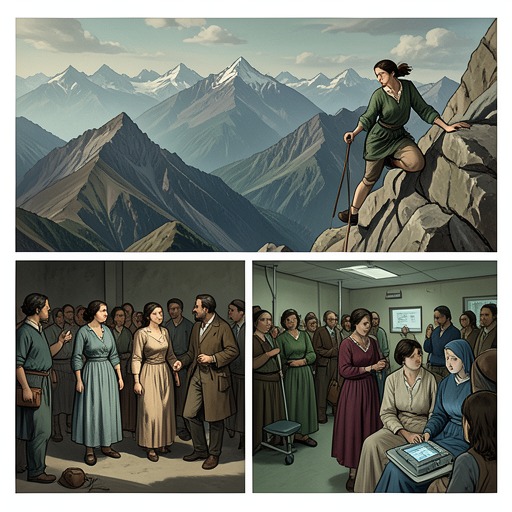
During the Collingwood expedition, after coming through an ice-fall, Alleluia sees a man sitting in the lotus position on an outcrop, his eyes closed beneath a tartan tam-o’-shanter. She recognizes him as Wilson from his archaic dress and startling conduct. When he opens his eyes, he greets her with a light nod and accompanies her through the day, at times walking beside her and at times seeming to hang in the air as she climbs. On a steep slope he belly-flops into the snow and glides upward as though carried by an invisible toboggan.
Alleluia responds to him with the ease of someone meeting an old acquaintance, though she cannot explain that familiarity afterward. Wilson talks about his loneliness and recounts his ascent, then adds accounts of things he has supposedly discovered after death. Among them is the yeti’s elaborate, circuitous, and fruitless mating ritual, which he says he witnessed recently on the South Col. His immaculate yellow-and-black tartan knickerbockers give this strange companion a precise, memorable outline, even as his impossible movements unsettle the distinction between mountaineering anecdote and supernatural encounter.
Alleluia later tells pupils at Brickhall Fields Girls’ School about seeing him. She presents the apparition as evidence that climbers’ accounts can leave out experiences that nevertheless occur, despite her own habitual preference for solid ground. But she does not tell the class what the encounter means to her. As Wilson patiently describes his ascent and his posthumous observations, she understands the meeting as a sign of kinship, perhaps even a prophecy: the dream of an unaccompanied climb is born in that moment. She also considers the darker possibility that Wilson is the angel of her death.
A private signpost for Alleluia
Wilson’s significance grows from the contrast between his failed expedition and Alleluia’s successful climb with Sherpa Pemba. His story does not simply warn her away from Everest. Instead, the apparition seems to point toward a version of climbing that exceeds the limits of an organized expedition: the solo ascent Wilson attempted and Alleluia begins to imagine for herself. His unfinished effort becomes a model for a desire whose danger is inseparable from its force.
That desire conflicts with the physical cost of climbing. Alleluia has flat feet and has been warned that they could make her a cripple if she does not take care. After Everest, she suffers unpredictable lapses of memory, including forgetting the word for fish and being unable, for a moment, to recognize the purpose of a toothbrush. She hopes the impairment is temporary, but keeps private another part of the experience: Wilson continues to appear on rooftops around Brickhall Fields, beckoning her. His presence makes the solo dream feel less like a passing ambition and more like a summons, while leaving its source and consequence uncertain.
Recurrence and narrative role
Wilson’s return to Alleluia’s London life gives the apparition a continuing place in the novel rather than containing it within a single high-altitude vision. She sees him among the chimneypots, still dressed in his old-fashioned clothes and inviting her onward. For a time, while she cares for Gibreel Farishta during his convalescence, the ghost is no longer seen; later references thus make his appearances intermittent, not a constant presence. His disappearance does not settle whether the danger has passed or merely receded.
The pattern also places Wilson beside another set of concealed visions. Alleluia keeps his appearances from Gibreel, while Gibreel conceals his own pursuit by the ghost of Rekha Merchant. Their intimacy therefore does not remove the private experiences each is withholding. For Gibreel, Alleluia’s visions are evidence that the boundary between dreams and waking life may be breaking down; for Alleluia, Wilson remains tied to the mountain and her secret ambition. The narrative lets the same ghost function as a personal portent and as part of a wider uncertainty about what counts as real.
Wilson has little presence outside the story Alleluia tells and the visions she keeps to herself, but that limited perspective is central to his effect. The reader encounters him through an experience that Alleluia recounts to schoolgirls, then learns that her public version omits its decisive private consequence: the birth of her solo-climbing dream. His historical failure, ghostly mobility, and repeated beckoning make him at once a remnant of an earlier Everest attempt and an unresolved possibility in Alleluia’s future. The novel neither confirms his prophecy nor explains his return; it preserves the unease between a ghost who may be calling her to danger and a climber who recognizes in him a kinship she cannot dismiss.