Mount Cone
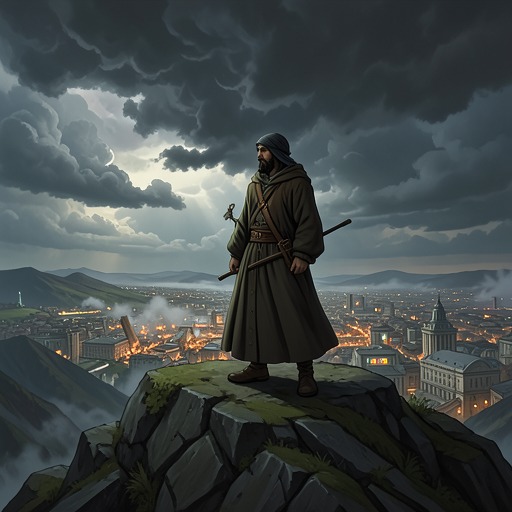
The Satanic VersesMount Cone is the mountain above Jahilia where Mahound withdraws from the city and enters the cave associated with his revelations. It is both a physical place reached by a demanding route and a vantage point from which Gibreel Farishta watches Jahilia. The mountain’s separation from the city gives the visionary episodes a distinct setting, but does not settle whether their voices come from an angelic or diabolic source.
Setting and Route
From Jahilia, the way to Mount Cone passes through dark ravines and across sand that differs from the city’s familiar white desert. The path climbs along the mountain’s spine, past the last trees and through increasingly large boulders, before reaching the peak. From there the route descends on the desert side; about five hundred feet below the summit lies a cave high enough to stand in, with pale sand covering its floor. The approach makes the cave a secluded destination rather than an ordinary extension of the city: a person must leave Jahilia behind, cross the peak, and descend before reaching it.
The route also marks a change in perspective. Jahilia lies behind the climber at the summit, while the featureless desert extends ahead. In the story’s images of the mountain, the city and wilderness are thus separated by a crest that Mahound must cross when he seeks solitude and Gibreel occupies as a watcher. The cave lies beyond that dividing point, below the summit on the desert-facing side.
Mahound’s Retreats
Mahound climbs Mount Cone alone despite a festival filling the city below. He is forty-four on the birthday described during one ascent, and his withdrawal is presented as consistent with his ascetic tastes. Dressed in two pieces of plain cloth, he makes the climb through the mountain terrain; he is physically fit, and his quick, cautious manner is associated with the experience of growing up an orphan. The contrast is deliberate: below him, the city is crowded with celebration, while the businessman leaves it for isolation.
The mountain is not a one-time refuge. Mahound sometimes leaves Jahilia for stretches of as long as a month to be alone in the wilds. Later, after Abu Simbel proposes a religious compromise involving Lat, Manat, and Uzza, Mahound’s followers see his distress but cannot resolve his dilemma for him. Hamza urges him to climb the mountain and seek Gibreel. Mount Cone consequently becomes the place to which Mahound turns when a public political and religious crisis cannot be settled among his companions.
Cave, Listening, and Revelation
At the cave, Mahound rests and then enters what the narrative calls a condition of listening, distinct from ordinary sleep. Gibreel’s account of the experience unsettles the division between the two figures: the angel seems to emerge from within the sleeping Mahound, and their connection is imagined as a cord along which the dream may move in either direction. The cave therefore hosts not just a revelation but a problem of attribution. It becomes difficult to say which figure is dreaming the other, or where the voice begins.
During one such episode, Mahound reviews the signs that have failed to persuade Jahilia’s inhabitants: the reported washing of his heart with Zamzam water, his journey to Jerusalem, and the reduction of the daily prayers from forty to five after he meets Moses on the return from the Throne. Despite these wonders and concessions, he says, people continue to worship Lat and want Uzza. His appeal to Gibreel at the cave arises from the gap between the revelations he has received and the city’s refusal to accept them.
That uncertainty becomes a physical struggle between Mahound and Gibreel. Afterward, Mahound wakes in the wilderness, finds no angel visible, and concludes that Shaitan had appeared in Gibreel’s guise during the earlier revelation. He hurries back to Jahilia intending to reject the verses he had memorized. Yet Gibreel’s account preserves the contradiction: Gibreel says that he supplied both the original statement and its repudiation. The cave and mountain thus frame a decisive crisis without providing an independent witness capable of resolving it.
Gibreel’s Vantage Point
Mount Cone is also where Gibreel watches the events in Jahilia. He alternates between a mobile, camera-like perspective among the people below and the position of a spectator on the mountain, looking down at the city as though it were a screen. That elevated position makes him a witness to its conflicts and transformations, but not necessarily an authority who can explain them. He observes and weighs the action while remaining entangled in the dreams that make him part of it.
After Mahound has escaped Jahilia and reached an oasis, Gibreel is often alone on the mountain summit. In his dreams, the three winged figures Lat, Uzza, and Manat return to attack him, and he cannot simply dismiss them as Mahound later dismisses a revelation as diabolic. The mountain’s solitude therefore changes meaning across the narrative: Mahound uses it as a retreat, Gibreel uses it as a viewing place, and Gibreel’s repeated dreams turn it into a setting for an unresolved persecution.
Migration and Later Echoes
From Mount Cone, Gibreel watches the faithful leave Jahilia for a place of palms and water. Their migration begins a new era, with the old life of the city left behind; Mahound eventually slips away as well. The mountain remains above the departing community, a stationary point from which a major change in the story can be seen but not reversed. Its role is not to guide the travelers to their destination, but to frame the separation between the city they abandon and the future they seek.
The cave returns in Salman the Persian’s dream. He sees Mahound there from a hovering viewpoint and recognizes that the perspective resembles Gibreel’s; he then considers whether he might instead have been Shaitan. Remembering the earlier dispute over the Satanic verses, Salman begins secretly altering the rules he writes down for Mahound. The later episode extends Mount Cone’s significance beyond Mahound’s own retreats: the cave becomes the setting through which another character re-enters the unresolved question of who speaks, who records the speech, and whether revelation can be distinguished from its human or diabolic double.