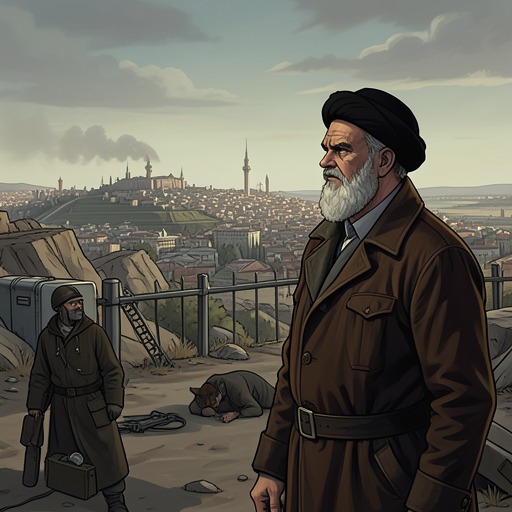
Muhammad Sufyan
The Satanic VersesMuhammad Sufyan, the proprietor of the Shaandaar Café and landlord of the rooms above it, is a former schoolteacher whose learning, humor, and practical hospitality make him a mentor to Brickhall’s transient community. Exiled from Dhaka after cultural differences with military officials, he carries a pluralistic education into a new life in London. His welcome to Saladin Chamcha, newly arrived in a transformed body, is generous but not uncomplicated: Sufyan offers him refuge among people he calls his own, while Saladin insists that he has spent much of his life trying to escape that very belonging.
Background and Character
Sufyan is a small, broad man, just over five feet tall, with a hennaed, moustache-less beard and a little white cap associated with his devotion. He has recently made the pilgrimage to Mecca. The narration presents him as a believer without fanaticism and a man of considerable intellectual curiosity: a self-taught reader of classical writing across cultures, as well as an unashamed VCR enthusiast. Before emigrating, he taught school in Dhaka. His dismissal followed cultural differences with generals, and he describes himself with a self-deprecating joke as less an immigrant than an emigrant runt. That wryness is characteristic: he can make an awkward circumstance the occasion for wit without pretending it has not shaped his life.
His learning is eclectic rather than confined to one tradition. Sufyan’s understanding of the subcontinent includes its multiple cultures, and he argues that centuries of contact have made Western culture part of that inheritance too. He takes intellectual pleasure in putting different accounts of change beside one another, rather than insisting that a single authority settle every question. His manner combines religious devotion with curiosity, argument with warmth, and an evident reluctance to turn belief into dogma.
The Café, Family, and Work
The Shaandaar Café is both Sufyan’s business and one of the social centres of Brickhall. His wife, Hind, is its celebrated cook: customers come from across London for her samosas, Bombay chaat, gulab jamans, and other dishes. Sufyan takes the money, serves tea, and moves through the work of the eatery, while Hind’s cooking and enterprise make her the chief architect of its success. Their business eventually enables them to buy the whole four-storey building and rent out its rooms. The café therefore joins food, livelihood, and housing: it is an enterprise built around Hind’s skill, but also a place where Sufyan’s sociability gives people room to meet and stay.
Their migration has rearranged the roles and measures of success that mattered in their earlier life. In Dhaka, Sufyan had been a teacher with pupils and professional standing; in London, those are lost, and he works in the café. Yet he appears lively and at home in the city, even beginning to gain weight there, while Hind, despite being the cook and breadwinner, is described as deeply dissatisfied. The contrast complicates any simple equation between economic success and contentment. The café prospers, but prosperity does not restore the life either of them once knew, and the work that sustains the household has not made each partner feel equally fulfilled.
A Neighbourhood Mentor
Sufyan’s attention extends beyond the family business. When Jumpy Joshi sits glumly in the café after Pamela Chamcha has thrown him out, Sufyan notices his mood and draws him into conversation. He teases Jumpy about his solitary, unworldly habits: he does not drink, has little interest in money, owns few possessions, and does not pray, although his conduct can resemble that of a religious ascetic. The teasing is affectionate rather than dismissive. Sufyan knows it is cheering Jumpy, and, when Jumpy remains dispirited over the following days, Sufyan and his family continue trying to lift him. On the fourth evening, a personal telephone call brings a visible change to Jumpy’s face; Sufyan quietly recognizes that the voice he has been waiting for is not an inward one.
His humour makes the café a place where people can admit confusion without immediately being reduced to it. He recruits the lawyer Hanif Johnson to help explain Jumpy’s unusual way of living, turning the question into a communal exchange rather than a private judgment. Sufyan’s portrait of Jumpy registers the gap between conventional signs of success and the impression that Jumpy may possess some private knowledge: he is educated, poor, unmarried at forty, and apparently going nowhere, yet seems to know a secret. Sufyan does not resolve that mystery. His role is to notice, tease, and keep the conversation open.
Shelter for Saladin Chamcha
When Jumpy brings the shivering Saladin to the Shaandaar house at night, Sufyan wakes, puts on his spectacles, and responds to the horns on Saladin’s head with an allusion to Lucius Apuleius. Apuleius’s account of transformation into an ass gives Sufyan a learned comparison, while the story’s goddess Isis supplies a joking precedent for metamorphosis reversed. But Sufyan does not leave the matter at literary wit: he suggests hot soup and says he will wake Hind. The immediate practical offer matters as much as the display of learning. Saladin is given food and a place to recover, even though he is too exhausted and miserable to explain what has happened for himself.
At a late-night gathering of the Shaandaar residents, Sufyan listens while Jumpy recounts Saladin’s fall from the sky and considers possible explanations for his condition. He invokes Lamarck and Darwin, distinguishing the argument about mutation from the problem of how a change could help an individual. The inquiry is not a diagnosis; the people present do not know what has happened. Instead, Sufyan’s scientific and literary references show him trying to make an incomprehensible event discussable, while the group recognizes that Saladin has been subjected to wrongful arrest, intimidation, detention, and medical mistreatment. Jumpy asks Sufyan to make the vacant attic room available. Sufyan waives the rent, moved by solidarity and guilt, and treats the injured newcomer as someone entitled to care rather than as a spectacle.
That hospitality meets a limit when Sufyan tells Saladin that the best place to heal is among his own people. Alone in the attic, Saladin rejects the identification: he is not Sufyan’s kind and has spent half his life trying to get away from people like him. The disagreement does not undo Sufyan’s generosity, but it shows that shelter and belonging are not interchangeable. Sufyan offers community as comfort; Saladin experiences the offer as a claim about an identity he has deliberately tried to leave behind.
Mutability and the Self
Sufyan remains solicitous even after an encounter in which the thought of religious intervention provokes an alarming response from Saladin. Saladin raises his arms; smoke fills the room, and a piercing sound interrupts Sufyan. When it clears, Saladin opens a window, fans away the fumes, and apologizes, unable to explain what came over him. He fears that he is changing into something bad. Sufyan does not answer that fear with condemnation. Instead, he turns to a philosophical dispute about whether change destroys the former self or leaves its essence intact.
Drawing on Lucretius and Ovid, Sufyan presents opposing accounts: one in which crossing one’s boundaries means the old being has died, and another in which a continuing soul adopts different forms as it migrates. He prefers Ovid’s view and reassures Saladin that the soul remains the same through its changing appearance. This is not proof that Saladin’s transformation can be reversed, nor does the episode supply Sufyan with an explanation for it. It is an act of interpretation and consolation, consistent with his broader character: he answers an unfamiliar crisis by bringing several intellectual traditions to bear, and tries to preserve a person’s continuity even when the body seems to contradict it. His welcome thus rests on both material care and a learned faith in the possibility that a self can persist through change.