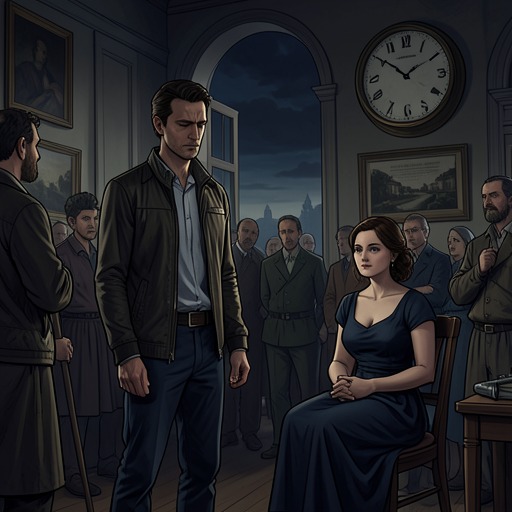
Pamela Chamcha
The Satanic VersesPamela Chamcha is Saladin Chamcha’s estranged wife and Jumpy Joshi’s partner, a forceful public campaigner whose confidence in her own account of reality is tested by the very events she tries to explain. Her life brings together a failing marriage, a new relationship, and a campaign against alleged police witchcraft; its final turn is the Brickhall fire, in which she dies while heavily pregnant.
Identity and background
First introduced under the name Pamela Lovelace, she falls in love with Saladin partly because of his exceptionally innocent-looking face. Its soft, cherubic appearance charms her, while he resists her description of him as round and insists that he has a bone structure. The contrast gives their early attraction a lightly comic quality: she sees a disarming surface, and he wants that surface understood as something more substantial.
Pamela’s sense of herself is shaped by family history as well as marriage. Her uncle Henry Higham presided over the Grosvenor Marbles case, in which young people were jailed or deported for possessing marbles after a protest. His harsh public reputation burdened Pamela, who felt weighed down by her own right-wing voice. In a private moment of reckoning, she mentally releases herself from his legacy and from the ghosts of her parents, preparing to leave the past behind. That effort to begin again recurs throughout her story, though it never amounts to a clean break from what came before.
Marriage, separation, and competing realities
Pamela comes to regard Saladin’s attachment to England as an idealized picture postcard. As she explains to Jumpy, Saladin’s imagined country is made up of the Royal Family, cricket, Parliament, the Queen, warm beer, and mince pies; he fails, in her view, to attend to what is actually happening around him. She sees herself as part of that national picture, but insists that she is also real in her own right. Her disagreement with him is not only marital: it concerns whether belonging to England means embracing an inherited fantasy or confronting the country’s less comfortable realities.
Her account of Saladin’s politics becomes especially sharp when she recalls his support for the Falklands War. She rejects his analogy of a threatened home, arguing instead that the conflict resembles a dispute in which one party occupies a house and another arrives armed, claiming it. The exchange reveals her resistance to comforting metaphors that, in her view, conceal unequal power. It also anticipates her later public work, where she confronts forms of racialized fear and official authority rather than treating them as abstractions.
By the time Pamela tells Jumpy that her marriage to Saladin is over, the relationship has become, in her view, a place where she cannot speak freely. She recalls being interrupted in public and describes his certainty as protection for an emptiness he cannot face. Her decision to leave is presented as final, not as a passing threat. Later, after the catastrophic news that the plane carrying Saladin broke apart, she calls the airline to insist that he telephoned her. The airline representative cannot accept her account of a man surviving the destruction at thirty thousand feet. Pamela’s fury at being disbelieved turns into fury at Jumpy, whom she suspects of deceiving her about Saladin’s survival. The episode places her between what she knows from the voice on the phone and what the ordinary explanation of the disaster says is possible.
Jumpy Joshi and the attempt to begin again
Pamela and Jumpy grow close after her separation from Saladin. Their relationship develops amid her drinking and her refusal to discuss her former husband’s possible survival. She treats Saladin as dead and rejects the possibility that he could be alive in a transformed body, describing him to Jumpy as a freak with no claim on her. Jumpy initially argues that she should divorce Saladin and recognize his rights, but eventually stops challenging her denial. The disagreement does not disappear; it becomes one of the pressures inside their relationship.
Pamela’s own habits make intimacy difficult. She drinks heavily, and Jumpy’s attempt to raise the subject ends with him being sent out of the house. She receives him again without acknowledging the rupture, while certain subjects remain forbidden: her background, the bottles she has emptied, and any suggestion that Saladin is alive. Jumpy continues to return, but his concern and his silence accumulate alongside his attachment. Their relationship is therefore neither a simple refuge from the marriage nor a settled new life; it has its own evasions and strain.
Pamela’s brush with a potentially fatal motorway accident prompts a feeling of release. Afterwards, she celebrates being alive with a solitary dinner of venison and wine, then retreats to a bedroom in a stone tower and watches old films. She imagines her adolescence and family history falling away, and prepares to be free of the latest ghost in her life. The hope of renewal is vivid but provisional: her past has not vanished, and the person she has tried to put behind her soon returns.
The supernatural enters domestic life
When Saladin’s transformation becomes harder to dismiss, Pamela’s fixed account of normality begins to fracture. Her hair turns white overnight; she shaves it and covers her head with a burgundy turban. She allows Jumpy to consider that she may have been bewitched, but counters his suggestion that her appearance could be a delayed reaction to news of Saladin by pointing to the dog’s similar change. Later, the white-haired dog is present when Saladin visits. Her appeal to the dog does not resolve the mystery; it underscores that the disturbance is not confined to Saladin’s body.
The contradiction is particularly pointed because Pamela is professionally involved in investigating allegations of witchcraft among local police officers. She argues that what passes for normality has become an inadequate guide to events, and takes seriously reports from Black residents who fear occult intimidation by police. Jumpy remains skeptical, but Pamela’s public voice gives the campaign authority and helps keep it from being dismissed. At the same time, she refuses to connect the alleged supernatural practices to Saladin’s transformation. She can investigate other people’s accounts of the uncanny while shutting out the one that implicates her own marriage.
Saladin’s return and the final campaign
When Saladin returns in human form, Pamela is off balance. She is pregnant by Jumpy, continues to drink, and has to meet the husband she had treated as dead. Saladin realizes during their conversation that he no longer wants to resume the marriage. He proposes moving back into the large Notting Hill house, occupying separate rooms, and then selling the property so that Pamela can divorce him. She offers no counterargument. Their meeting changes the terms of the separation: Saladin is no longer asking to be believed as a voice on the telephone, but asserting his return and his claim to a place in the house.
Jumpy is alarmed by the prospect of Saladin living there, and his fear aggravates the tension between the three of them. Pamela tells Jumpy that he must obtain Saladin’s permission before entering the house, leaving her partner waiting outside. The scene exposes how the home has become contested ground: Saladin has returned to it, Jumpy feels displaced by him, and Pamela is left managing a conflict neither man can resolve for her.
Pamela’s final public action grows out of her work on police witchcraft allegations. At a meeting arranged through Walcott Roberts, she and Jumpy visit Antoinette Roberts, whose son’s murder is believed to have been connected to his work investigating the subject. One of the men present gives Pamela a red plastic briefcase containing evidence said to document witches’ covens within the Metropolitan Police. Antoinette urges her to act against those implicated. Pamela and Jumpy then take the briefcase toward the Brickhall Community Relations Council offices so that she can make copies for trusted colleagues. They are followed by a van.
The offices burn, and Pamela dies in the fire while heavily pregnant. The subsequent account says that the alarm had been switched off and that two people entered with a key; since the dead woman worked for the organization, an inside job was suggested, though the reason remained obscure. Inspector Stephen Kinch also links the fire to the Shaandaar Café fire and speculates that the dead man may have been the real arsonist and Pamela no more than his accomplice or dupe. These are investigative possibilities, not a settled explanation. Her death closes the attempt to turn private conviction into public action, while leaving the causes of the blaze unresolved.
Narrative role
Pamela’s story is organized around competing claims about what counts as real. She challenges Saladin’s idealized picture of England, but later protects herself from the reality of his survival; she treats reports of occult police misconduct as credible, yet resists the supernatural explanation closest to home. Her changing appearance and the dog’s matching whiteness make the boundary between personal crisis and inexplicable event increasingly difficult to maintain.
Her political work also gives her a life beyond the marriage plot. The campaign connects her to people who fear racialized policing, to a murdered investigator’s family, and to evidence that may implicate the police themselves. The red briefcase carries that work toward the council offices, but the fire destroys the possibility of a clear public reckoning. Pamela is neither simply vindicated nor exposed as mistaken: the evidence she receives is never fully resolved, and the official account of her death remains conjectural. Her trajectory instead shows how a determined effort to name a hidden reality can be entangled with private denial, uncertain knowledge, and lethal consequences.