Saladin Chamcha
The Satanic VersesSaladin Chamcha’s story turns the making of a self into both an achievement and a vulnerability. An actor who has deliberately fashioned his face, voice, and English identity, he finds those constructions overwhelmed by a bodily transformation that others read as proof of evil. His movement from the flight to London, through humiliating confinement and refuge among people he resists calling his own, and finally to revenge and rescue, makes his relationship with Gibreel Farishta the measure of how difficult it is to separate injury from judgment and hatred from forgiveness.
Identity and Self-Invention
Saladin is introduced on a flight to London, watching the city of his birth recede after a small magic trick has helped the plane take off. The relief that briefly crosses his face belongs to a man who has long treated escape as self-creation. He has spent years shaping a handsome, carefully controlled face and has come to think of it as simply his own, forgetting the face that preceded it. He has also cultivated a voice to match. His profession as an actor and voiceover performer makes this self-fashioning practical as well as personal: identity is something he can work on, present, and refine.
A childhood episode, told with the uncertainty of a folktale, places this guarded adult disposition in an earlier setting. At ten, on his way home from school in Scandal Point, he recoils from the jostling and noise of the crowded bus. Finding a black leather wallet in the street abruptly lifts his nausea; he opens it and discovers that it contains a substantial amount of money, including currency usable on black markets. The episode establishes his alertness to opportunity, but its deliberately uncertain telling does not settle what he does next.
In another memory of childhood, he walks with his parents, Changez Chamchawala and Nasreen Chamchawala, in a garden at sunset. He now calls himself Saladin, following the fashion of his English school, although he remains Chamchawala until an agent later shortens the name for his acting career. His father has planted a walnut tree on the day of his birth, making the garden a record of family attachment. Yet Saladin feels that knowing and naming the trees has taken something from the place: before he learned their names, it seemed better. The scene links his pursuit of a chosen identity with a recurring unease that language and classification can distance him from what they appear to secure.
Transformation and Confinement
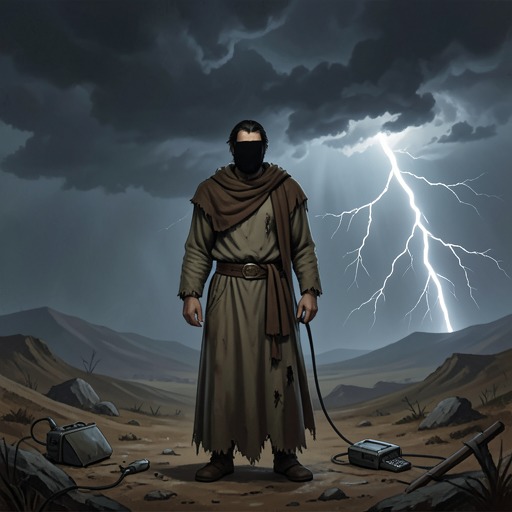
After the fall, Saladin’s recollection of the passage through the sea is unsettled. As he lies in a state of severe cold, he cannot decide whether the water truly parted, whether the travelers went beneath it, or whether the experience had another explanation. The questions remain questions; the episode offers no reliable account from him that resolves the crossing. His uncertainty matters because the subsequent bodily changes are equally difficult to fit into a settled explanation.
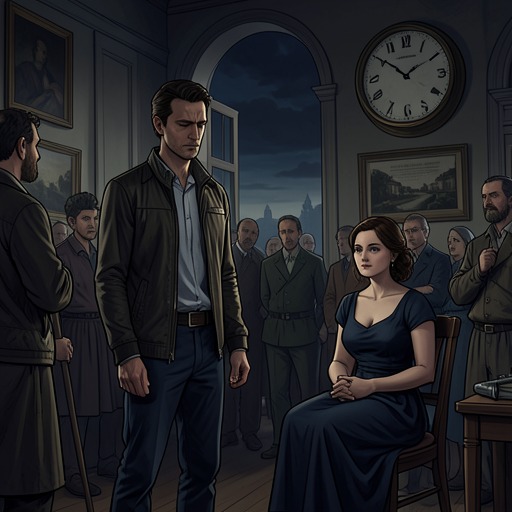
The police detention makes that change a public humiliation. In the van, officers discover the goat-like features beneath his clothes and treat him as an object of ridicule. Saladin tries to answer their treatment with the credentials of the life he has built: he gives his formal and professional names, cites his membership in Actors’ Equity, the Automobile Association, and the Garrick Club, and urges them to check the police computer. His appeal to institutions and records cannot make the people holding him recognize the person those records describe. His carefully maintained identity has become, in their eyes, irrelevant to his altered appearance.
Saladin escapes only after a large, coordinated breakout from the sanatorium and the nearby detention centre. Hyacinth Phillips has been treating him, and his lungs have improved enough for him to leave the ward when she gives the signal. He follows instructions rather than directing the operation himself. Outside, he passes bound guards and sees other escapees whose bodies combine human and nonhuman features, including plantlike, insectlike, or stone-and-brick forms. The scene enlarges his condition beyond a solitary aberration, while offering no simple explanation for the transformations.
Refuge and the Rejection of a Prescribed Identity
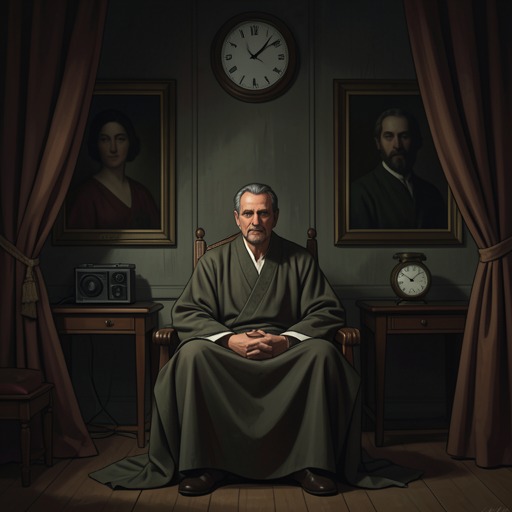
Muhammad Sufyan receives Saladin at the Shaandaar Café and the rooming house above it. Sufyan is a former teacher and a self-taught reader of classical texts from several cultures; he approaches the transformed man through both practical care and literary analogy. When Jumpy Joshi brings Saladin to him, Saladin is dirty, exhausted, and largely passive. Sufyan invokes the story of a reverse transformation and proposes hot soup as a first step. The contrast between mythic precedent and ordinary care gives the refuge its character: recovery is approached through food, shelter, and companionship rather than a grand solution.
Sufyan tells Saladin that the best place to heal is among people of his own kind. Saladin rejects the offer’s assumptions when he is alone: he insists that Sufyan’s people are not his people, and that he has spent half his life trying to get away from them. His response makes the Shaandaar a refuge that he needs but cannot comfortably claim. Care does not erase his distance from the community, and the community’s welcome cannot dictate how he names himself.
At first, Saladin interprets the demonic form as evidence that he has become evil itself. He then argues against that conclusion, reminding himself that appearances do not reliably reveal the person beneath them. Yet his resistance to the label does not restore the old confidence in self-fashioning. In a private reflection, he describes himself as inward by nature and as someone who had hoped to approach finer things, only to become caught up in the disorder of the world. His image of the sea giving him up while the land drags him down turns survival into a condition of continued displacement, rather than a return to a secure former self.
The transformation intensifies over the weeks and months in the attic. Saladin’s horns grow, his body becomes increasingly hairy, a tail develops, and ordinary clothes cease to fit; he adopts loose garments obtained for him by Anahita Sufyan. When Mishal Sufyan comes to meet him, Saladin has grown to more than eight feet tall, and smoke emerges from his nostrils in two colors. Despite the terror he causes among the residents, Mishal challenges his assumption that he can simply go out into the world in this state. The exchange makes his altered body a practical obstacle as well as a symbol imposed by other people.
Gibreel Farishta, Hatred, and Return
Saladin’s transformation also changes how he understands his connection to Gibreel Farishta. When news about Gibreel reaches the attic, Saladin erupts in anger and recalls their earlier intimacy: Gibreel had leaned against him, spoken of nightmares, and fallen from the sky singing. His fury turns on what he experiences as Gibreel’s betrayal and absence. At the same time, Saladin’s inward reflections place the event within a larger dispute about agency. Thinking of Zeeny Vakil and her confidence in choice and cultural mixture, he concludes that life may impose change as an accident or a process rather than deliver the new beginning a person intended.
At Club Hot Wax, Gibreel appears to Saladin as the angelic counterpart to his own demonic form. The two become mirror images in a conflict that cannot be reduced to a stable opposition between good and evil. After the destructive confrontation, Saladin is found asleep amid broken furniture and melted wax figures, restored to a human shape. The narrative connects his humanization to the concentrated force of his hatred, an unsettling reversal in which an emotion that has helped make him monstrous also accompanies his return to human proportions.
Restoration does not settle the grievance. Much later, when Saladin sees Gibreel again, the blankness in Gibreel’s expression recalls the earlier moment when Gibreel stood by as Saladin, horned and captive, was taken away. That memory brings the hatred back; explanations and possible excuses do not outweigh what Saladin remembers as abandonment. He acts in revenge by exploiting Gibreel’s weakness, and runs through the High Street after spending the evening with a distraught Alleluia Cone without remorse. The scene insists that Saladin’s humanity includes the capacity to choose a cruel act; the demonic appearance cannot serve as the explanation for every deed.
The final turn comes amid a burning building and a city gripped by conflict. Smoke parts to reveal a clear way to the door, and Gibreel carries Saladin through it into the night. The rescue does not cancel the remembered betrayal or make their history simple. It creates a limited, concrete possibility of forgiveness where anger and enmity still surround them. For Saladin, the movement back toward life is therefore neither a return to his carefully constructed pre-transformation self nor a clean moral redemption. It is a fragile change in his relation to the person he had made his adversary.