Srinivas
The Satanic VersesSrinivas is a prosperous toy merchant whose comfortable life in Chatnapatna is interrupted by the arrival of Ayesha and the villagers of Titlipur on their march toward the Arabian Sea. Though he has long treated the idea of religious renunciation as a way to imagine himself adventurous without giving up comfort, he eventually leaves his home and joins the pilgrimage. His passage from watching the procession to walking with it, and finally entering the sea in an attempt to help those disappearing beneath the water, makes him a witness to the journey’s changing force: spectacle becomes personal commitment, and shared wonder ends in irreversible loss.
Identity and ordinary life
Srinivas is a toy merchant and factory owner in Chatnapatna. His wife regards his occasional threats to abandon everything, including his name, and become a wandering holy man as a tolerable performance of devotion and adventure. The proposed life of a mendicant satisfies both sides of his self-image, but his habits suggest little readiness to surrender domestic ease: he sits comfortably on the porch, plays with his five-year-old daughter Minoo, and continues to enjoy a hearty appetite. His earlier insistence on an alarming flight into the Grand Canyon in America gives his wife further reason to regard adventure as something he likes to imagine and occasionally stage, rather than a settled renunciation of ordinary life.
That contrast gives his eventual departure weight. The empty porch chair and unfinished glass of lime juice are not signs that Srinivas has planned a new life; even he cannot fully explain what draws him from his morning routine. His decision develops in response to the procession itself, and to the figure leading it, rather than from a previously declared spiritual discipline.
The procession reaches Chatnapatna
Srinivas first hears that an extraordinary procession is approaching: children in the streets describe villagers carrying their belongings along the potato track, led by a silver-haired girl beneath butterflies. Mirza Saeed Akhtar follows in an olive-green Mercedes-Benz. The arrival of roughly one hundred and fifty people is large enough to draw attention across Chatnapatna. Factory workers ask Srinivas to let them stop work for a couple of hours to see the event. He agrees, though he remains on his porch for a time, trying to suppress his growing excitement. He later describes the feeling as a presentiment and tells Mishal Akhtar that he knew the villagers had not come merely for refreshments: Ayesha had come for him.
When the procession reaches the roadside canteen, the pilgrims crowd around food while police threaten action against what they mistake for a sectarian march. Srinivas is especially struck to learn that Mishal and her mother are walking with the villagers, dressed simply and without jewels. A Brahmin who has never considered going on a pilgrimage to Mecca, he is nevertheless impressed by the march. Mirza Saeed explains to the police that the villagers intend to walk to the Arabian Sea because they believe its waters will part. Srinivas then sees Ayesha clearly for the first time and recognizes her, blurting out a question about the Family Planning dolls. His unexpected outburst is ignored, as the attention turns to Ayesha. She smiles and nods to the officer, who immediately backs down and apologizes; later, when local youths throw stones from nearby rooftops, the police arrest them.
A personal recognition
Srinivas’s response to Ayesha is not only amazement at the spectacle of the butterflies. During the midday rest, he wanders among the pilgrims in a daze, feeling that a turning point in his life has arrived, and keeps searching for Ayesha. He finds her resting beneath a pipal tree with Mishal Akhtar, Mrs. Qureishi, and Osman. When he later sees Ayesha asleep under her covering of butterflies, his attention fixes on a connection he does not voice to Mirza Saeed: the sleeping girl has the same face as the goddess pictured on the calendar in his factory.
That recognition also clarifies the difference between the two men’s responses. Mirza Saeed argues that goddesses and shakti are abstract concepts, and that practical reason demands an end to the march. Srinivas does not claim to be a philosopher. He acknowledges Wealth as a goddess suited to a businessman and, more privately, as a presence in his heart. The text leaves his response grounded in recognition and feeling rather than a formal theological argument: he sees an image he already knows in Ayesha, yet follows her into an event that exceeds the safe, decorative space of the factory calendar.
Joining the pilgrims
When the procession leaves Chatnapatna, Srinivas goes with it despite his wife’s pleas. She takes Minoo up in her arms as she tries to make him reconsider, but he explains to Ayesha that he does not intend to visit Mecca; he has simply felt an urge to walk beside her, perhaps as far as the sea. His departure is therefore a limited intention that becomes part of a much larger journey. He does not begin as one of the believers who voted to obey Ayesha’s command, but chooses to join the walkers on his own terms.
Walking among the villagers changes his position from observer to participant. He sees the vast butterfly swarm above them, shading the pilgrims like an immense umbrella, and understands it as taking over the protective function of the great tree at Titlipur. A few dozen butterflies settle on his shoulders and turn the exact shade of his scarlet shirt. Muhammad Din, walking beside him with Khadija, reaches out and takes his hand. The gesture places the toy merchant within the moving company: the butterflies’ transformation of his shirt is a visible sign of his inclusion, while the Sarpanch’s handclasp makes that welcome personal.
The march proceeds under increasingly difficult conditions. The pilgrims move at the pace of the slowest, with delays caused by children’s sickness, official harassment, and problems with their carts; at best they cover two miles a day. The first death comes on the eighteenth day, when Khadija dies after continuing to walk despite a dream in which she meets Azraeel. By the ninth week the journey has become a national story, attracting journalists, politicians, commercial sponsors, tourists, and religious extremists. Srinivas is part of the procession as it becomes not merely a village undertaking but a public and politically contested spectacle.
The sea and the end of the pilgrimage
The journey culminates when the pilgrims reach the Arabian Sea. Srinivas sees the group pass from the city’s asphalt toward the beach, where they look upon the sea for the first time. Mishal, too weak to stand unaided, is supported by two village men; Ayesha is beside her. Mirza Saeed imagines that Ayesha has stepped out of the dying woman, but then reproaches himself for being drawn into supernatural explanations. Srinivas’s own earlier sense of Ayesha’s resemblance to the goddess on his factory calendar has prepared him to see the pilgrimage through a mixture of ordinary recognition and wonder, though the narrative does not give him a separate explanation for what follows.
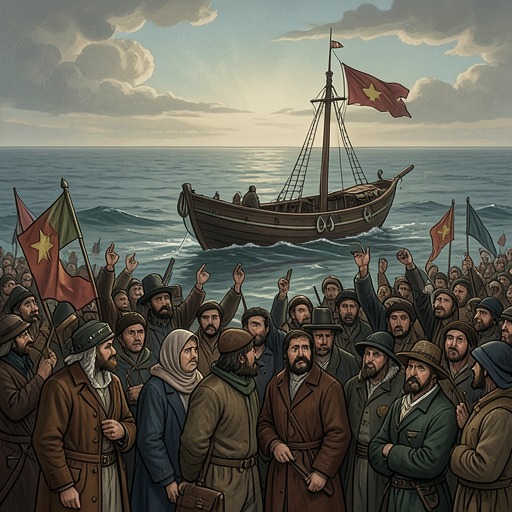
Ayesha, Mishal, and the villagers walk forward into the water and subside below sea level. No one resurfaces. Srinivas runs into the sea with Saeed, Osman, Muhammad Din, and Mrs. Qureishi, calling for help. He is dragged back out, as are the others who entered the water; Saeed continues diving farther out before he, too, is rescued, exhausted and unwell. The pilgrimage ends not in the promised passage across the ocean floor but in the disappearance of its central company. Srinivas survives, but his participation has carried him far beyond the brief walk he first imagined: the man who left home to accompany Ayesha to the sea is among those who enter it as the pilgrims vanish.