The Boundary Between Dreams and Waking Reality
The Satanic VersesThe Boundary Between Dreams and Waking Reality is a central fault line in Gibreel Farishta’s experience, where visions cease to stay safely within sleep and waking life takes on the force of a dream. The boundary matters not only because it becomes harder to tell what Gibreel sees, but because his attempts to restore separation can deepen the division within himself. Allie Cone shares in the strange traffic between worlds, and the novel repeatedly leaves open whether its apparent miracles belong to supernatural events, psychological crisis, or realities that refuse to fit a single explanation.
Visions and concealed knowledge
Before Gibreel’s crisis becomes an open rupture, Allie has her own visions. Though flat feet seem to rule out serious mountaineering, she remains possessed by Everest and keeps hidden an impossible ambition: a solo ascent associated with Maurice Wilson. After returning to London, she sees Wilson among the chimneypots, beckoning in his old-fashioned clothes. She does not tell Gibreel. He, in turn, conceals his pursuit by the spectre of Rekha Merchant. Their physical intimacy therefore does not amount to full knowledge of one another; each keeps a dangerous ghost behind a closed door.
Gibreel reacts with alarm when Allie tells him about her visions. Her account becomes evidence, for him, that the dream world is leaking into waking hours and that the barriers between them are failing. This is not a shared diagnosis: the same visions that make the boundary seem porous to Gibreel are experiences Allie has kept private, and the narrative does not establish that they have one agreed explanation. A morning scene brings the unseen past into their room by another route. Gibreel finds Allie’s marked copy of The Marriage of Heaven and Hell and discovers a photograph of her dead sister, Elena, pressed in its pages. Allie’s request that he put the photograph back where he found it registers the persistence of a loss that the couple rarely discusses. The book, the annotations, and the hidden photograph connect remembered experience and present intimacy without resolving what visions mean.
The rupture in Allie’s home
The boundary breaks dramatically during a quarrel. Gibreel, furious and clutching his toga, dresses in the clothes he has available, including a scarlet-lined overcoat and grey felt trilby associated with Don Enrique Diamond. Allie watches from the doorway. He leaves in anger, expecting her to soften and offer him a way to stay; instead, she shrugs and walks away. At that precise moment, he hears a sound like a dam bursting and sees God. The vision arrives not in sleep but in the ordinary setting of Allie’s home, amid the consequences of an argument that has ended their immediate exchange.
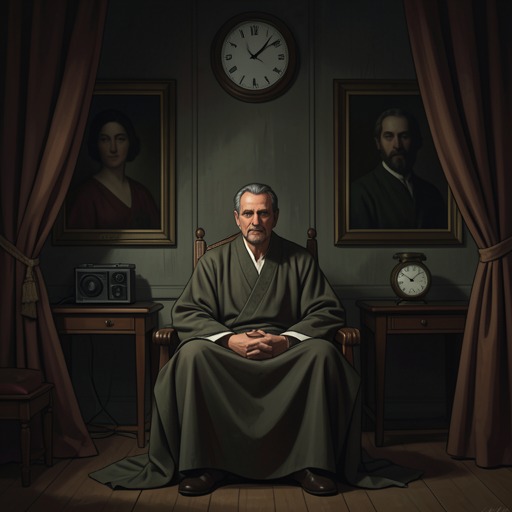
The figure Gibreel sees is strikingly unlike his expectation of the Almighty: a middle-aged, balding, bespectacled man with a cropped salt-and-pepper beard. It identifies itself as Ooparvala, the Fellow Upstairs. Gibreel tests whether this might instead be Neechayvala, the Guy from Underneath. The answer does not settle the nature of the apparition. It insists that the divine may be multiple and hybrid or pure and absolute, without resolving the alternatives. The storm that follows the challenge gives the encounter material consequences within the scene, while the form and identity of the visitor remain strange and difficult to classify.
The apparition frames Gibreel’s dreams as revelation: it says that revelation was sent in dreams to clarify both divine nature and Gibreel’s own, and reproaches him for resisting sleep. It also demands that he take up work. Gibreel responds humbly and says he was already leaving; Allie, meanwhile, tells him that she loves him. Their exchange places two claims beside one another: a supernatural summons that presents dreams as instruction, and a human relationship in which Allie tries to reach a man who has turned away. The episode makes the dream-waking divide a practical crisis, not an abstract puzzle, but does not provide an independent confirmation of Gibreel’s vision.
Treatment and the divided self
At the Maudsley Hospital, Gibreel receives medication, sleeps for long periods, and is compliant when awake. He recounts to Allie the background to his illness: a succession of strange dreams preceded a near-fatal breakdown in India. He fears that the experience may recur, and speaks as though an angelic, possessed self were another person who might take control. Allie challenges that separation, arguing that the feared self is still him. Her reassurance cannot settle the problem, but it identifies the cost of treating the crisis as an alien presence rather than part of his own life.
For a time, treatment appears to help. Gibreel seems calmer and more in control, and he can regard the dreams as separate from himself. Yet the dreams continue. At night he speaks verses in Arabic, a language he does not know. Allie writes down what she hears phonetically and takes the fragment to the Brickhall mosque, where a mullah recognizes it as a statement about exalted females whose intercession is desired. The passage gives the dreams a significance beyond private imagery, but it still reaches the reader through Gibreel’s sleep-talk and Allie’s act of recording and seeking help.
The apparent recovery rests on a precarious distinction. Gibreel’s sense that the dream episodes belong to someone else seems, at first, to help rebuild the wall between sleep and waking. In retrospect, however, that very separation is bound up with splitting his identity into two entities. He tries to suppress the other self, but by naming it as other he also preserves and strengthens it. The treatment’s hopeful appearance and the narrative’s account of the division therefore pull in opposite directions: a clearer distinction between dream and waking may look like recovery while concealing a deeper fracture in the self.
Recurrence and competing realities
Later, as Gibreel waits in a theatrical chariot to descend, the strange feeling returns. He experiences himself as approaching a choice between two realities, both present, one visible but unseen. He cannot tell which world he will enter. Even his planned opening line belongs to both, with a different meaning in each. The scene translates the earlier inner division into the structure of a public performance: Gibreel is at once returning to the stage and uncertain which reality the stage occupies.
The audience surges toward him, and John Maslama, whom Gibreel recognizes from an earlier encounter, identifies himself as a herald who has spoken of the Lord’s coming. Gibreel notices that at least half the crowd wear rubber horns, signs of belonging and defiance. At that sight, he feels the universe fork and steps onto the left-hand path. The novel thus makes the choice between realities coincide with a visible division among spectators, but does not reduce the crowd’s response to proof that Gibreel’s perception is objectively true.
After his disappearance, an official account says he was lifted away in the chariot; a later revelation in the Voice contradicts the claim that the winch was ever set in motion and describes a paid effort to fabricate the story. Meanwhile, rumours that Gibreel levitated spread among London’s Asian population, alongside reports of a halo. The competing accounts keep disappearance suspended between staged explanation, public legend, and apparent miracle. Later still, Gibreel collapses on Alleluia Cone’s doorstep, asking forgiveness and saying that the experience has happened again. She puts him to bed; he escapes into sleep, away from London and toward Jahilia, because the terror has crossed into his waking hours. Sleep no longer offers a refuge from waking reality: it becomes a route from one frightening world into another.