The Brickhall riots and Shaandaar fire
The Satanic VersesThe Brickhall riots and Shaandaar fire turn a borough already strained by racial hostility, disputed policing, and the aftermath of Uhuru Simba’s death into a scene of confrontation and rescue. The sequence links public anger over the Granny Ripper investigation with the police decision to declare riot conditions, then narrows from a city street confrontation to the burning Shaandaar, where Saladin Chamcha and Gibreel Farishta make a choice that reverses their enmity.
Causes and mounting tension
Two nights after Simba’s death, the Granny Ripper struck again behind Charringtons Brewery in Tower Hamlets. The following night another old woman was murdered near the adventure playground in Victoria Park, Hackney. The killer’s concealed signature appeared again, though its precise configuration had never been made public. Inspector Stephen Kinch offered the theory that a copycat had somehow discovered the secret and taken up the dead Simba’s mantle. The explanation did little to reassure a borough already divided over Simba’s death and the investigation.
That division had a public face as well as a private one. Some white observers treated Simba’s death as a deserved end to a murderer; in Brickhall, others mourned and defended him, and anger over his death gathered force in the streets. Media coverage emphasized his political support for Qazhafi, Khomeini, and Louis Farrakhan, while young people in the borough kept the anger alive. When the police commissioner quadrupled the police presence in Brickhall and held additional officers in reserve, the scale of the deployment itself became a cause for alarm. The football programme for the weekend was cancelled to free police resources.
The atmosphere was already volatile beyond the Ripper case. Black families faced attacks on council estates, black schoolchildren were harassed on their way home, and brawls broke out in pubs. At the Pagal Khana, an altercation after a group of young men spat over people’s food ended with three Bengali waiters charged with assault, while the group that had provoked the incident was not detained. Accounts of black youths being taken away in unmarked vehicles and returning with injuries circulated through the community. Sikh, Bengali, and Afro-Caribbean men began patrolling the borough to protect residents. Hanif Johnson warned Mishal Sufyan that one more Ripper killing could ignite the anger: Simba’s death, he said, made the killer’s apparent freedom especially hard for people to accept.
Capture and declaration of riot conditions
Fifteen minutes before Saladin’s later arrival in Brickhall, seven young Sikh men travelling in a Vauxhall Cavalier heard a cry beneath the Malaya Crescent canal bridge. They found a fair-haired man with a scalpel fleeing from the body of an old woman; her blue wig had fallen into the canal. The patrol caught and overpowered him. The event was widely understood as the capture of the mass murderer, but it did not immediately calm the borough.
By eleven that night, news of the arrest had spread alongside rumours that police had been reluctant to charge the suspect, that the patrol members themselves had been detained, and that officials planned a cover-up. Crowds gathered at street corners as pubs emptied, and fights broke out. Three cars had their windows smashed, a video store was looted, and bricks were thrown. At half-past eleven on Saturday night, as clubs and dance halls released their crowds, the divisional superintendent, acting in consultation with higher authority, declared riot conditions in central Brickhall. The Metropolitan Police then deployed against the people designated as rioters. The arrest had removed a suspected killer from the streets; it had not resolved the deeper conflict about whose lives were protected, whose accounts were believed, or how the police exercised power.
Saladin turns toward the fire
At the declaration of riot conditions, Saladin was leaving dinner with Alleluia Cone at her apartment overlooking Brickhall Fields. He had been maintaining appearances and offering sympathetic words without genuine feeling. Crossing the Fields, he saw helmeted police advancing behind plastic shields, helicopters overhead, and water cannons moving into position. He ran by instinct, but in the wrong direction: toward the Shaandaar, not away from it. His flight carries the citywide violence into the building where the story’s private antagonism will be tested.
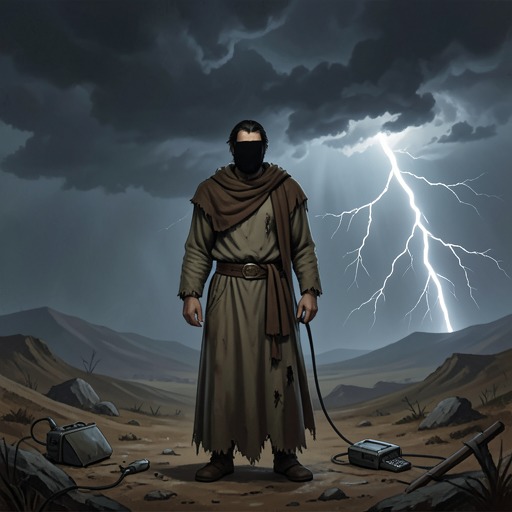
By the time Saladin reached the High Street, he saw the Shaandaar burning and stopped. He then saw Gibreel and ran inside. Calling for Mishal, Sufyan, and Hind, he found the ground floor not yet alight, but the stairs were blocked by fire. Above, Mishal’s parents were unconscious in their room, overcome by smoke; other people in the burning building were also trapped and unable to call out. Saladin could not reach them by the stairs. Inside the fire, Gibreel had already entered the café and was moving toward Saladin, whom he recognized as the adversary he had been seeking.
Rescue and aftermath
The fire closes around both men. Saladin is pinned beneath a fallen beam, with broken ribs and arms, while smoke fills the space and flames reach his coat. Gibreel drops his trumpet, frees him, and lifts him up. Then Gibreel exhales toward the exit. Saladin, gasping and close to fainting, seems to see the fire and smoke divide, opening a route to the door. The narrative leaves him uncertain whether the parting was truly visible, but Gibreel carries him along that passage and out into the night. The immediate turn is stark: Saladin, who has come to Brickhall after an evening of calculated insincerity and revenge, risks himself to enter the burning building; Gibreel, whose pursuit has brought him to the Shaandaar, chooses to save him.
Outside, Mishal is weeping for her parents, and Hanif comforts her. Gibreel collapses after carrying Saladin out. An ambulance takes the two unconscious men and Mishal and Hanif away; Saladin receives oxygen, while Gibreel, exhausted, babbles in his sleep about a magic trumpet and the fire. Mishal considers the possibility that what she witnessed was more than an actor’s performance, but Hanif insists on a social and political explanation, describing the night as part of British history and change. The disagreement leaves the rescue poised between miracle and material history. The riot and fire do not settle Brickhall’s conflicts, but within a night defined by hostility and rage, the rescue provides a limited, consequential reversal: Saladin and Gibreel emerge alive, and their relationship has moved, however precariously, from retaliation toward forgiveness.