The Desh Revolution
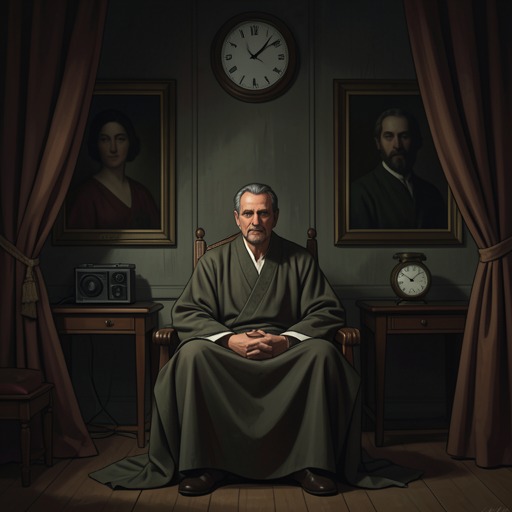
The Satanic VersesThe Desh Revolution is a dream sequence in which the Imam’s opposition to history becomes a mass uprising against Empress Ayesha. Broadcast through Bilal’s voice, the revolution brings the people to the Empress’s palace, defeats her forces, and appears to replace ordinary time with the Imam’s timeless order. But the victory is deeply compromised: the uprising’s collective devotion is entangled with deadly force, Gibreel Farishta is made to fight on the Imam’s behalf, and the final image of the Imam engulfing the people turns liberation into another form of domination.
Background and the Imam’s program
The revolution is presented as part of Gibreel Farishta’s continuing dream narratives, not as a straightforward report of a political event. In the dream, the Imam’s still, monumental presence is linked to a radio transmission that travels from Kensington to an imagined Desh. Bilal, an American convert whose voice had previously reached the top of the popular music charts repeatedly, sings the Imam’s message over clandestine radio waves. The voice’s authority is essential to the operation: the Imam has selected Bilal for his vocal power, turning a voice associated with American popular culture into an instrument of rebellion against the Empress’s state.
Bilal objects to the idea that his voice represents the powerful West, since he, too, belongs to an oppressed people. The Imam answers by distinguishing oppression from the habits acquired near power: in his account, a person can absorb power’s posture and manner even while suffering under it. That exchange makes the broadcast more than a means of transmitting orders. It exposes the revolution’s uneasy use of a voice formed within the culture it opposes, and the Imam’s claim to interpret what that voice means.
The Imam’s enemy is not only the Empress. He condemns history itself, along with progress, science, and rights, as departures from the divinely completed revelation. He sets spiritual certainty against historical change and describes the Empress as bound to time, while identifying himself with water, fertility, and eternity. His proposed new order would eliminate clocks and birthdays, making its followers the same unchanging age in the sight of God. The rhetoric casts revolution as an escape from history, but it also presents the Imam’s doctrine as a total authority over knowledge and social life.
The march on the palace
Gibreel carries the Imam through the night to the city beneath a conical mountain, where the palace stands at the foot of the slope. The Imam’s account of the revolution becomes visible in the crowds converging on the palace gates. People fill the city’s routes and proceed along a twelve-lane avenue lined with eucalyptus trees. They move in groups of seventy abreast toward the guards, who are arranged in three ranks and armed with machine guns.
The guards fire on each advancing group, and those behind continue over the bodies of the dead. Mothers in doorways send their sons into the procession. The scene makes the uprising’s human cost inseparable from its spectacle of collective resolve: the people advance with extraordinary persistence, but the Imam interprets their deaths as evidence of love for him. Gibreel rejects that reading, identifying the force behind their response as hatred produced by the Empress’s rule. The disagreement is central to the event. The Imam treats sacrifice as proof of allegiance; Gibreel sees a population driven toward him by the violence of the regime it opposes.
When the crowd finally reaches the guns, its numbers overwhelm the guards and silence their weapons. The people then continue at the same measured pace toward the palace. The change in power is achieved not through a negotiated surrender but through mass action that the Imam presents as the arrival of his promised order. The palace lights go out as the march approaches, and a supernatural confrontation follows inside and above the Empress’s seat of power.
The defeat of the Empress and Al-Lat
A cry rises from the dark palace, and Al-Lat appears, emerging from Ayesha’s shell. The Imam orders Gibreel to kill her. Though Gibreel understands that the Imam is directing the fight through him and is willing to sacrifice him for the cause, he has no control over being propelled into battle. The conflict thus extends the revolution’s pattern of proxy action: the Imam commands, while another figure bears the immediate risk.
Gibreel and Al-Lat are both weakened by the struggle. She falls, and her defeat appears to confirm the revolution’s conquest of the old order. Gibreel then sees the Imam lying at the palace entrance as the people pass through the gates; in the dream’s disturbing reversal, the Imam appears to swallow them. The new leader’s victory therefore does not end the question of who commands the people. The Empress’s rule has fallen, but the image of the Imam absorbing the advancing crowd makes their deliverance look like incorporation into his power.
Timeless victory and the dream’s frame
After Al-Lat disappears, clocks throughout the capital begin to chime beyond the ordinary count of hours. Their continuing sound is associated with the end of measurable time, the returning exile, the victory of water over wine, and the beginning of the Imam’s timeless era. The bells do not simply mark the restoration of familiar time; they announce a new temporal order that claims to supersede it. The revolution fulfills the Imam’s stated desire to break with history, yet the clocks’ impossible continuation leaves that victory uncanny rather than settled.
The dream sequence also belongs to a larger pattern in which Gibreel’s night narratives resume after interruption, and his own image returns in the role of an archangel. His experience of the Desh revolution is therefore both political vision and involuntary dream drama. The shift from the histories of Jahilia and Yathrib to the Imam and the Empress briefly leads him to hope that the recurring curse has ended; when the new narrative follows the same pattern, that hope fades. Within this frame, the revolution’s grand claims remain subject to the instability of Gibreel’s dream. It stages a revolt against history, but it cannot escape the dreamer’s recurrent, troubling transformations of power, faith, and deliverance.