Titlipur Pilgrims
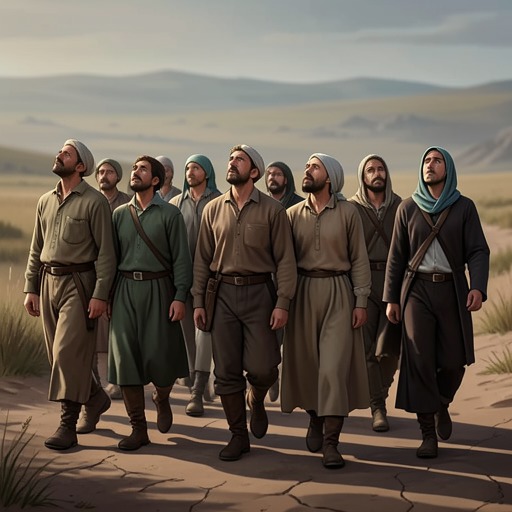
The Satanic VersesThe Titlipur Pilgrims are the men, women, and children of Titlipur who undertake a foot pilgrimage to Mecca after Ayesha declares that the angel Gibreel has commanded it. They leave ordinary village life for an arduous march shaped by collective discipline and a promised miracle: at the Arabian Sea, the waters will open and allow them to walk across the ocean floor. Their journey becomes both a public spectacle and a contest over who can interpret Ayesha’s revelation; at its end, she, Mishal, and the central body of pilgrims disappear beneath the sea.
Identity and the Command
After being missing for seven days, Ayesha returns to Titlipur dressed in butterflies and asks Sarpanch Muhammad Din to convene an emergency meeting of the village council. She tells its members that she has flown with the angel to the highest heights and received a message that is also a command. All the villagers, she says, must prepare to walk to Mecca, kiss the Black Stone at the center of the Kaaba, and visit the Haram Sharif. The pilgrimage is presented not as an individual choice but as a demand addressed to the whole community.
Ayesha further promises that after the pilgrims walk roughly two hundred miles to the sea, its waters will part for them. The village council votes unanimously to obey. The decision makes the pilgrimage a collective undertaking in practical as well as spiritual terms: only the youngest infants are excused from walking, and adults will carry them in rotation. Muhammad Din initially considers arranging litters for the elderly and infirm, but his wife insists that the angel’s instruction to walk must be followed. The villagers pool food and supplies, divide their weight among the walkers, and gather cooking utensils, bedding, animals, and a few carts. Personal belongings are to be kept to a minimum.
Departure and the Road South
The procession is already preparing to leave when Mirza Saeed Akhtar arrives and tries to stop it. He makes angry speeches and confronts individual villagers, but the work resumes after he gives up. At Chatnapatna, the arrival of about 150 people draws a crowd. Srinivas, a local toy manufacturer, first resists leaving his porch to see them; once the procession arrives, he recognizes Ayesha and later joins the march, although he does not intend to go to Mecca. The police initially treat the gathering as a potentially sectarian demonstration. Mirza Saeed explains that the pilgrims intend to reach the Arabian Sea, and Ayesha’s quiet encounter with the officer ends the immediate police confrontation. Later, youths associated with the RSS and Vishwa Hindu Parishad throw stones at the procession; the local police arrest them.
Srinivas accompanies the pilgrims when they leave town, saying that he wants to walk with Ayesha for a while, perhaps as far as the sea. He sees butterflies spread above the marchers like an immense canopy, and some settle on his shoulders, changing to match the color of his shirt. The spectacle deepens the pilgrimage’s hold on him, while the companionship of the walkers crosses distinctions between the village pilgrims and a prominent outsider. Muhammad Din and his wife Khadija, despite their age, continue on foot.
The promised destination lies through a drought-stricken landscape. As rain fails, cattle search for water and other families travel south in hope of finding it. Mirza Saeed argues that salt water cannot save the pilgrims, but he continues alongside them, repeatedly trying to persuade Mishal, his gravely ill wife, to rest in his air-conditioned car. His chauffeur eventually leaves the vehicle to join the walkers, forcing Saeed to drive himself. His appeals, threats, and offers of bribes fail to turn the pilgrims back; his concern for Mishal is entangled with his attraction to Ayesha and his growing despair.
Hardship, Public Attention, and Doubt
The march advances at the pace of its slowest members: about three hours in the morning and three more after the heat, with delays caused by sick children, official harassment, and problems with the carts. At best, the pilgrims cover two miles a day. The journey is described as roughly 150 miles to the sea and expected to take about eleven weeks. On the eighteenth day Khadija, who has walked with her husband for decades, dreams that the visitor is Azraeel rather than Gibreel. She later asks to rest at a ruined roadside inn; her death is identified as the pilgrimage’s first.
By the fifth week, older pilgrims are in sharply worsening health, food is running low, and water is difficult to find. As the procession enters more populated areas, buses and trucks force walkers out of their way, people insult them, and local authorities sometimes make them keep moving through the night rather than sleep in town. Osman’s bullock dies on the road. These hardships make the pilgrimage’s discipline tangible: the villagers continue together even as exhaustion, scarcity, and deaths expose the cost of their shared commitment.
By the ninth week, news of the march has spread widely. Journalists, politicians, tourists, businessmen, and other onlookers follow the pilgrims. Visitors are especially struck by the butterflies that cover Ayesha and serve as her only solid food; photographs and enlarged images of her appear in public. At the same time, religious extremists denounce the march as an effort to appropriate a pre-Islamic national tradition and inflame communal tensions. The procession is thus interpreted from outside both as a religious claim and as a political threat.
That dispute over interpretation also arises within the group. After a foundling is killed by a crowd outside a mosque, the weary pilgrims refuse to move on. Ayesha warns them that turning away from God may bring abandonment in return, but the villagers turn their backs on her and draw together. Mirza Saeed challenges her over the way she conveys the angel’s message: she gives her own interpretations rather than the angel’s exact words. Ayesha replies that the angel speaks in clear, memorable forms, but the exchange leaves the gap between revelation and its human interpreter plainly exposed. The pilgrims’ collective obedience is not unbroken certainty; it is repeatedly tested by what they witness and by the authority claimed in the name of the angel.
The Sea and the Pilgrimage’s End
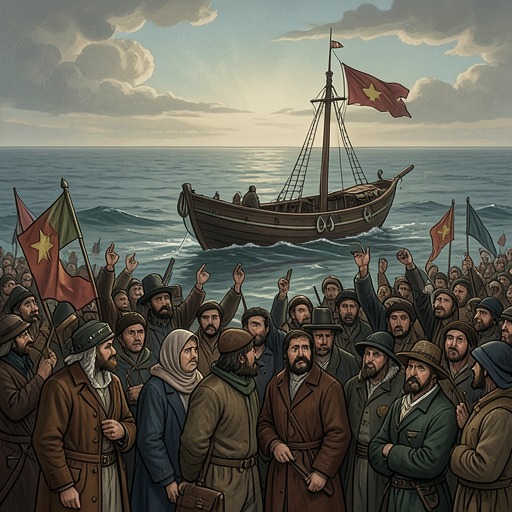
The pilgrims eventually reach the Arabian Sea at high tide, passing from the city’s streets and refuse onto the beach. Mishal, too weak to stand unaided, is supported by two villagers; Ayesha is beside her. Mirza Saeed imagines that Ayesha has somehow emerged from Mishal, as if the brightness of the dying woman had taken the prophetess’s form, then recognizes that he may himself be yielding to the supernatural interpretation he has resisted. This perception binds the two women in his mind at the very moment the promised test is about to arrive.
The pilgrims walk into the water. Ayesha, Mishal, and the villagers go below the surface and are never seen again. Mirza Saeed, Osman, Srinivas, Muhammad Din, and Mrs. Qureishi enter the sea in response and are rescued; Saeed continues searching longer than the others before he, too, is pulled out. The pilgrimage is over, but its ending offers no ordinary confirmation of the promised crossing: the pilgrims do not return to report what happened beneath the water. In hospital, Saeed finds a police investigator waiting at his bedside, as the authorities consider whether the survivors can be charged with attempted illegal emigration.
Narrative Significance
The pilgrims’ journey gives religious conviction a social form: shared provisions, a common pace, and the rule that nearly everyone must walk make faith a practice sustained by a group rather than a private declaration. Yet those same demands expose the limits of solidarity. Illness, death, scarce supplies, hostile crowds, and the foundling’s killing press the villagers to reconsider whether continuing is fidelity or submission to an authority they cannot verify.
The novel places their uncertainty within a wider pattern of contested voices and revelations. Mahound describes listening to Gibreel as a process that can seem to arise from within his own deepest self, while Gibreel’s silence during Mahound’s crisis leaves the source of the message unresolved. In another strand, the Imam’s political voice reaches listeners through Bilal’s surreptitious radio transmission. These episodes do not explain the pilgrims’ experience, but they reinforce its central problem: a message may be received as divine, mediated through a human voice, and disputed by those asked to obey it. The Titlipur Pilgrims’ disappearance leaves that dispute open, making their march at once a communal act of belief and an ordeal whose decisive outcome remains beyond the survivors’ knowledge.