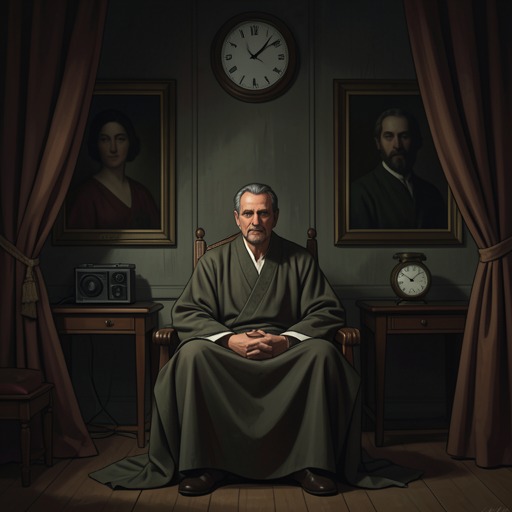
the Imam
The Satanic VersesThe Imam is an exiled political and religious leader whose dream of a triumphant return to Desh hardens into a campaign against Ayesha and against history itself. In the novel’s visionary sequences, he rules from a rented London flat while imagining revolution at home: a figure of deliberate stillness whose authority nevertheless moves through radio, followers, and Gibreel Farishta. His exile gives his politics its central contradiction. He waits for the future by refusing the present, seeking to return unchanged from the place that shelters him.
Identity and Exile
In a dream that carries Gibreel to a mansion block in Kensington, the Imam sits awake behind curtains in dim light, apparently staring into the future. The narration defines him as an exile, not simply an émigré, refugee, or immigrant. Exile is bound to the imagined return: he looks ahead by looking back, suspended like a photograph above the country to which he expects to return. His London home, correspondingly, is less a settled household than a waiting room. The distance between where he is and where he believes he belongs becomes the focus of his thoughts.
He treats the city that has given him sanctuary as a contaminating foreign presence. The curtains remain closed against Abroad, and on the rare occasions he goes out, he walks within a protective square formed by eight young guards, keeping his gaze fixed so that London cannot lodge in his eyes. He wants to return able to claim that the city left him ignorant and unsullied. This insistence makes exile both a political grievance and a discipline of self-preservation: residence in London is unavoidable, but inwardly he refuses to belong to it.
The flat’s material details sharpen that refusal. Its furniture is expensive, ugly, and acquired in a hurry; the bookcases hold clippings rather than books, and ordinary domestic actions are organized around the household’s dependence on the Imam. Even using the shower requires the retinue to avoid turning on a kitchen tap, while food is brought back by bodyguards rather than cooked at home. Attempts to put down roots appear to him as admissions of defeat. The domestic space therefore embodies his exile: provision without belonging, and a household arranged to wait rather than to make a life.
Ayesha, Images, and the Exile’s Household
The Imam’s hostility to images gives his dwelling an unusual order. Pictures that once hung on the walls are gone, as though they withdrew from his unspoken disapproval. He permits a few postcards of Desh—a mountain above a city, a village beneath a great tree, and a mosque—but preserves a more intimate and potent image in his bedroom: a portrait of Ayesha. She is his enemy and his counterpart, and he keeps her likeness close even as the narrative describes her as keeping his portrait near her in her own distant seat of power. The two figures plot each other’s deaths across the separation between London and Desh.
That mutual possession unsettles the Imam’s stated rejection of representation. He banishes images, yet the portrait of Ayesha remains; the homeland is reduced to postcards, yet those small pictures sustain his political imagination. The images do not dissolve the distance between exile and home. Instead, they make absence present and give his rivalry with Ayesha a private, watchful form. His opposition to her is thus personal as well as political, carried into the room where he lies and looks toward the image of the ruler he hopes to overthrow.
Water and Political Doctrine
The Imam’s routine centers on water. His son, Khalid, brings him a glass every five minutes, holding it with one hand and supporting it with the other. The water is passed through an American filtration machine before the Imam drinks it, and the young men around him know his treatise on its purity. To him, water’s simplicity and life-preserving character make it a moral principle as well as a drink. He contrasts it with Ayesha’s wine and with the image of her holding a skull filled with dark fluid, treating her consumption as evidence of corruption. In his doctrine, water preserves and purifies; those who pollute it also pollute the soul.
This distinction becomes a political prophecy. The Imam predicts that the future will judge those he regards as blasphemers and that water will have its day while blood flows like wine. The private austerity of the flat expands into a promised reversal of power. His speech gives the language of purity a revolutionary force, but the contrast is also a way to condemn Ayesha and mark her government as morally illegitimate. The narrative links the small repeated act of drinking to the large scale of his ambition: from a glass in a London room, he imagines a transformation of nations.
The Voice of Revolution
The Imam’s stillness is set against the activity radiating around him. Khalid reports who is guarding the sanctum, while Bilal broadcasts the day’s message by radio toward Desh. The Imam is described as stone-like and apparently motionless, yet the radio transmission makes him politically present at a distance. Bilal’s voice enters a ham radio in Kensington and emerges in the imagined homeland as the Imam’s own thunderous address. The distinction between the leader and the speaker blurs: his authority travels through another man’s voice.
The Imam chose Bilal for the beauty and authority of his voice, which had once reached the top of the hit parade repeatedly. Bilal initially objects when the Imam characterizes that voice as shaped by the house of power and associated with Western authority. The Imam answers by recognizing Bilal’s own oppression while arguing that proximity to power can leave its habits in a person. This exchange shows both the alliance between them and its unequal terms: Bilal supplies the sound through which the Imam’s message reaches the people, while the Imam explains to him what his voice means politically.
The broadcast calls for revolution not only against Ayesha but against history. The Imam rejects progress, science, and rights as deceptions that draw people away from the Path; in his account, knowledge was complete when Allah finished the revelation to Mahound. He promises that, once history’s veil is undone, Paradise will appear. His program is therefore not simply a change of ruler. It seeks to halt historical change and recover a divinely completed order, making the imagined return to Desh an attack on the very idea of forward movement.
Gibreel and Authority by Proxy
The Imam’s influence also reaches Gibreel through dreams. In one scene, the apartment’s carpet holds Gibreel fast as he insists that the revelation is complete and asks to be released. The Imam answers through Bilal’s voice, although the broadcaster is absent, and commands Gibreel to fly him to Jerusalem. The apartment then gives way to a rooftop beside a water tank. Rather than traveling under his own power, the Imam mounts Gibreel’s shoulders and is carried into the night. The scene turns the Imam’s apparent immobility into a means of movement: the world shifts around him, while another person bears the burden of his journey.
That dependence becomes most consequential in the imagined uprising against Ayesha. As the people reach the guns and silence the guards, the Imam announces that the decisive moment has come. When Al-Lat emerges from the palace, he orders Gibreel to kill her. Gibreel recognizes that the Imam is fighting by proxy and is willing to sacrifice him to the cause. The Imam’s authority has thus passed from distant broadcast to direct command: he claims the victory of the people while sending Gibreel into the confrontation.
The Imam’s narrative role rests on this tension between passivity and control. He appears as a fixed figure in exile, but his voice travels, his followers prepare for revolution, and Gibreel is made to act on his behalf. The same longing that keeps him oriented toward a lost homeland also fuels a project that would unmake history and restore an imagined completeness. His water doctrine promises purity, while his political vision culminates in conflict and delegated risk. The novel leaves that contradiction visible: the Imam can command the struggle, but the visions show its cost borne by others.