the Recitation
The Satanic VersesThe Recitation is the novel’s name for the revealed words associated with Mahound, but it is never presented simply as a stable text arriving untouched from a divine source. It passes through speech, hearing, memory, and scribal inscription; its disputed verses and Salman the Persian’s alterations make those stages part of the story’s central uncertainty about revelation and authorship.
Speaking and Recording
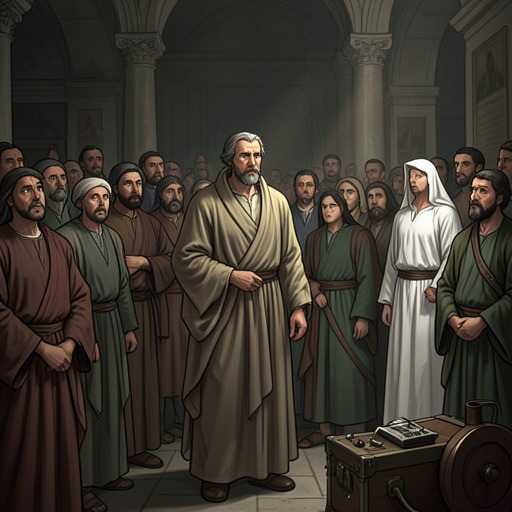
At a gathering of poets in Jahilia, Mahound distinguishes himself from the assembled writers: he does not claim to be a poet, but says he brings verses from a greater source. Abu Simbel challenges the audience’s impatience by insisting that a message genuinely spoken by God must be heard by the world. Mahound then announces the beginning of the recitation of “The Star,” and the scribes start writing. The scene gives revelation a public setting and a material record: the words are spoken aloud, received by an audience, and committed to writing.
The sequence also makes reception part of the event. Mahound recites verses about Lat, Uzza, and Manat, including an affirmation of their intercession. Hind rises, and Abu Simbel responds with the gestures and formula of Muslim prayer, prostrating himself; Hind follows. The congregation’s astonishment and the surrounding cries of devotion turn the recitation into a moment of religious and civic consequence. The words do not remain private language: they prompt visible responses among Jahilia’s leading figures and its gathered public.
Disputed Revelation and Withdrawal
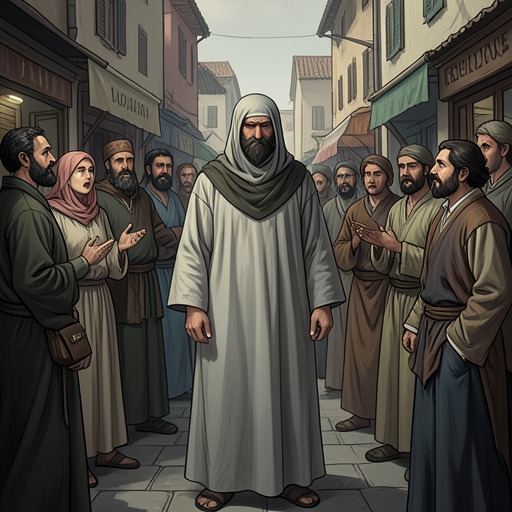
The novel later recasts the episode through Mahound’s struggle with the Archangel Gibreel. After their wrestling match, Mahound wakes and concludes that the earlier words came from the Devil in the guise of an angel. He returns to Jahilia intending to expunge the verses he now judges satanic. The narrative complicates this explanation: Gibreel, observing the scene, claims that he was the speaker on both occasions, for the original verses and for their repudiation. The question is therefore not resolved by a simple contrast between two clearly distinguishable voices. The same figure is associated with both utterance and reversal, while Mahound’s certainty changes after he listens again to what he believes he has heard.
This reversal makes the Recitation’s authority depend on interpretation as well as delivery. Mahound’s return to the city is an attempt to correct the record, but the account says the rejected material survives in a small number of unreliable collections even as orthodox interpreters try to undo its story. The disputed passage thus persists as a problem of transmission: an utterance can be withdrawn, but its traces and competing explanations remain.
Salman the Persian as Scribe
Salman the Persian’s experience gives the problem of authorship a second, deliberately human form. After a dream places him above Mahound at the cave on Mount Cone, Salman remembers the earlier dispute and wonders whether he had been Gibreel or Shaitan. He then begins testing Mahound while recording rules and verses. At first, he makes a small change, writing “allwise” where Mahound has described God as “all-hearing, all-knowing.” Mahound does not detect it. Salman next records “Jew” where Mahound said “Christian”; again, Mahound accepts what he reads aloud.
For Salman, these unnoticed substitutions are more than scribal mistakes. They demonstrate that his own language can enter the text without being recognized by the Messenger as different from revelation. The experiment leaves him shaken and sad: he had expected Mahound to catch the first change, giving him a chance to confess and correct it, but instead he continues altering the words. When Mahound eventually shows doubt at one of Salman’s versions, the scribe understands that the test has reached its limit. He weighs destruction and revenge against survival, and chooses to leave Yathrib before Mahound can discover everything. The Recitation’s vulnerability here arises not from an openly declared rival scripture but from tiny edits made inside an act of faithful transcription.
Text, Power, and the Novel’s Construction
The Recitation is also linked to Gibreel Farishta’s later understanding of himself. After using the trumpet Azraeel against approaching men, Gibreel identifies himself as the Archangel Gibreel, the angel of the Recitation, and imagines revelation as a power that can make people’s innermost desires real. The association broadens the idea of recitation beyond a fixed verbal text: in Gibreel’s vision, revelation has consequences in the world, and the fulfilment of desire can become destructive. His subsequent declaration about divine judgment connects that power to the consuming fire of the city.
The acknowledgements further mark the novel’s own handling of sacred language. They state that its Qur’an quotations are composites drawing on English versions by N. J. Dawood and Maulana Muhammad Ali, with additions by the author. That note identifies a literary construction made through translation and adaptation; it does not collapse the novel’s fictional account of disputed revelation into a claim about religious doctrine. Read together, the public recitation, Mahound’s reversal, Salman’s edits, and Gibreel’s self-understanding make the Recitation a focal point for questions of voice, textual authority, and the uncertain passage from spoken word to written record.