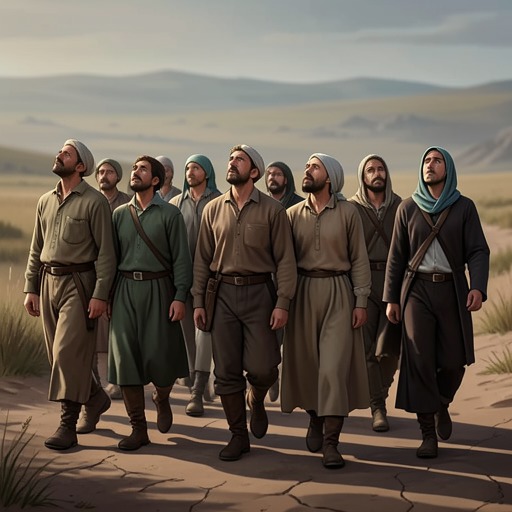
the kahin
The Satanic VersesThe kahin is an orphan from Titlipur whose transformation into a prophetess turns her private visions into a command followed by an entire village. Known as Ayesha, she claims that the archangel Gibreel has sent the villagers on foot to Mecca and promised that the sea will open for them. Her story makes belief consequential: it reorganizes village life, draws public scrutiny, and ends at the Arabian Sea, where she and the pilgrims disappear beneath the water and are never seen again.
Identity and Early Life
Before she becomes the kahin, Ayesha lives on the margins of village society. Mishal Akhtar identifies her to Mirza Saeed Akhtar as an orphan who makes small enamel animals and sells them by the trunk road. She has had epilepsy since childhood. As she grows older, the young men of Titlipur treat her independence and refusal of suitors as grounds for ridicule, while her seizures deepen their suspicion of her. She remains chaste and largely isolated, living with her handmade animals and an unusual diet of butterflies.
Osman the convert, a former untouchable from the neighboring village of Chatnapatna, takes up a quiet watch near her home. He is in love with her, though she does not acknowledge his presence. His attention is protective rather than reciprocal, and later her claim to have been taken by an angel leaves him grieving. His attachment provides a human counterpoint to the supernatural authority she acquires: he has stayed near her in ordinary life, but cannot claim a place in the sacred story she tells.
Ayesha’s livelihood also brings her into contact with Srinivas, who objects to her association with Osman because he has converted to Islam. When she brings him her dolls, he first refuses them, then offers to buy a different kind of doll that promotes family planning. Ayesha declines the offer and leaves. The episode places her between competing religious and social expectations before she becomes the center of a larger dispute over faith and belonging.
Transformation and Vision
At nineteen, Ayesha sets out to walk back to Titlipur along a potato track. When she returns roughly forty-eight hours later, her appearance has changed: her hair is white, her skin has the appearance of a newborn’s, and butterflies settle over her body. Osman sees her but is too awestruck to approach. Ayesha sleeps for a day and a night, then goes to Sarpanch Muhammad Din and says that Gibreel appeared to her in a vision and rested beside her. She presents the encounter as the beginning of a communal obligation, not merely a private marvel.
The account remains unsettled by another version of the encounter. Gibreel dreams of finding Ayesha resting beneath a tamarind tree; in the dream he cannot rise, and afterward sees her transformed and receiving a message. The vision she reports and the dream he experiences overlap without confirming one another. The novel therefore gives her authority a double foundation: the villagers receive her as a messenger, while the reader also sees how her appearance and story enter Gibreel’s dream life.
After a later disappearance, Ayesha returns to Titlipur on the seventh day and asks for an emergency meeting of the Titlipur panchayat. There she says that she has flown with Gibreel to the highest heights and that his message is also a command. Her certainty is expressed through what she requires of others; she does not offer a detailed account of the angel’s exact words.
The Command and the Village’s Response
Ayesha tells the panchayat that every man, woman, and child must prepare to walk to Mecca, to kiss the Black Stone at the Kaaba in the Haram Sharif. The elders object that the villagers cannot simply abandon their homes and crops, and note that poverty and ill health can excuse people from the pilgrimage. Ayesha remains silent while they debate. The decision that follows is not explained as a reasoned agreement: after a pause, the village accepts the command.
She supplies the journey’s defining promise. The pilgrims, she says, will walk two hundred miles to the shore, put their feet in the foam, and cross the ocean floor after the waters part. When Osman questions the plan, Ayesha answers him directly. Her words turn the expedition from an arduous journey into a test of whether the promised miracle will occur.
The village begins to prepare before dawn. The panchayat votes unanimously to obey, and the community pools food, cooking utensils, bedding, and other provisions. The elderly and infirm are not to be carried in litters; the villagers understand the instruction as requiring everyone to walk, while the youngest infants will be carried in rotation. Mirza Saeed argues against the undertaking, but the preparations continue. Ayesha later invites him to join the pilgrims and frames the journey as a chance to save his soul. Her command thus reaches beyond the village’s collective decision into the strained lives of Saeed and Mishal Akhtar.
The Pilgrimage Under Pressure
The march proceeds at the pace of its slowest members, with sickness among children, harassment by authorities, and practical delays. The pilgrims manage at best about two miles a day, with roughly one hundred and fifty miles still to cover before the sea and an estimated eleven weeks of travel. On the eighteenth day, Khadija sees Azraeel in a dream and dies after continuing with the march the next morning. Her death makes the costs of the journey concrete even as the group carries on.
By the ninth week, the pilgrimage has become a public spectacle. Journalists, politicians, commercial sponsors, tourists, and other onlookers converge on it. Photographs of Ayesha appear in newspapers, and her image is used on advertising hoardings. The attention does not settle what her visions mean; instead, different observers try to fit the march into their own expectations. Religious extremists denounce the Ayesha Haj as a provocation and argue that foot pilgrimage belongs to an older national tradition rather than to Islam. Ayesha predicts that there will be no trouble, but the growing attention shows how quickly a village act of faith has become a public contest over religious and national identity.
The march reaches a further crisis when a foundling is stoned to death outside a mosque. The exhausted pilgrims refuse to continue. Mishal is too ill to rally them, and Ayesha warns that turning away from God may bring divine rejection. Mirza Saeed then challenges her about the source of her instructions: she gives interpretations, he observes, rather than the angel’s precise words. Ayesha answers that Gibreel speaks to her in clear and memorable forms. The exchange sharpens the central uncertainty around her authority. She does not claim to relay a transcript; the command reaches the community through her interpretation, which believers must either accept or question.
The Sea and the Disappearance
The final approach to the Arabian Sea brings the pilgrims from the city’s streets onto the sand. Mishal, now too weak to stand unaided, is supported by two villagers; Ayesha walks beside her. At the shore, the promise of the journey becomes an immediate choice between the visible water and the revelation Ayesha has announced. The pilgrims enter the sea. None of them comes back to the surface.
Mirza Saeed, Osman, Srinivas, Sarpanch Muhammad Din, and Mrs. Qureishi run into the water to help. The latter survivors are pulled or dragged back to shore, while Saeed continues diving farther out until rescuers bring him back exhausted and faint. Ayesha, Mishal, and the villagers of Titlipur are never seen again. The pilgrimage ends not with an explained miracle or a confirmed account of death, but with disappearance. Ayesha’s transformation has made her a figure of prophecy to her followers; the sea leaves that prophecy unresolved, while fixing its human cost in the survivors’ rescue and Saeed’s attempt to search beneath the waves.