Custom-House
The Scarlet LetterThe Custom-House of Salem, a brick edifice on a dilapidated wharf, serves as the framing device for Nathaniel Hawthorne's The Scarlet Letter. It is the place where the narrator, a Surveyor of the Revenue, spends three years in a state of intellectual torpor, only to discover the faded scarlet letter and the manuscript of Surveyor Jonathan Pue that provide the foundation for the tale. More than a mere setting, the Custom-House embodies the political and moral compromises of public office, the decay of Salem's commercial glory, and the tension between the mundane demands of bureaucracy and the creative life of the imagination.
Physical Description and Atmosphere
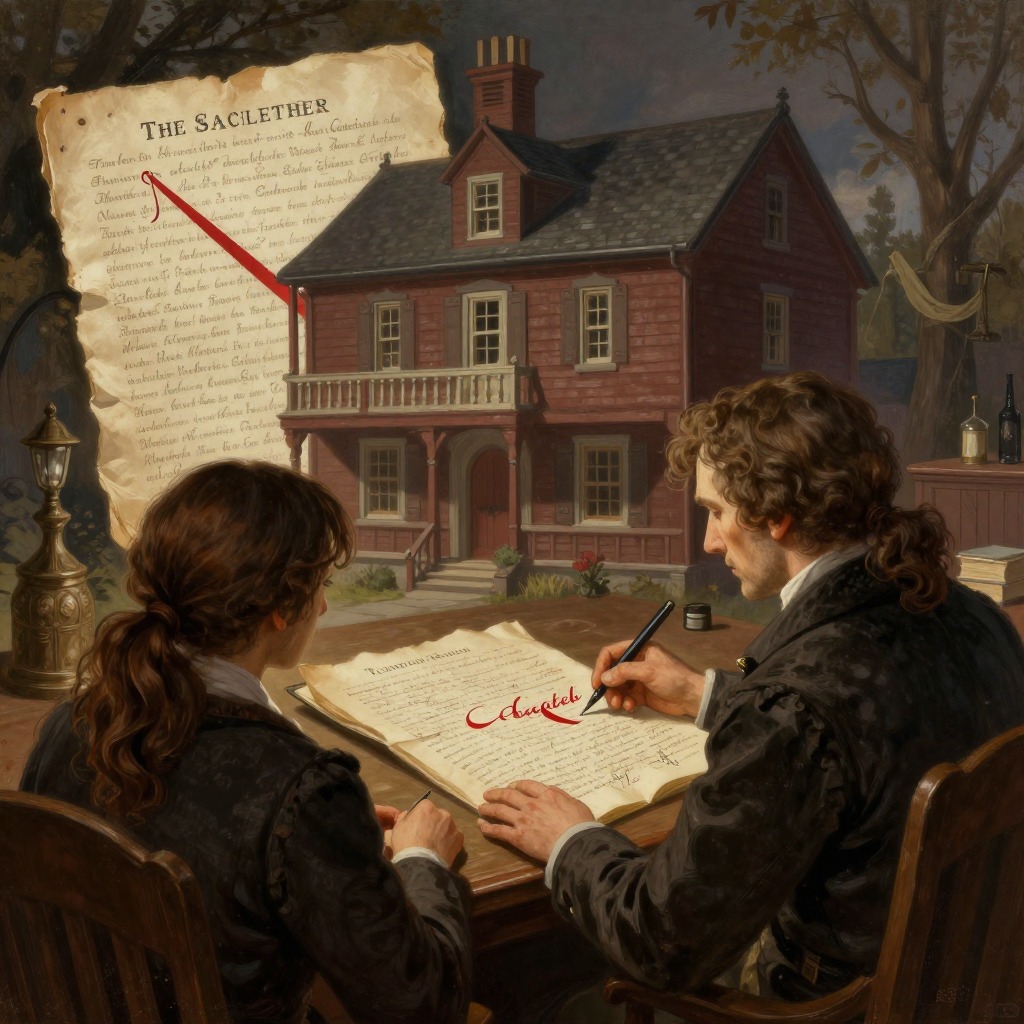
The Custom-House stands at the head of a wharf that was bustling half a century earlier but is now burdened with decayed wooden warehouses and exhibits few signs of commercial life. The building's front is ornamented with a portico of half-a-dozen wooden pillars and a balcony, beneath which a flight of wide granite steps descends toward the street. Over the entrance hovers an enormous specimen of the American eagle, with outspread wings, a shield before her breast, and intermingled thunderbolts and barbed arrows in each claw, threatening mischief to the inoffensive community. Inside, the narrator's office is about fifteen feet square, cobwebbed and dingy with old paint, its floor strewn with grey sand. The furniture includes a stove with a voluminous funnel, an old pine desk with a three-legged stool, and two or three exceedingly decrepit wooden-bottom chairs. The library consists of a score or two of volumes of the Acts of Congress and a bulky Digest of the Revenue laws. The room is a sanctuary into which womankind, with broom and mop, has very infrequent access. In the second storey, a large unfinished room with brick-work and naked rafters contains barrels of official documents and heaps of rubbish, where the narrator eventually discovers the scarlet letter and Pue's manuscript.
The Narrator's Tenure and the Officers
The narrator takes up his post as Surveyor with the President's commission in his pocket, finding himself at the head of a patriarchal body of veterans, mostly ancient sea-captains who have drifted into this quiet nook after being tossed on every sea. The Collector, a gallant old General and New England's most distinguished soldier, sits by the fireplace, his step palsied, his countenance mild and kindly, yet seeming remote from the bustle of commercial life. The narrator grows to like these old officers, despite their wearisome repetition of sea-stories and mouldy jokes. One permanent Inspector, a man of fourscore years with a florid cheek and brisk step, is a remarkable specimen of winter-green, possessing no power of thought, no depth of feeling, but a rare perfection of animal nature and a gourmand's memory of good dinners. The narrator reflects that the Custom-House officers, by the tenure of their situation and the nature of their business, can hardly be very praiseworthy or respectable personages; they lose their own proper strength by leaning on the mighty arm of the Republic, and the ejected officer seldom returns to himself.
The Discovery of the Scarlet Letter
One idle and rainy day, while poking and burrowing into the heaped-up rubbish in the unfinished upper room, the narrator chances upon a small package done up in ancient yellow parchment. It contains a commission under the hand and seal of Governor Shirley in favour of Jonathan Pue as Surveyor of His Majesty's Customs for the Port of Salem, and, more importantly, a small roll of dingy paper around which is twisted a certain affair of fine red cloth, much worn and faded, with traces of gold embroidery. This rag of scarlet cloth, on careful examination, assumes the shape of the capital letter A, each limb precisely three inches and a quarter in length. The narrator, placing it on his breast, experiences a sensation of burning heat, as if the letter were red-hot iron. The accompanying manuscript, recorded by Surveyor Pue, contains a reasonably complete explanation of the whole affair, detailing the life and conversation of one Hester Prynne, who flourished during the period between the early days of Massachusetts and the close of the seventeenth century. The narrator, feeling a filial duty toward his official ancestor, resolves to bring the mouldy and moth-eaten lucubrations before the public.
The Stifling of Imagination and the Liberation
During his three years in the Custom-House, the narrator finds that the atmosphere is so little adapted to the delicate harvest of fancy and sensibility that his imagination becomes a tarnished mirror. The characters of the narrative refuse to be warmed and rendered malleable; they retain all the rigidity of dead corpses. Moonlight, sunshine, and the glow of firelight are alike unavailing. The narrator feels his intellect dwindling away, like ether out of a phial, and begins to grow melancholy and restless, fearing he will become much such another animal as the old Inspector. The election of General Taylor to the Presidency brings a change of administration, and the narrator, a Democrat, is among the first to be removed from office. This ejection, which he compares to being murdered after having entertained thoughts of suicide, proves liberating. He opens his long-disused writing desk, makes an investment in ink, paper, and steel pens, and becomes a literary man again. The lucubrations of Surveyor Pue come into play, and the narrator, though his intellectual machinery is rusty, finds himself happier while straying through the gloom of these sunless fantasies than at any time since he quitted the Old Manse. The Custom-House, with its life of official formalities, lies like a dream behind him, and he is free to write the tale of the scarlet letter.