Governor Bellingham
The Scarlet LetterGovernor Bellingham is a high-ranking colonial magistrate in Boston who embodies the stern authority of the Puritan establishment, presiding over Hester Prynne's public shaming and later attempting to remove her daughter Pearl, yet he ultimately participates in the civic ceremonies that mark the colony's political life.
Identity and Position
Governor Bellingham is a gentleman advanced in years, with a hard experience written in his wrinkles, and he wears a dark feather in his hat, a border of embroidery on his cloak, and a black velvet tunic beneath. He is not ill-fitted to be the head and representative of a community which owed its origin and progress not to the impulses of youth but to the stern and tempered energies of manhood and the sombre sagacity of age. During the scene of Hester Prynne's public ignominy, he sits in the balcony of the meeting-house with four sergeants about his chair bearing halberds as a guard of honour, surrounded by other eminent characters distinguished by a dignity of mien belonging to a period when the forms of authority were felt to possess the sacredness of Divine institutions. His mansion is a large wooden house built in a fashion of which specimens still exist in older towns, its walls overspread with a kind of stucco in which fragments of broken glass are plentifully intermixed, so that when the sunshine falls aslant-wise over the front it glitters and sparkles as if diamonds had been flung against it by the double handful. The hall of entrance is wide and reasonably lofty, extending through the whole depth of the house, with furniture consisting of ponderous chairs elaborately carved with wreaths of oaken flowers and a table in the same taste, all being of the Elizabethan age or earlier and heirlooms transferred from the Governor's paternal home. On the wall hangs a suit of mail of the most modern date, manufactured by a skilful armourer in London the same year Bellingham came over to New England, including a steel head-piece, a cuirass, a gorget and greaves, with a pair of gauntlets and a sword hanging beneath, all so highly burnished as to glow with white radiance and scatter illumination everywhere about the floor. Though bred a lawyer and accustomed to speak of Bacon, Coke, Noye, and Finch as his professional associates, the exigencies of this new country have transformed him into a soldier as well as a statesman and ruler, and this bright panoply has been worn by him on many a solemn muster and training field and glittered at the head of a regiment in the Pequod War.
Role in Hester Prynne's Punishment and the Attempt to Take Pearl
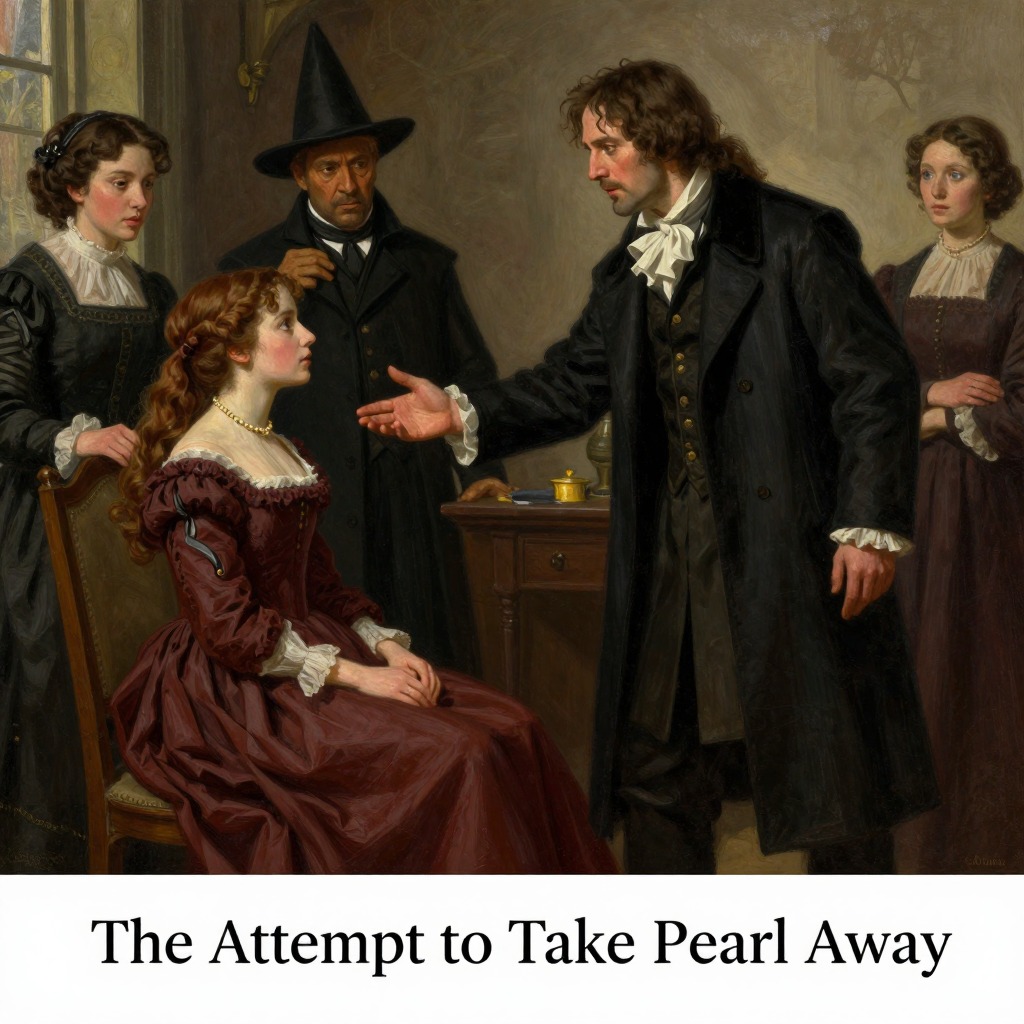
Governor Bellingham is one of the most busy among those who promote the design to deprive Hester Prynne of her child, Pearl, on the supposition that the child is of demon origin and that a Christian interest in the mother's soul requires them to remove such a stumbling-block from her path. When Hester comes to his mansion with a pair of embroidered gloves and to plead for her daughter, Bellingham steps through the window into the hall followed by his three guests, fixes his naturally stern regard on the wearer of the scarlet letter, and declares that the point has been weightily discussed whether those of authority and influence do well to trust an immortal soul to the guidance of one who has stumbled and fallen. He tells Hester that it is because of the stain which that letter indicates that they would transfer her child to other hands. After Pearl's perverse refusal to answer the Reverend Mr. Wilson's catechism questions, Bellingham cries out that here is a child of three years old who cannot tell who made her, and that without question she is equally in the dark as to her soul, its present depravity, and future destiny, and he declares that they need inquire no further. It is only after the young minister Arthur Dimmesdale's powerful and earnest plea that Bellingham relents, saying that the minister has adduced such arguments that they will even leave the matter as it now stands, so long at least as there shall be no further scandal in the woman, though care must be had to put the child to due and stated examination in the catechism and to ensure that she go both to school and to meeting.
Participation in Civic Ceremonies and the Election Day
On the day when the new Governor is to receive his office at the hands of the people, Bellingham appears as part of the procession of magistrates and citizens on its way towards the meeting-house, where the Reverend Mr. Dimmesdale is to deliver an Election Sermon. The primitive statesmen of the colony, including Bellingham, are elevated to power by the early choice of the people and seem to have been not often brilliant but distinguished by a ponderous sobriety rather than activity of intellect, possessing fortitude and self-reliance, and in time of difficulty or peril standing up for the welfare of the state like a line of cliffs against a tempestuous tide. The traits of character here indicated are well represented in the square cast of countenance and large physical development of the new colonial magistrates. During the procession, Bellingham keeps an anxious eye upon Dimmesdale, and when the minister pauses opposite the scaffold, Bellingham leaves his own place in the procession and advances to give assistance, judging from Dimmesdale's aspect that he must otherwise inevitably fall, but something in the latter's expression warns back the magistrate. Later, at old Roger Chillingworth's decease, Bellingham serves as one of the executors of his will, along with the Reverend Mr. Wilson, by which Chillingworth bequeaths a very considerable amount of property to little Pearl.