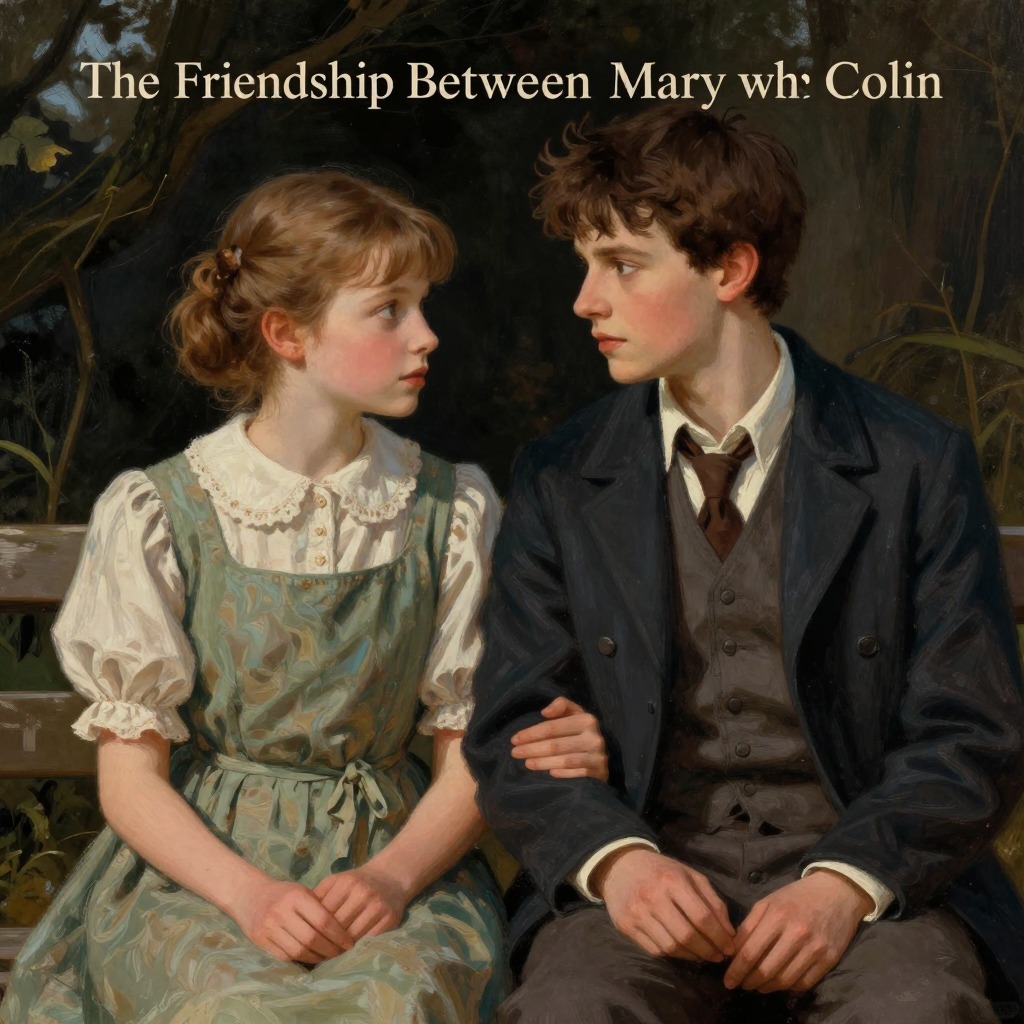
Mary Lennox and Colin Craven (cousins)
The Secret GardenMary Lennox and Colin Craven are cousins, a relationship that forms the emotional and structural core of the novel. Their bond, discovered in the middle of a stormy night, transforms both children from isolated, tyrannical invalids into healthy, joyful companions who together restore the secret garden and themselves.
Discovery and First Meeting
Mary Lennox first learns of Colin's existence not from any servant or relative but through a sound: a fretful, childish crying carried down the dark corridors of Misselthwaite Manor on a night when the wind "wuthered" round the house. Driven by curiosity and a rebellious mood, she leaves her room with a candle, follows the faint sound through a tapestry-covered door, and finds herself in a big room with ancient, handsome furniture. There, on a carved four-posted bed hung with brocade, lies a boy with a sharp, delicate face the color of ivory and eyes too large for it. He is crying fretfully. When he sees her, he asks in a half-frightened whisper if she is a ghost. She asks him the same. He tells her his name is Colin Craven. She tells him she is Mary Lennox. "He is my father," the boy says of Mr. Archibald Craven. "Your father!" Mary gasps. "No one ever told me he had a boy!" Colin explains that the servants are forbidden to speak of him, that he is kept hidden because he is always ill and believed to be dying, and that his father cannot bear to look at him. Mary, in turn, tells him she heard him crying and wanted to find out who it was. They sit together through the night, talking, and before she leaves she sings him a low Hindustani chant until he falls asleep.
The Cousin Bond and Its Immediate Effects
The discovery that they are cousins—a fact they themselves forget until Colin suddenly exclaims, "Do you know there is one thing we have never once thought of? We are cousins"—gives their relationship a formal name, but its power lies in what it unlocks. Colin, who has never had a companion his own age, immediately declares that Mary must come and talk to him every day. He tells the nurse and Mrs. Medlock, "This is my cousin, Mary Lennox. I asked her to come and talk to me. I like her." Dr. Craven and Mrs. Medlock are astonished; the boy who has thrown tantrums at the mere sight of a stranger is now sitting up, laughing, and eating with a healthy appetite. Mary, for her part, finds in Colin a fellow prisoner of the great house's secrets. She tells him about the robin, about Dickon, about the moor, and—carefully at first—about the garden. She extracts a promise from him: he will not force the servants to open the garden door. Instead, she will find a way in, and they will share it as a secret. "I never had a secret," Colin says, "except that one about not living to grow up. They don't know I know that, so it is a sort of secret. But I like this kind better."
Shared Secrets and Mutual Transformation
The cousin relationship becomes the engine of both children's recovery. Mary tells Colin about the secret garden, and he, in turn, tells her about his mother's portrait hidden behind a rose-colored silk curtain. They plan together how to get him into the garden without anyone knowing. They devise a system of "play actin'"—Colin pretends to be weak and fretful in front of the adults while secretly growing stronger every day. Mary brings him news of the garden's progress, of the green points pushing through the earth, of the robin building its nest. Colin, who has never wanted to go outside, begins to long for fresh air. "I should not mind fresh air in a secret garden," he says. When Mary finally tells him the whole truth—that she has already been inside the garden, that she found the key and the door weeks ago—he does not betray her. Instead, he is enraptured. "It is just what you thought it would be," he says. "It sounds just as if you had really seen it." Their shared secret binds them more tightly than any blood tie could.
The Climax of the Cousin Relationship
The most dramatic expression of their bond comes during Colin's worst tantrum. After Mary misses a day in the garden to work with Dickon, Colin flies into a hysterical rage, screaming and beating his pillow. The nurse, Mrs. Medlock, and Martha are helpless. It is Mary who bursts into the room and shouts, "You stop! I hate you! Everybody hates you!" She tells him that half of what ails him is "hysterics and temper" and demands to see his back to prove there is no lump. Her furious, unsympathetic words shock him into stillness. When he shows her his back, she declares there is not a lump as big as a pin. "If you ever say there is again, I shall laugh!" This confrontation, born of their intimate knowledge of each other's weaknesses, breaks the cycle of fear and self-pity. Colin, for the first time, asks, "Do you think—I could—live to grow up?" And Mary, having already lived through her own transformation, is the one who insists he can.
The Cousins in the Garden
Once Colin is brought into the secret garden, the cousin relationship reaches its fullest expression. They work side by side, weeding, digging, planting. They perform the "Magic" ceremony together, sitting cross-legged under the plum tree, chanting that the Magic is in them. Colin learns to walk, then to run, and Mary is there for every step. When Ben Weatherstaff discovers them and calls Colin a "poor cripple," it is Mary who shouts up at the wall, "He's not got a lump as big as a pin! I looked and there was none there—not one!" And when Colin, standing upright for the first time, declares, "I shall live forever and ever and ever!" Mary is the one who has been whispering under her breath, "You can do it! You can do it!" Their relationship is not romantic but profoundly restorative: two children who were each, in their own way, locked away from life, who find in each other the courage to unlock the door.