Secret
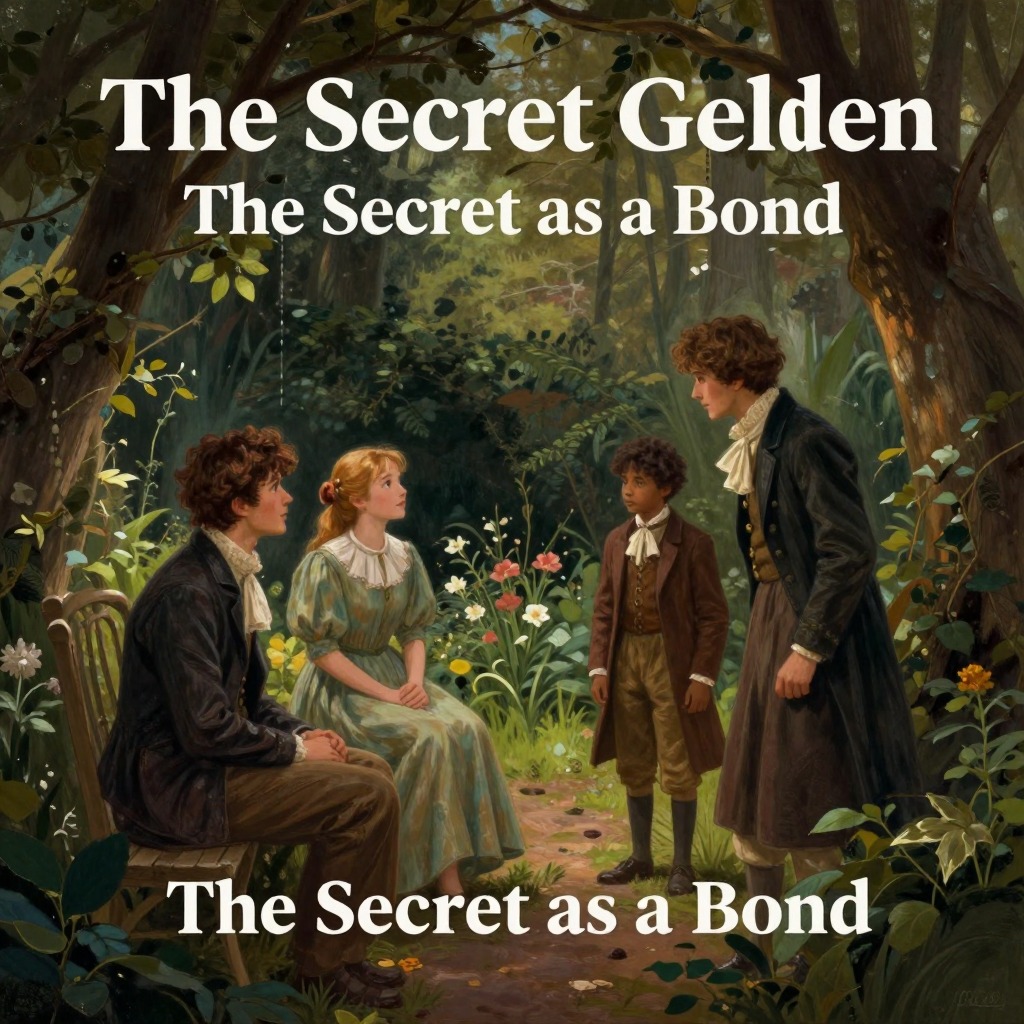
The Secret GardenThe Secret is the animating principle of The Secret Garden, a force that shapes the narrative from its opening mysteries to its climactic revelations. It is not merely a plot device but a structuring element of the story's world, governing who may know what, when, and under what conditions. The secret garden itself—locked for ten years, its key buried—is the story's central enigma, but the concept radiates outward to encompass the hidden existence of Colin Craven, the clandestine work of Mary and Dickon, and the carefully guarded truth of Colin's recovery. Secrets in this novel are not static; they are discovered, shared, tested, and ultimately transformed into sources of power and intimacy.
The Garden as the Original Secret
The secret garden was locked by Archibald Craven after his wife Lilias died from a fall within it, and he buried the key so that no one could enter. For ten years, the garden remained a forbidden place, its door hidden under thick ivy and its existence known only through rumor and prohibition. Martha tells Mary that "Mr. Craven had it shut when his wife died so sudden. He won't let no one go inside. It was her garden. He locked th' door an' dug a hole and buried th' key." This act of sealing the garden transforms it into a sacred, haunted space, a physical manifestation of grief and loss. The secret becomes a challenge and an allure for Mary, who is immediately curious about "the garden which no one had been into for ten years." She wonders what it looks like and whether any flowers still live there, and the mystery gives her something to think about in the otherwise empty and lonely house.
The Discovery and Keeping of Secrets
Mary's discovery of the key—unearthing it from freshly turned soil where a dog had been digging—and her subsequent entry into the garden are acts of secret acquisition. She immediately understands the importance of concealment: "if she liked it she could go into it every day and shut the door behind her, and she could make up some play of her own and play it quite alone, because nobody would ever know where she was." The secret gives her a sense of ownership and purpose she has never had. When she meets Dickon, she tests his trustworthiness by asking if he can keep a secret, and he proves himself by saying, "I'm keepin' secrets all th' time. If I couldn't keep secrets from th' other lads, secrets about foxes' cubs, an' birds' nests, an' wild things' holes, there'd be naught safe on th' moor." He leaves her a note with a picture of a missel thrush on its nest and the words "I will cum bak," confirming that her secret is safe with him.
Colin's Secret and the Power of Shared Knowledge
Colin Craven himself is a secret, hidden away in his room because his father cannot bear to look at him and because the servants are forbidden to speak of him. When Mary discovers him crying in the night, she enters a world of secrecy that mirrors her own. Colin tells her, "They daren't" tell her about him, and he explains that he won't let people see him because he is afraid of being stared at and talked over. The secret of his existence is a burden and a source of his isolation. When Mary shares the secret of the garden with him, she gives him something to live for. He says, "I never had a secret, except that one about not living to grow up. They don't know I know that, so it is a sort of secret. But I like this kind better." The shared secret of the garden becomes the foundation of their friendship and the engine of Colin's recovery.
The Transformation of Secrecy into Play and Power
As Colin grows stronger, the children turn secrecy into a game of "play actin'." They pretend Colin is still an invalid to throw the servants and Dr. Craven off the scent, groaning and complaining when they are in earshot, then laughing uncontrollably once they are safe in the garden. Colin says, "I won't have people whispering and asking questions and I won't let my father hear about it until the experiment has quite succeeded." The secret becomes a source of power and agency, allowing Colin to control the narrative of his own recovery. He plans to reveal himself dramatically to his father, walking into his study and saying, "Here I am; I am like any other boy." The secret, once a tool of oppression and grief, is now a tool of joy and self-determination.
The Final Revelation and the End of Secrecy
The climax of the novel occurs when Archibald Craven, drawn home by a dream and a letter from Susan Sowerby, walks into the garden and finds Colin running and laughing. Colin bursts through the ivy-covered door and nearly crashes into his father, then stands tall and declares, "Father, I'm Colin. You can't believe it. I scarcely can myself. I'm Colin." The secret is finally revealed, and with it, the transformation is complete. Colin tells his father, "It was the garden that did it—and Mary and Dickon and the creatures—and the Magic. No one knows. We kept it to tell you when you came." The secret, once a wall between people, becomes the bridge that reunites father and son. The novel ends with the secret no longer needed, as Colin walks back to the house with his father, "with his head up in the air and his eyes full of laughter."
Upon its initial publication as a novel in 1911, The Secret Garden received largely favorable reviews and sold briskly, with a second printing announced within a month. It was marketed as adult fiction, having first appeared in a magazine for adults, and became a bestseller during the 1911 Christmas season, appearing on critical "best of" lists from The New York Times and Literary Digest. Burnett herself regarded it as her favorite novel, though she considered another of her works her Great American Novel. Despite this early success, the book fell into near obscurity after Burnett's death in 1924; her obituaries mentioned Little Lord Fauntleroy but passed over The Secret Garden in silence. The author's literary reputation waned over subsequent decades, possibly due to biases against books with a female audience. Nevertheless, the novel maintained a devoted readership and continued to rank highly in reader polls. In the 21st century, the story has been adapted into multiple graphic novel versions, including a 2021 retelling set in modern New York titled The Secret Garden on 81st Street, and a Japanese-language adaptation released in 2012.