Spring
The Secret GardenIn Frances Hodgson Burnett's The Secret Garden, Spring is far more than a seasonal backdrop; it is the central agent of change, a living force that awakens the dead garden and, with it, the spirits and bodies of the children. Its arrival is the story's pivotal event, marking the transition from isolation, illness, and despair to connection, health, and joy. The season is consistently personified as a powerful, almost magical entity that "comes" with a procession of color, scent, and sound, and its progress is meticulously charted through the eyes of Mary Lennox, Colin Craven, and Dickon Sowerby.
The Herald of Change
The first hints of Spring's approach are felt in the transformation of the moor and the gardens. After a violent rainstorm, the sky clears to a "brilliant, deep blue" that Mary had never dreamed of, and the moor itself looks "softly blue instead of gloomy purple-black" . Martha explains that this change signals that "th' springtime's on its way," though it is still far off. This promise of renewal is immediately tied to physical health: the fresh air gives Mary an appetite for the first time in her life, and the wind whips color into her cheeks. The season's power is also evident in the earth itself, which Ben Weatherstaff describes as being "in a good humor makin' ready to grow things." He tells Mary to watch for "bits o' green spikes stickin' out o' th' black earth," a direct invitation to participate in the season's work of creation.
The Garden's Awakening
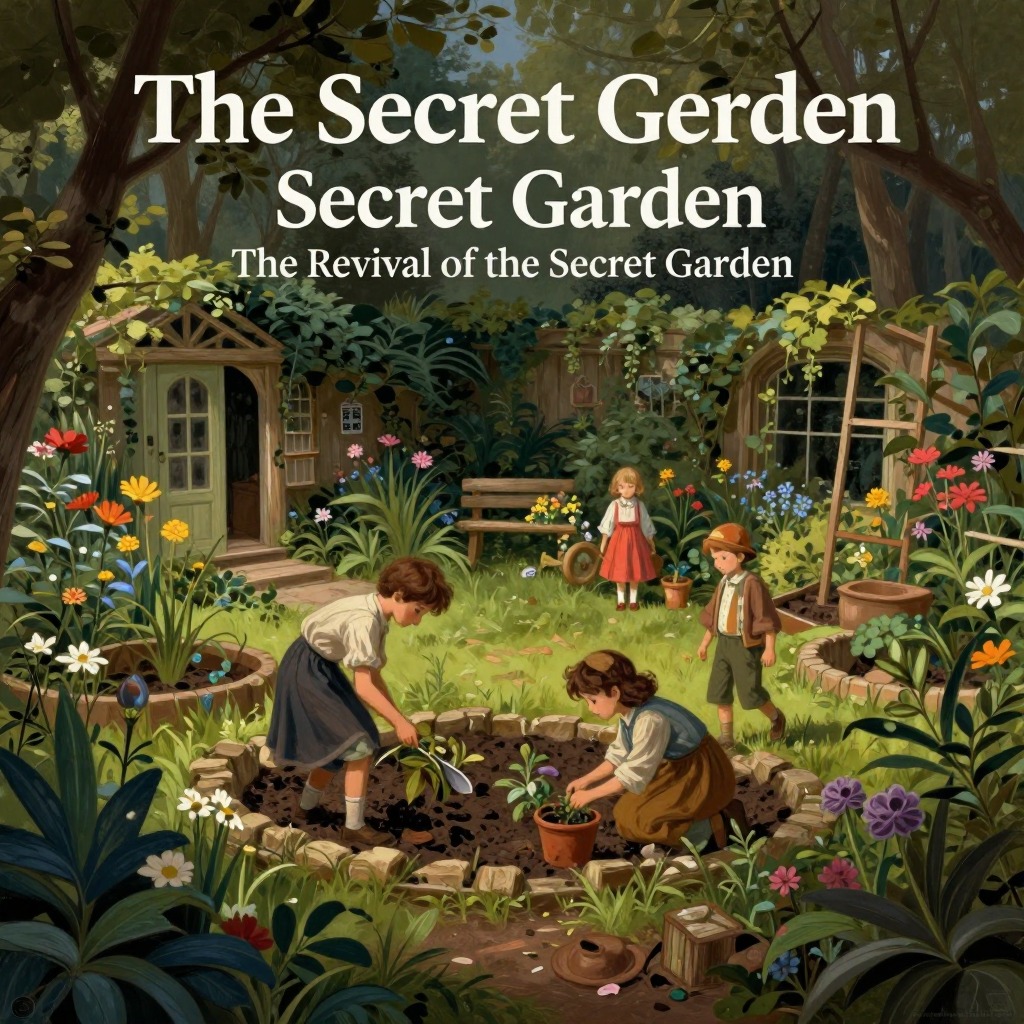
The secret garden itself becomes the primary stage for Spring's miracle. When Mary first enters, it is a place of "wintry brown" grass and gray, leafless rose stems, a seemingly dead world. Yet even then, she finds "sharp little pale green points" pushing through the black earth—crocuses, snowdrops, and daffodils that have survived ten years of neglect. As the season progresses, the garden undergoes a breathtaking transformation. Dickon, the embodiment of natural wisdom, explains that the seemingly dead wood is still "wick" (alive) and that with care, there will be "a fountain o' roses" by summer. The gray walls are overtaken by a "green mist" and then a "green gauze veil" as leaves unfurl. The garden becomes a riot of color: "clumps of crocuses burst into purple and orange and gold," and later, the grass is carpeted with flowers. This rebirth is not passive; it is actively nurtured by Mary and Dickon, who dig, weed, and prune, working in partnership with the season.
The Season of Life
Spring's most profound effect is on Colin Craven, the bedridden boy who believes he is dying. The season directly counters his obsession with death and deformity. When Mary bursts into his room with the cry, "It has come! The Spring!" , Colin feels his heart beat and sits up in bed. He opens the window to let in the "freshness and softness and scents and birds' songs," and for the first time, he breathes deeply, feeling "something quite new and delightful." The garden's awakening becomes a metaphor for his own. He declares, "I shall get well! ... And I shall live forever and ever and ever!" The season gives him a reason to live, a project to focus on, and a tangible proof that life can triumph over decay. Dickon, too, is a creature of Spring, his very appearance—with his "poppy-colored cheeks" and eyes "like a bit of the sky"—reflecting the season's vitality. He describes the morning of Spring's full arrival as a time when "th' world's all fair begun again," and he ran across the moor "shoutin' an' singin'" .
The Culmination of Magic
Spring culminates in a series of symbolic acts that seal the children's transformation. The season provides the setting for the "Magic" ceremony, where Colin, Mary, and Dickon sit in a circle under a blossoming plum tree and chant to invoke the life-giving force. The garden itself becomes a "temple of gold" as the season deepens. The final, triumphant reunion between Colin and his father, Archibald Craven, occurs when Colin bursts through the ivy-covered door, a boy "glowing with life" and "full of boyish laughter." The garden, now a "wilderness of autumn gold and purple and violet blue and flaming scarlet," has completed its cycle, but the Spring that began it all has permanently altered the lives of everyone it touched. It is the season that proves the power of the "Big Good Thing," the force that makes seeds swell, sun shine, and a sick boy become well.