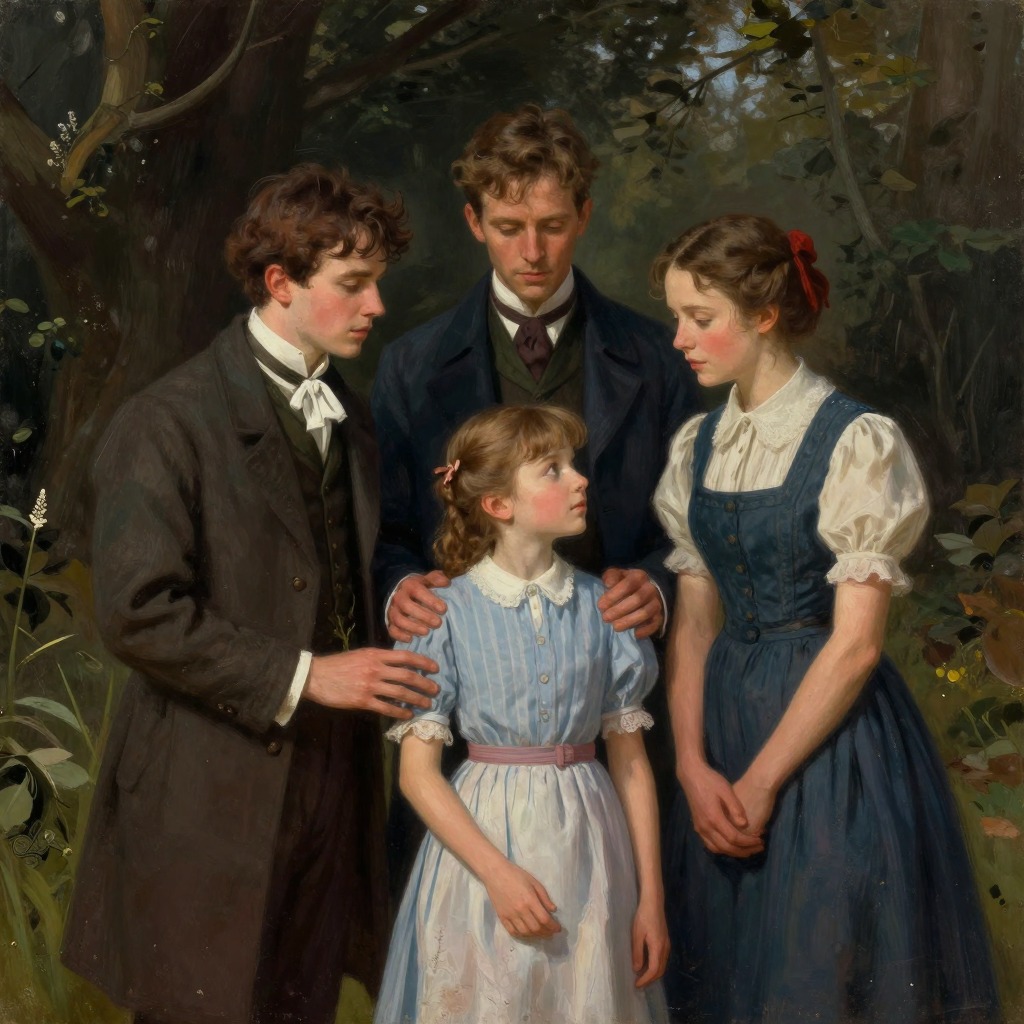
the Sowerby cottage
The Secret GardenThe Sowerby cottage stands on the moor, a five-mile walk from Misselthwaite Manor, and is the home of Martha, Dickon, and their ten other siblings, all living in four little rooms on the sixteen shillings a week their father earns. It is a place defined not by its material poverty but by the abundant life, warmth, and practical wisdom of its mother, Susan Sowerby. For Mary Lennox, newly arrived from India and utterly unused to affection or family life, the cottage represents a world of healthy, boisterous, and loving chaos that she has never known. For Colin Craven, isolated and morbid in his sickroom, it becomes a symbol of the ordinary, vigorous life he has been denied. The cottage is thus a crucial geographical and emotional pole in the novel, standing for the regenerative power of simple, loving human connection against the isolation and grief that have gripped Misselthwaite Manor.
Location and Domestic Life
The cottage is a cramped but clean dwelling where fourteen people live in four small rooms, and the children, as Martha describes, "tumble about on th' moor an' play there all day." Despite the scarcity—Martha notes that her father's wages of sixteen shillings a week barely provide porridge for everyone—the home is kept scrupulously clean by Susan Sowerby, a woman Mrs. Medlock describes as "that sensible an' hard workin' an' goodnatured an' clean that no one could help likin' her." The cottage smells of "nice, clean hot bakin'" and has a good fire, and when the children come in from playing on the moor, they "just shouted for joy" at the hot doughcakes with brown sugar their mother has made. Dickon himself declares their cottage "good enough for a king." This domestic scene of warmth and contentment, born of love rather than wealth, stands in stark contrast to the hundred-room, largely empty and silent Misselthwaite Manor, where Mary initially feels lost and Colin lies in his brocaded bed, attended by servants but starved of genuine family feeling.
Role in Mary's Transformation
The cottage, and especially the stories Martha tells about it, is one of the first things to draw Mary out of her sour self-absorption. Mary is fascinated by the sheer number of children and their rough-and-tumble life, and she is particularly drawn to the figure of the mother, Susan Sowerby, whom she has never met but already likes. It is Martha's description of the cottage and its inhabitants that first sparks Mary's interest in Dickon, a "healthy sentiment" that marks the beginning of her emotional awakening. The cottage also becomes a promised destination: Martha asks her mother if Mary might be driven over for a visit, and Susan Sowerby agrees, a plan that fills Mary with excitement at the thought of "going into the cottage which held twelve children" and seeing the mother who seems so unlike the mothers she knew in India. This anticipated visit represents Mary's first real desire to connect with a world beyond her own needs and grievances.
Symbolic Significance and Contrast with Misselthwaite
The Sowerby cottage functions as a powerful symbolic counterweight to Misselthwaite Manor. The Manor, with its hundred locked rooms, its grieving master, and its hidden, invalid son, is a place of secrets, silence, and death-in-life. The cottage, by contrast, is a place of openness, noise, and teeming life. Where the Manor's wealth has produced isolation, the cottage's poverty has produced a tightly knit, resourceful family. The cottage is the source of the skipping rope that gives Mary her first taste of healthy exercise and joy, and it is the home of Dickon, the "animal charmer" whose connection to the natural world is the key to reviving the secret garden. The cottage's ethos—practical, loving, and unsentimental—is embodied in Susan Sowerby's wisdom, which eventually reaches even the reclusive Archibald Craven through her letter urging him to come home. The cottage thus represents the ordinary, healthy human life that both Mary and Colin must learn to embrace in order to be healed.