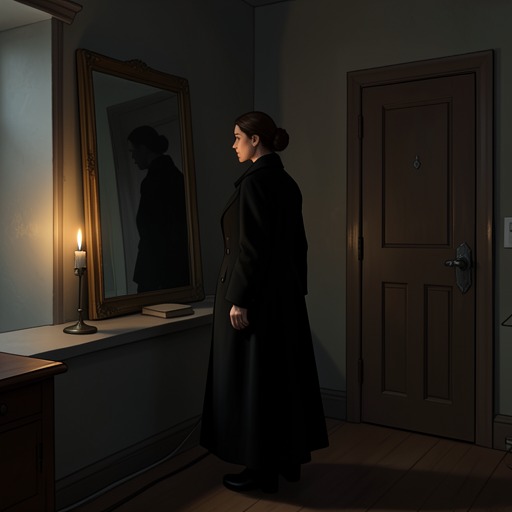
Celeste Rodriguez
The Secret VampireCeleste Rodriguez is introduced as an eighteen-year-old member of the Rodriguez family, arriving in Cape Town with her father Elijah Rodriguez and younger sister Brianna Rodriguez after the town’s violent human–vampire past has been concealed beneath an apparently ordinary present. Her decisive significance lies in the way personal grief becomes a force capable of changing an entire supernatural order: she begins as a bereaved, suspicious young woman searching for honesty about her mother, yet ends as the person who breaks Samara’s control, protects the vampire royal family, and helps create a future in which humans and Vampires can live together.
Identity and Introduction
Celeste enters the story while arranging a room in the family’s new house. Her unease is immediate and specific: she notices that there are no photographs showing the family together and confronts Elijah Rodriguez about why her mother is not pictured. When he refuses to answer and angrily sends her to her room, Celeste leaves the house carrying both resentment and unresolved grief. Her insistence on knowing what happened to her mother establishes honesty as one of her central emotional demands; secrecy is not merely frustrating to her, but a sign that family bonds have been damaged.
Her first encounter with the hidden world occurs almost immediately after she walks into town. Feeling that something is strange, she looks toward the Forest, but while crossing the road she freezes in front of an approaching car. An unknown young man, Callum, pulls her away and then walks off before she can question him. The rescue leaves Celeste with a mystery rather than an explanation: she knows that Callum saved her, but does not yet know that he is an adopted member of the vampire royal family. This meeting begins the relationship that later becomes central to both her emotional life and the political conflict surrounding the Vampires.
Grief, Family, and Early Vulnerability
Celeste’s grief over her mother remains active rather than settled. She later visits Brianna Rodriguez’s grave with tulips, places them at the graveside, and speaks to her sister about everything, including Callum. The visit shows how Celeste uses the grave as a private place for confession when ordinary family communication has failed. Her sorrow is compounded by conflict at home: after Elijah Rodriguez returns drunk and becomes violent, Celeste orders Brianna to go upstairs and takes the beating herself. She collapses before Callum, who has heard her scream, breaks down the door, and carries her away.
Callum takes Celeste to the Forest near the graveyard because he cannot bring her to the Vampire Castle or to doctors without exposing the secret of his world. He places her head on his lap, wraps her in a blanket, and promises that she will never face danger again. While he sleeps, Celeste’s body glows with a purple light; she stirs and calls for her mother. The episode places her human suffering beside the first visible sign that she is not ordinary, while also making Callum’s protective attachment to her inseparable from her vulnerability and grief.
Celeste’s relationship with her sister Susie Rodriguez is similarly shaped by both affection and strain. After Susie reveals that she once danced with Callum at a club, Celeste feels betrayed that Callum did not tell her and withdraws from him. Later, when Susie challenges her reaction, Celeste angrily orders her sister out of the room. The sisters’ quarrels do not erase their bond, however; Celeste continues to protect Susie, including during the violence at home and later when Susie’s transformation into a Vampire turns her into a danger to other people.
Recognition by the Vampire World
Celeste’s unexplained importance becomes explicit when Samara brings Carmilla a document identifying Celeste as special. Samara tells Carmilla that Celeste cannot be touched or harmed, and Carmilla wonders whether the girl might also be Callum’s mate. Samara presents the information as protection, but privately uses it to plant doubt in Carmilla’s mind. Celeste therefore becomes politically significant before she understands why: her identity is treated as knowledge that can influence the vampire royal family, even while she herself remains outside that family’s explanations.
This position is complicated by the human–vampire divide. The town’s earlier war had made humans and Vampires enemies, and the surviving peace arrangement demanded no hunting and no biting. Celeste’s life nevertheless becomes entangled with the vampire court through Callum, Carmilla, Susie Rodriguez, and Samara. Her importance does not arise from inherited royal status; it emerges through relationships, moral choices, and a power that remains hidden until the crisis reaches its height. In that sense, she occupies a boundary position between the human family she is trying to understand and the supernatural family whose secrets repeatedly endanger her.
Captivity, Revelation, and Resistance
Celeste’s boundary position becomes a direct physical danger when Samara turns her into a bargaining instrument. Samara keeps Celeste captive in the basement and tells Gabriel that the prisoner is a “golden ticket” for negotiating greater power with Callum. Gabriel secretly tries to help, unlocking the door and feeding Celeste a peanut-butter-and-jelly sandwich when she is weak and has gone days without a decent meal. Samara interrupts the attempted escape, uses a spell to weaken both of them, forces Celeste back downstairs, and threatens to kill Gabriel if he helps again. The captivity gives Celeste a concrete understanding of Samara’s rule: supernatural power is being used not only to injure bodies, but to isolate people, manipulate family loyalties, and convert a vulnerable person into political leverage.
The danger intensifies because Callum initially believes that Celeste caused Carmilla’s death. After Susie Rodriguez, newly transformed into a Vampire, attacks Carmilla in the Forest, Callum’s grief turns against Celeste even though Celeste tried to stop the assault and sought help for Carmilla. In the hospital, Callum refuses to hear about Celeste and later sneaks into her room, grabs her by the neck, and threatens to make her feel death before she reaches the emergency button and escapes him. Celeste’s suffering thus becomes the emotional cost of a false accusation: the person who once carried her from domestic violence now becomes another source of violence because Samara’s larger deception has redirected his mourning.
Celeste nonetheless refuses to surrender her claim to truth. In a dream, Carmilla appears in a Forest and tells Celeste that Samara killed both of their mothers. Carmilla also rejects Celeste’s belief that she is ordinary, telling her that she is special, possesses a gift, and is Callum’s soulmate. The dream connects private bereavement with supernatural inheritance: Celeste’s mother and Carmilla are both dead, yet Carmilla’s appearance gives Celeste a form of guidance that the living have withheld. The message does not remove her fear; it gives that fear a task, requiring her to become brave enough to help Callum.
Her power finally becomes publicly undeniable when she confronts Samara at the Vampire Castle. With friends and allies present, Celeste uses her ability to create a portal showing the past. The vision exposes Samara’s confession that she killed Carmilla and Celeste’s mother because she wanted power and wanted to become the most powerful Witch in the world. It also reveals that Samara manipulated Damien by pretending to be Hannah in order to separate Celeste and Callum. Celeste’s gift therefore functions as an instrument of historical correction: it replaces denial with visible evidence and restores the connections that Samara deliberately fractured.
The revelation does not leave Celeste untouched. She grows weak while sustaining the portal, falls, and must be held by Isabelle and Damien. When Samara attacks her, Celeste uses the little energy she has left to trap Samara inside a magic hourglass. Vlad then carries the hourglass to the dungeons and imprisons Samara, turning the space where Celeste was held into the punishment site for the woman who controlled it. Celeste collapses afterward, but the doctor confirms that she will recover. Her victory is therefore not a simple display of limitless power; it is an act of costly resistance in which truth, evidence, and endurance overcome captivity and deception.
Reconciliation, Partnership, and Legacy
Celeste’s victory over Samara also enables the restoration of relationships that deception and grief had broken. When Susie Rodriguez confronts her outside the Vampire Castle, Susie insists that Callum belongs with her and accuses Celeste of trying to take him away. Celeste refuses to answer the accusation with violence. She reminds Susie that she is her sister, says that Callum loves someone else, and continues speaking to her even as Susie cries over the deaths of their mother and Brianna Rodriguez. The admission of grief allows Susie’s humanity to return; she apologizes, and the sisters embrace before joining the effort to stop Samara. Celeste’s response transforms a rivalry shaped by vampiric obsession into renewed sisterly solidarity, making reconciliation part of the resistance rather than a private emotional afterthought.
After recovering, Celeste accepts Callum’s proposal at the Cape Town College sports field. Callum kneels and tells her that being with her makes him feel alive, while losing her left him trapped, alone, and lifeless; Celeste answers by nodding and kissing him as fireworks mark their engagement. The proposal gives their relationship a public future after its earlier pattern of rescue, suspicion, separation, and threatened violence. It also joins the human and vampire worlds through personal commitment: Celeste is not absorbed into Callum’s identity, nor is Callum returned to an isolated royal existence, but both carry their divided histories into a shared promise.
Three years later, Celeste and Callum are married and have a son, Silas, while Callum has succeeded Vlad as Vampire King. Celeste’s family life now exists within the vampire royal household rather than outside it, and Susie Rodriguez is likewise married to Darren and raising a daughter, Alessia. The final domestic scene gathers former companions and surviving family members in the garden as the children play, while Elise records the occasion with a group selfie. Celeste holds Silas and explains that the two bright stars in the sky are his grandmothers watching over him, converting the losses of her mother and Carmilla into an enduring family memory. Her ending therefore binds grief to continuity: the dead remain present through remembrance, while the living inhabit a future shaped by the truth Celeste forced into view.