Celeste's Kidnapping by Samara
The Secret VampireCeleste's kidnapping by Samara turns a private confrontation into a campaign of coercion: Samara abducts Celeste, confines her in a basement, and treats her as leverage in a bid for power over Callum. The captivity isolates Celeste from her friends and family, but it also brings Samara's intentions into view and sets the conditions for the eventual exposure of her crimes.
Causes and Abduction
The immediate crisis follows Celeste's encounter with Susie at college. Susie taunts her about having spent the night with Callum, then threatens to kill Celeste if she tells Callum that Susie killed Carmilla. Damien films the confrontation, recognizing that the footage could prove Celeste's innocence. Before Celeste can get home, however, someone knocks her down in an alley and drags her away. The timing links the abduction to the danger surrounding Susie's secret, even as the eventual captor is revealed to be Samara.
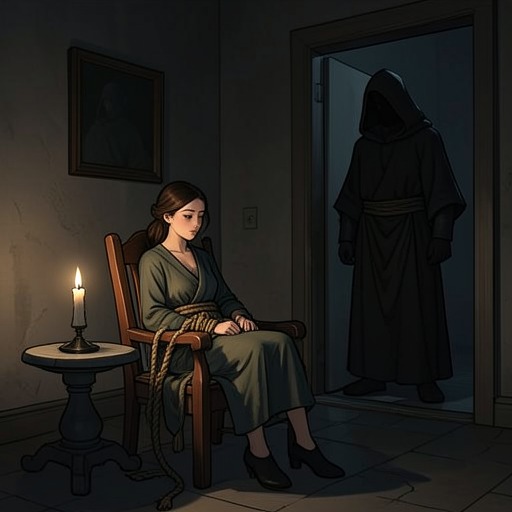
Celeste wakes hours later with her hands and legs tied. At first, Gabriel is the person she sees in the basement, and she demands to know why he kidnapped her. The question reflects how little she can see of the larger scheme from inside the confinement: Gabriel is present, but Samara is directing events. When Damien calls, Celeste asks Gabriel to answer so she can get help. Samara intervenes, takes the phone, and smashes it against the wall, cutting off that connection. She then sends Gabriel upstairs and tells Celeste she will return, making clear that Celeste is being held deliberately, not accidentally.
Confinement and Coercion
Samara identifies herself to Celeste and gives her capture a direct connection to Callum. When Celeste asks why she has been taken, Samara explains her plan; Celeste recognizes its cruelty and calls her wicked. Samara brings her stew, but Celeste spits it back rather than accept food on Samara's terms. Samara responds by torturing her. The confinement thus becomes both physical punishment and an attempt to impose control over Celeste's choices, down to whether she will eat.
The isolation has visible consequences. Celeste becomes hungry and weak, and her attempts to free herself do not succeed. When Gabriel secretly brings her a peanut-butter-and-jelly sandwich and juice, she eats eagerly and says she has not had a decent meal in days. She asks him to help her, but his first visit does not lead to release. Later, he unlocks the basement and tries to take her out; Samara catches them, uses a spell to weaken them, and forces Celeste back downstairs. She warns Gabriel that she will kill him if he tries to help Celeste escape again. His compassion is real, but Samara's threat makes him another person under her control rather than a reliable route out.
The Captive as Leverage
Samara's purpose is broader than punishing Celeste. She tells Gabriel that Celeste is her golden ticket and that she plans to negotiate with Callum for greater power. The kidnapping therefore converts Celeste's relationship with Callum into an instrument of political and personal leverage. Samara's plan rests on the assumption that Callum's attachment can be exploited, while Celeste herself is treated as an object in that bargain.
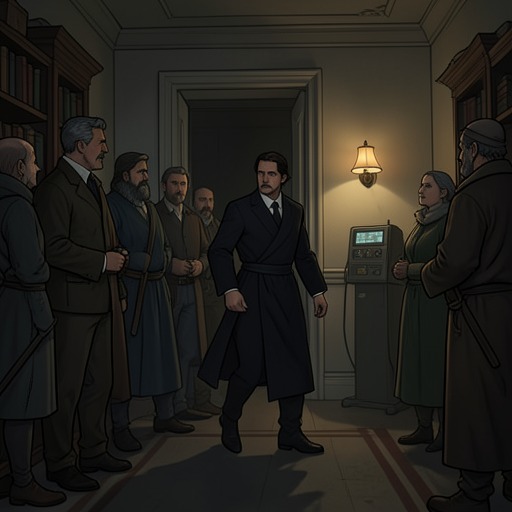
That calculation is reinforced by Samara's actions elsewhere. She disguises herself as Carmilla and uses the likeness to manipulate Vlad, urging him to avenge her supposed death by killing Celeste. The kidnapping unfolds alongside this deception: Celeste is imprisoned as leverage against Callum while Samara steers Vlad toward violence against her. Callum, meanwhile, feels Celeste's pain and realizes that someone is hurting her, although he does not yet know who has taken her. His connection to her becomes a means by which the danger registers beyond the basement, even before he can reach her.
Escape and Exposure
The captivity is not Samara's only use of Celeste. In a dream at the Hospital, Celeste sees Carmilla, who tells her that Samara killed both Carmilla and Celeste's mother and that Celeste has a special gift. The dream connects Celeste's immediate peril to the family crimes behind Samara's scheme. It also shifts Celeste's understanding of herself: she has believed she is ordinary, while Carmilla tells her she is Callum's soulmate and that Callum needs her. The revelation gives the captive a role in confronting the force that has confined her, rather than leaving her defined solely by helplessness.
Celeste eventually escapes the basement. When Samara returns to the Witch's Hut and finds her gone, she transforms into Hannah and contacts Damien, attempting to exploit his trust. The escape therefore interrupts Samara's control but does not immediately end the danger; Samara changes tactics and continues trying to manipulate those searching for Celeste. In the final confrontation, Celeste uses her power to show the past, and Samara confesses that she killed Carmilla and Celeste's mother for power and had pretended to be Hannah to manipulate Damien and drive a wedge between Celeste and Callum. Celeste's imprisonment thus culminates not simply in flight but in the disclosure of the crimes that motivated it.
Significance
The kidnapping concentrates the story's conflict in a sequence of enclosed spaces: the alley where Celeste is seized, the basement where Samara binds and tortures her, and the wider struggle in which Samara tries to turn relationships into instruments of control. Gabriel's attempts to feed and free Celeste create a contrast between care and coercion, while Samara's destruction of Celeste's phone and threats against Gabriel show how she maintains her hold through isolation and fear. Yet confinement does not silence Celeste. Her later escape and use of her gift expose Samara's ambition and killings, reversing the intended power dynamic: the person held as a bargaining piece becomes the witness whose evidence brings Samara's scheme into the open.