Human–Vampire Coexistence
The Secret VampireHuman–Vampire Coexistence is the hoped-for end to a conflict in which Vampires ruled Cape Town and humans lived in fear, and later the principle Callum compels Vlad to accept in writing. The story presents peace not as the automatic result of one victory or signature, but as a settlement repeatedly threatened by violence, supernatural coercion, and personal grief. Its eventual promise rests on both a formal agreement and relationships that cross the old divide.
From war to the prospect of peace
Ten years before the main events, the balance of power in Cape Town had left humans unable to move safely at night. The Mayor, a human, declared war against the Vampires, whose King and Queen ruled the town. The conflict brought heavy human losses: the Vampires were powerful, and their speed and stealth initially allowed them to evade garlic bombs and holy water.
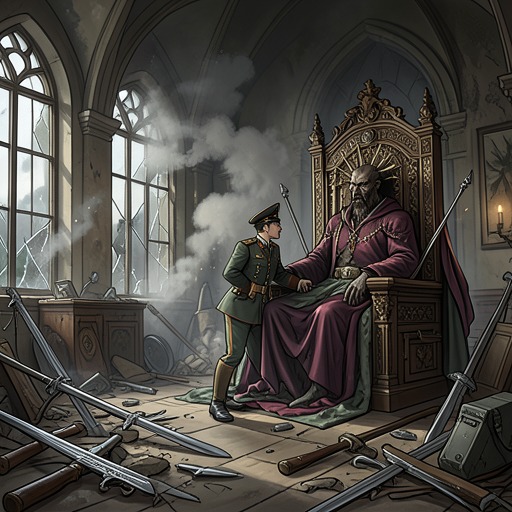
The human campaign changed when its forces used a giant garlic bomb and holy water. Many Vampires died or retreated, and the weather’s shift from storm to sunshine accompanies the humans’ sense that victory is near. At that point coexistence appears as a term the defeated Vampire King may have to accept: the remaining Vampires would live in peace under the rule of no hunting and no biting. The proposal thus begins as a condition imposed by the apparent victors, not as evidence that mistrust or the underlying conflict has already been resolved.
Callum makes peace a written obligation
The later pact emerges from a direct confrontation within the royal household. Before challenging Vlad, Callum has been identified as the young man who woke in the Vampire King’s castle without a reflection and was told he was dead. After Carmilla dies giving birth to Elise, Vlad names him Callum, makes him a prince, and turns the human doctor who witnessed the birth into a Vampire. Callum’s human origins and incorporation into the royal family place him across the boundary that the war had made absolute.
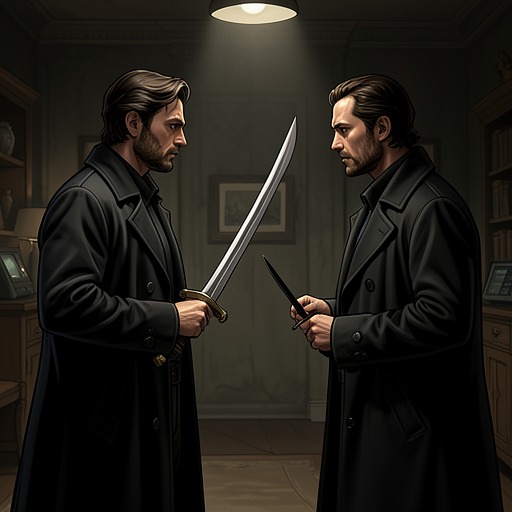
When Vlad and Callum duel, Vlad initially appears to have the advantage. Callum draws strength from thoughts of Celeste and Susie, turns the fight, and drives Vlad into a corner. Vlad concedes, saying he will not feed on humans; Callum refuses to treat a verbal promise as sufficient and produces a contract for Vlad’s signature. He states that humans and Vampires can coexist peacefully, and Vlad signs. The scene makes the settlement more than a change of feeling: Callum asks the reigning King to bind himself to a concrete commitment. At the same time, the evidence shows a private agreement between father and son, not a larger institution or an account of how compliance will be monitored.
A pact tested by violence and coercion
The agreement does not erase the dangers that surround it. Susie, newly transformed, feeds on people and kills; Callum tries to stop her, explaining that the killings put Vampires at risk. Her actions recall the earlier pattern of predation, while also showing that the boundary between the two groups is no longer stable: a human member of Celeste’s family has become a Vampire. Celeste later rejects Susie’s claim that she is merely a monster, but Susie’s remorse and changing sense of herself do not undo the deaths.
Carmilla’s death further destabilizes the settlement. Susie bites her in the woods, and Callum, grieving and convinced that Celeste is responsible, vows revenge and attacks her in the Hospital. Those acts turn the agreement’s promise of peace into a precarious restraint rather than a settled social reality. Vlad is also manipulated by Samara, who takes Carmilla’s form and uses a spell to direct him against Celeste. He resumes killing a human and pursues Celeste, while Callum and Damien search for her. The renewed violence is therefore not simply a return to open war: it is driven by bereavement, false belief, and magical interference within the royal family and its circle.
Enforcement, exposure, and the limits of order
The story’s response to danger relies on several kinds of power rather than on the contract alone. Isabelle gives Celeste a wooden stake and explains that a Vampire can be killed by a stake through the heart. Celeste later uses one against a Vampire nurse who attacks her. Elsewhere, silver causes Vlad agony when Samara traps him with a silver chain, and Samara uses magic to disguise herself as Carmilla and influence him. These episodes show that the pact exists in a world where humans and Vampires remain vulnerable to different forms of force, and where supernatural manipulation can undermine judgment and authority.
The crisis turns when Celeste exposes Samara’s actions and confines her in a magical hourglass. Vlad, freed from the spell, learns that Samara killed Carmilla and Celeste’s mother to gain power, and that she also manipulated Damien’s feelings by pretending to be Hannah in order to divide Celeste and Callum. Vlad imprisons Samara in the dungeon. This resolution removes the immediate source of the false accusation and royal violence, but the punishment is personal and absolute rather than presented as a public process for enforcing the pact. The story depicts peace as dependent on exposing deception and restraining those who threaten it, while leaving the wider rules of accountability largely unspecified.
The settlement’s personal future
The closing events give coexistence a family and generational dimension. After Celeste recovers, Callum proposes to her at the college sports field; she accepts, and fireworks accompany the celebration. Three years later they are married, have a son named Silas, and Callum has succeeded Vlad as Vampire King. Susie and Darren are also married and have a daughter, Alessia. The final family gathering brings together Callum’s royal household and Celeste’s circle, including Isabelle, Darren, Damien, Gabriel, and Susie.
This ending suggests a future in which ties between people and Vampires can be lived as kinship rather than managed only as a truce between enemies. It does not explicitly establish that every Vampire has obeyed the pact or that all human–Vampire disputes have ended. Instead, its strongest image of coexistence is the continuity of a mixed circle of friends and family after a history of war, revenge, and attempted manipulation. The written agreement supplies the political demand; the restored relationships and next generation give that demand its hopeful human scale.