Human–Vampire War of Cape Town
The Secret VampireThe Human–Vampire War of Cape Town is the founding conflict behind the story’s uneasy human–vampire order. It begins in a town where humans fear going outside after dark and vampires hold political power, then shifts toward a human victory through garlic bombs and holy water. Its aftermath is not a settled peace: the demand for an end to hunting and biting returns years later in the form of a signed contract, showing that coexistence depends on promises as well as power.
Causes and Background
The opening places the conflict ten years in the past, in Cape Town, where the vampire population is high and humans are not safe. Vampires rule the town under a king and queen; humans, afraid of being killed or fed upon, have become so constrained by danger that they cannot leave their homes at night. The war’s human cause is therefore presented as a response to sustained vulnerability, not as an isolated dispute.
The human Mayor declares war on the vampires. The Vampire King is unhappy with the decision, but the opening account gives no further diplomatic exchange or specific immediate trigger. Instead, it establishes the opposing sides through their unequal positions: humans seek relief from a threat that governs ordinary life, while the vampires are already organized under royal rule.
Course of the War
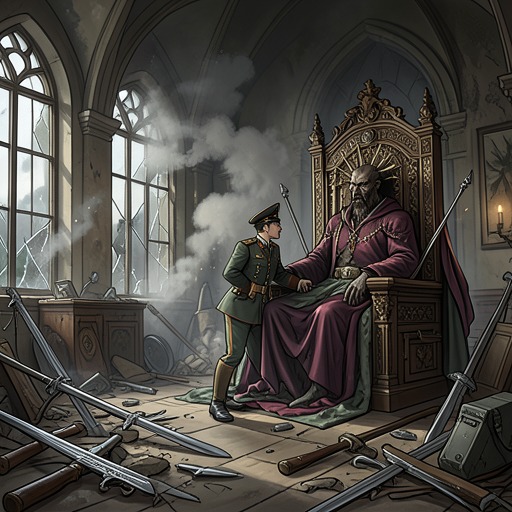
When the humans attack, the vampires are ready. The first exchanges favor the vampires: they repel human attacks, and the town becomes a bloodbath. As the weeks pass, more humans die, and the vampires’ greater power makes the conflict appear heavily one-sided. Human forces try garlic bombs and holy water, but the vampires are quick and stealthy enough to avoid these early attacks.
The turning point comes when the humans deploy a giant garlic bomb aimed into the sky, alongside holy water directed at the vampires. The change in tactics makes it seem as though the humans are winning: many vampires die or retreat. The account marks the reversal with the weather over Cape Town changing from stormy rain to sunshine. The humans feel victory approaching and anticipate that the Vampire King will have to submit to a peace agreement and manage the remaining vampires under a prohibition on hunting and biting. The shift in weather accompanies the apparent change in military fortune, but the text presents the peace as an anticipated outcome at this stage, not as an agreement already concluded.
Settlement and Later Enforcement
The war’s political settlement is made concrete later, when Callum challenges Vlad to a duel after finding him feeding on Susie. Callum stakes the contest on Vlad’s agreement to leave humans alone if Callum wins; Vlad counters that, if he wins, he will feed on Celeste. After Callum prevails, he rejects a promise alone as insufficient and brings out a contract. Vlad signs it, and Callum frames its purpose as peaceful coexistence between humans and vampires. This later scene turns the war’s anticipated peace into a written commitment, secured through a contest of force and the demand for a signature.
The need for such enforcement remains visible in the later plot. Celeste receives a wooden stake from Isabelle, who explains that a vampire can be killed by a stake through the heart if Callum proves dangerous. After Susie is bitten, she wakes with a neck wound and a fading reflection; at the hospital, a doctor interprets the wound as evidence that a wild beast tried to kill her. Susie later feeds on a blood bag and, after leaving the hospital, kills people. These episodes do not recount a return to war, but they show that the human–vampire boundary remains dangerous even after a peace commitment has been signed.
Legacy and Significance
The war establishes the central political problem of Cape Town: humans cannot be secure while vampires retain the ability to prey on them, but victory alone does not create trust or stable coexistence. The conflict moves from fear and mass violence to a proposed prohibition, and finally to a contract whose terms depend on the authority and willingness of those who sign it. Its legacy is therefore both a change in the balance of power and an unresolved question of compliance.
The story’s repeated movement between violence and attempted restraint gives the war continuing force beyond its opening account. Later disputes over feeding, the use of a stake, and the effort to restrain Susie echo the original struggle over who is protected and who can impose limits. The war is not merely a past battle: it supplies the conditions under which every subsequent promise of peace must be tested.