Magic Sand Trap Cage
The Secret VampireThe magical hourglass prison is a supernatural confinement device used by Celeste to defeat Samara at the moment her crimes are publicly exposed. Its decisive significance lies in the way it turns testimony and recovered memory into physical judgment: once Samara’s guilt is established, Celeste does not merely accuse or repel her but seals her inside an hourglass, after which Vlad transfers the prison to the castle dungeon and makes confinement Samara’s permanent fate.
Appearance and Function
The device appears as an hourglass capable of imprisoning a person through magic. Its function is not described as ordinary containment. When Celeste uses it, Samara is enclosed within the hourglass and remains conscious enough to beat against its boundaries and demand release. The object therefore combines a recognizable timekeeping form with an explicitly supernatural purpose: it makes captivity visible, compact, and inescapable.
The hourglass also gives material form to a conflict that has otherwise been fought through spells, disguises, emotional manipulation, and hidden rooms. Samara’s power has depended on controlling appearances, including transforming herself into Carmilla’s likeness and manipulating Vlad through that disguise. The prison reverses that logic. Instead of allowing Samara to define what others see, it fixes her body and punishment in a form that the entire household can witness.
Creation at the Exposure of Samara
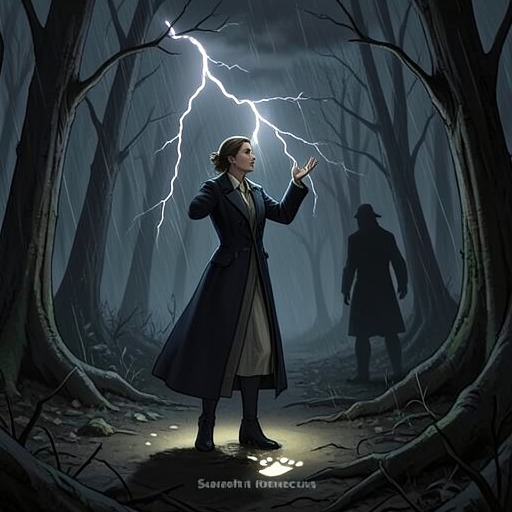
The magical hourglass prison is created during the confrontation at the castle after Celeste returns with Susie, Damien, Gabriel, Isabelle, and Darren to stop Samara. Celeste announces that Samara murdered Carmilla and Celeste’s mother, while Samara denies harming her own sister. Celeste then uses her supernatural power to open a portal showing the past, producing visual evidence that reaches beyond conflicting statements.
The magical demonstration forces a confession. Under the pressure of the revealed past, Samara admits that she killed Carmilla for power, killed Celeste’s mother, and sought to become the most powerful witch in the world. She also confesses that she manipulated Damien’s feelings by pretending to be Hannah in order to separate Celeste and Callum. The hourglass therefore follows a chain of exposure: hidden crimes become visible through magical replay, the replay produces an admission, and the admission gives Celeste the grounds for direct action.
Celeste is already weakened by the effort of displaying the past. She falls and must be supported by Isabelle and Damien, yet she retains enough energy to act when Samara attacks her and blames her for the situation. Celeste then traps Samara in the hourglass. The device is thus created not from an effortless display of power but at a moment when Celeste’s evidence-bearing ability and her physical exhaustion meet in the same confrontation.
Imprisonment and Transfer to the Dungeon
Once trapped, Samara beats against the hourglass and cries out to be released. Her protest echoes the captivity she imposed on Celeste, who had been held for days in the basement and tied up after Gabriel’s failed attempt to free her. The reversal is direct: the woman who used a hidden dungeon and coercive magic to control others becomes the visibly contained prisoner herself.
Celeste collapses after completing the spell, and Callum comes to her aid. Gabriel checks her pulse and says that she needs rest, while Callum carries her inside and places her on the couch. The immediate consequence is therefore divided between recovery and punishment: Celeste’s body pays the cost of the act, while Samara remains immobilized inside the magical object.
Vlad takes the hourglass down to the castle dungeons and places Samara in a cell. He explicitly connects the sentence to the suffering Samara inflicted on Celeste, telling her that she trapped his little girl there for days and that the dungeon will now be her home for all eternity. The device is consequently not the entire punishment but the mechanism that makes Samara’s transfer into formal imprisonment possible. Elise reinforces the household’s condemnation by calling Samara mean and declaring that she deserves the fate.
Narrative Significance
The magical hourglass prison resolves the story’s recurring struggle over proof. Earlier, Susie’s attack left bodily evidence on the victim’s neck, while Celeste’s accusation against Callum was initially dismissed because the circumstances made her appear responsible for Carmilla’s death. Callum’s later understanding changes only after Damien shows him a phone clip in which Susie confesses, revealing that Celeste had been innocent and that Callum had hurt her because he believed a false story. At the climax, the magical portal supplies a different but parallel form of verification by replaying the past and exposing Samara’s guilt.
The hourglass completes this progression from disputed signs to undeniable confinement. A wound can be misread, a visible stake can encourage a false accusation, and spoken denials can preserve deception; the hourglass, by contrast, makes the consequence of judgment physically undeniable. Its transparent, bounded form also contrasts with Samara’s earlier use of secrecy, disguise, and hidden captivity. What she concealed in the dungeon is now answered by an object whose punishment can be seen.
As a symbol, the hourglass joins time to accountability. Samara repeatedly postpones discovery while building power through murder, impersonation, and manipulation, but the device marks the point at which delay ends. The story does not leave her crimes suspended in uncertainty: the past is replayed, the confession is heard, the magical prison is formed, and the dungeon receives her. The object’s final meaning is therefore both practical and moral. It converts Celeste’s newly awakened gift into protection for the vulnerable and into a lasting limit on Samara’s ability to harm anyone else.