Vampire Castle
The Secret VampireVampire Castle is the elevated Gothic residence of the vampire royal family and one of the story’s decisive thresholds between ordinary human life and the hidden supernatural order. First presented as a place of old-fashioned decoration, crowns, royal blood, and concealed violence, it develops into a home, a school-party venue, a site of imprisonment, and finally the seat of Callum’s rule. Its rooms and dungeon repeatedly turn private family conflict into public political crisis.
Definition and Royal Setting
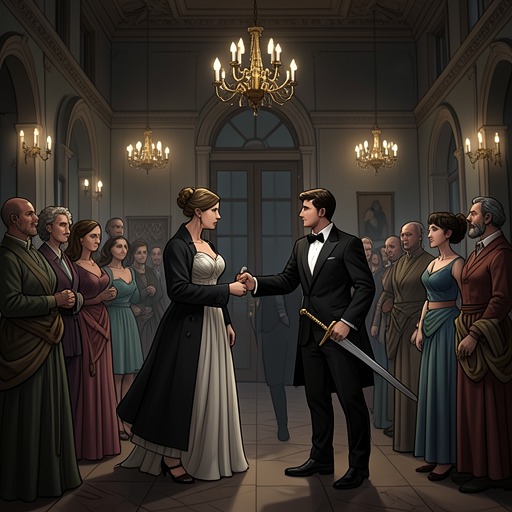
Vampire Castle is associated with Vlad, Carmilla, Callum, and Elise, whose family presents itself as a royal household while maintaining the appearance that protects vampires from human suspicion. When Callum first awakens there, he finds old-style decorations and discovers that his reflection is absent. Vlad identifies himself as the Vampire King and tells Callum that the dead young man will become their son and legacy. The castle therefore introduces both Callum’s supernatural identity and his involuntary adoption into the vampire dynasty.
The castle’s royal character is emphasized through crowns, servants, formal family roles, and the expectation that Callum will eventually inherit power. Its apparent grandeur is inseparable from secrecy: Vlad insists that Callum attend college and remain around humans so that no one suspects the family’s true nature. The castle is thus not merely a residence. It is the institutional center of a hidden kingdom, where domestic customs and political concealment operate together.
Family Origins and Hidden Violence
The castle is the setting for Callum’s transformation into the royal family’s heir and for Carmilla’s death and return to vampiric life. During the birth of a daughter, Carmilla dies, and Vlad bites her neck after she opens her eyes, while the human doctor recognizes that the household consists of vampires and attempts to flee. Vlad orders Callum to stop her, and Callum helps corner her before Vlad drains her. The scene establishes the castle as a place where affection, succession, and violence are fused: the arrival of a princess coincides with the destruction of a human witness and the irreversible consolidation of Callum’s new identity.
The same family structure later becomes a source of conflict. Vlad’s feeding on humans clashes with Callum’s growing attachment to Celeste and concern for her family. The castle shelters the royal family, but it cannot contain the ethical consequences of their predation. Arguments between Vlad and Callum inside the household eventually lead to their duel and to Callum’s demand that Vlad leave humans alone if Callum wins. The castle therefore functions as the pressure chamber in which inherited vampiric authority confronts a newer idea of protection and restraint.
Parties, Intrusion, and the Human World
The castle becomes temporarily accessible to outsiders during the Halloween party. Callum invites the college students to his place, described as a castle high on the hill, and the gathering turns the secluded royal residence into a social space shared with humans. Carmilla watches Celeste and seeks a sample of her DNA, using the blackout at the party to take a hair sample without Celeste’s knowledge. The festive setting consequently carries an investigative and predatory undercurrent: beneath the costumes and dancing, the castle remains a site where the vampire family studies and targets a human guest.
The party also exposes the castle’s danger through Gabriel’s assault on Celeste. Gabriel dances with her, leads her into an empty room, and tries to kiss her after closing the door. The castle’s hospitality therefore proves conditional and unstable. Its celebratory surface briefly disguises the same enclosed, threatening intimacy that defines the household’s darker spaces, while Callum’s suspicion of Gabriel marks the beginning of another conflict within the castle’s orbit.
Dungeons, Captivity, and the Architecture of Secrecy
The dungeon gives the castle its most explicit spatial expression of concealed history. When Callum suspects that Samara is hiding something, he brings Darren to the castle and leads him toward the locked lower rooms, declaring that they need to discover what she has hidden there. Darren eventually opens a locked room and finds Elise, a young girl crying and asking whether he has come to hurt her. Elise embraces Callum and explains that she has been imprisoned, transforming the dungeon from a vague site of suspicion into evidence of Samara’s abuse and betrayal.
The dungeon also becomes the endpoint of Samara’s punishment. After Celeste exposes Samara’s confession through a portal showing the past, Celeste traps her inside a magical hourglass. Vlad carries the hourglass down to the dungeons and places Samara in a cell, declaring that the dungeon will be her home for eternity because she imprisoned Elise there for days. The same underground space that concealed a victim is converted into a legally and symbolically sanctioned prison for the perpetrator.
Samara’s captivity of Celeste elsewhere in the castle’s supernatural network reinforces this pattern of hidden confinement. Gabriel finds Celeste weak and tied up in a basement, feeds her a peanut-butter-and-jelly sandwich and juice, and tries to help her escape, but Samara’s spell forces them back and threatens Gabriel with death. The castle’s enclosed architecture thus divides its inhabitants according to power: the basement and dungeon hold secrets, victims, and coercion, while the upper rooms host seduction, celebration, and royal display.
Transformation, Liberation, and Succession
The castle is also where supernatural control is finally broken. Samara uses a potion and a spell to manipulate Vlad, including transforming into Carmilla’s form and persuading him to avenge Carmilla by killing Celeste. Vlad becomes trapped in the spell’s emotional imitation of his dead wife and pursues Celeste under its influence. When Celeste later confronts him, she uses her supernatural power to break the spell. Vlad awakens confused, recognizes that Samara is not Carmilla, and rejects Samara’s claim that they are to be married, affirming his loyalty to Carmilla even after her death.
Celeste’s intervention changes the meaning of the castle. She is no longer simply the human guest endangered within a vampire stronghold; her power makes her an active force capable of restoring Vlad’s agency and exposing the family’s buried crime. Her portal reveals that Samara killed Carmilla, killed Celeste’s mother, and manipulated Damien’s feelings by pretending to be Hannah in order to separate Celeste and Callum. The castle’s secrets are not discovered through ordinary investigation alone but through Celeste’s ability to make suppressed history visible.
After Samara is imprisoned and Celeste recovers, the castle’s political future becomes more stable. Callum proposes to Celeste at the college sports field, and three years later he has taken over from Vlad as Vampire King. The castle consequently shifts from the site of Callum’s forced adoption and moral crisis to the seat of his legitimate succession. The transition suggests that inherited power has not vanished, but it has passed to a ruler whose central bond is with Celeste and whose story has been shaped by protection, accountability, and the possibility of coexistence.
Narrative Significance
Vampire Castle concentrates the book’s Gothic contrasts: beauty and danger, family and predation, royal ceremony and secret imprisonment, romantic promise and coercive control. Its height separates the vampire household from the human town, while its locked rooms and underground cells turn that separation inward, preserving the crimes that the family cannot openly acknowledge. Yet the castle is not permanently defined by horror. It also accommodates reunion, rescue, the exposure of truth, and the transfer of authority from Vlad to Callum.
As the story closes, the castle stands behind a new domestic order. Callum rules as Vampire King, while his marriage to Celeste joins the human and vampire worlds through family rather than secrecy alone. The location’s decisive significance lies in this transformation: what began as an alien royal enclosure that erased Callum’s former life becomes the center of a future shaped by recovered memory, defeated manipulation, and a more intimate form of coexistence.