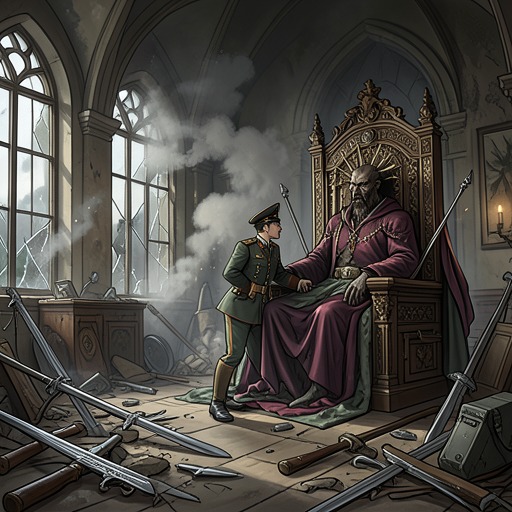
Vampire–Human Peace Pact
The Secret VampireThe Vampire–Human Peace Pact is Callum’s bid to turn a devastating conflict into a commitment to coexistence. Its decisive moment comes not on the battlefield but after Callum challenges Vlad: he insists that a promise is insufficient without the King’s signature, making the proposed peace a written obligation rather than a mere assurance.
War and the prospect of peace
The conflict begins when Cape Town’s human Mayor declares war on the Vampires. The Vampires are prepared for the attack, and their strength, speed, and stealth make the humans’ early assaults costly. As the fighting continues, the humans seek a secret weapon, using garlic bombs and holy water; the Vampires evade these weapons where they can.
The balance shifts when the humans deploy a giant garlic bomb aimed at the sky alongside holy water. Many Vampires are killed or forced to retreat, and the humans begin to believe they are close to victory. The weather over Cape Town changes from stormy rain to sunshine, accompanying their expectation that the Vampire King will soon have to accept peace. The proposed terms include a life in peace under the rule of No hunting and no biting. The battlefield turn therefore creates an opening for negotiation, though the account does not establish that the human campaign itself ends with a signed agreement.
Callum challenges the King
The pact takes shape later in a duel between Callum and Vlad. Carmilla tries to stop the confrontation, but Vlad insists on his authority and strength as King, while Callum declares that he intends to win. They fight using their powers. Vlad initially has the advantage; Callum then recalls Celeste and Susie and manages to drive him into a corner.
Seeing Vlad weakened and out of breath, Callum offers him a way to end the confrontation without continuing the contest. Vlad yields and promises that he will not feed on humans. Callum, however, refuses to treat a spoken promise as enough. He produces a contract and asks for Vlad’s signature, insisting that humans and Vampires can coexist peacefully. The demand turns the duel’s outcome into a concrete political act: Vlad’s submission is recorded in writing, rather than left as a private exchange between father and son.
Terms and royal authority
Vlad questions whether Callum is siding with humans, making clear that the proposed agreement challenges the boundary between the Vampire court and its former enemies. Callum answers with coexistence as the aim. Vlad signs the contract, then dismisses the prospect with apparent reluctance about losing the old order’s freedoms. The scene establishes a commitment by the Vampire King, but it does not show a human representative signing the same document or set out an enforcement mechanism. Its demonstrated terms center on Vlad’s promise not to feed on humans; the earlier wartime expectation of No hunting and no biting gives that commitment a broader context without proving that every condition was formally included in the contract.
Callum’s own history sharpens the significance of his argument. When he later defends his place in the family, he reminds Carmilla that he lived as a human before becoming a Vampire. That history does not make him a human negotiator, but it gives his appeal to coexistence a personal dimension: he belongs to the royal family while remembering the human life from which he came.
Meaning and limits of the pact
The pact’s central reversal is that military victory does not alone settle the conflict. Humans may appear to have gained the upper hand through their weapons, but the decisive agreement is secured through Callum’s challenge to royal authority and his insistence on a signature. The resulting document makes peace imaginable as a rule governing conduct, rather than simply a pause in violence.
The story later places this commitment alongside other forms of power and constraint. Isabelle gives Celeste a wooden stake and explains that a Vampire can be killed by a stake through the heart, showing that the danger of renewed conflict remains legible even after coexistence has been proposed. In a later confrontation, Celeste traps Samara in a magical hourglass and Vlad imprisons her for her crimes. Those events do not show the pact being enforced, but they underline the difference between a written promise, royal authority, and magical restraint. The pact matters as Callum’s effort to make peace binding; the evidence leaves open how fully that effort changes relations between the two communities.