Vlad and Callum's Duel
The Secret VampireVlad and Callum's Duel is the decisive confrontation in which Callum challenges Vlad's authority and forces the Vampire king to renounce feeding on humans. What begins as a quarrel over Susie's attack becomes a contest over the moral and political future of Vampires and humans, ending not with Vlad's death but with a signed contract affirming that humans and Vampires can coexist peacefully.
Causes and Stakes
The duel follows the discovery that Vlad had been feeding on Celeste's sister, Susie, leaving her critically injured in the Hospital. While Celeste waits in anguish for news and begins to suspect that Callum knows more about the attack, Vlad returns to the Vampire Castle angry that his son has demanded an end to feeding on humans. Vlad treats the practice as part of the established order, declaring that many humans have already been killed. Callum, by contrast, refuses to separate his feelings for Celeste from the violence inflicted on her family: he directly accuses Vlad of feeding on Susie and turns the accusation into a challenge.
The terms expose the duel's wider stakes. Callum proposes that, if he wins, Vlad must leave humans alone forever. Vlad answers by making Celeste the price of his own victory, saying that he will feed on her if Callum loses. The threat makes the conflict personal as well as ideological. Callum clenches his fist and resolves not to let Vlad harm Celeste, while Celeste, still at the Hospital and having finished her eighth cup of coffee, wonders whether Callum is truly a blood-sucking monster. The same contest therefore operates on two levels: Callum fights to protect a human he loves, and he fights to make that protection a rule rather than a single act of defiance.
Course of the Duel
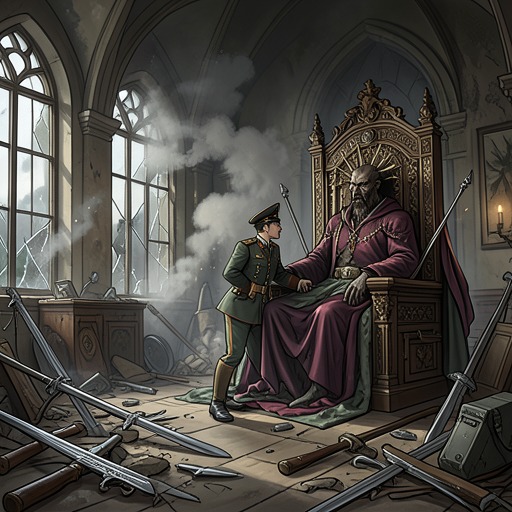
At the Vampire Castle, Vlad and Callum prepare to fight while Carmilla attempts to stop what she calls their nonsense. Vlad refuses to withdraw, invoking his status as king and as the most powerful Vampire. Callum answers that Vlad's time is over and insists that he will win. Their opposed claims make the combat a struggle between inherited sovereignty and an emerging alternative to it.
The fight proceeds through the use of their powers, with both Vampires' eyes turning red as the confrontation begins. Vlad initially has the advantage, and Carmilla watches from a corner as he presses Callum. The balance changes when Callum thinks of Celeste and remembers Susie. Those personal images give his resistance a concrete purpose: he is not fighting for prestige alone, but against the harm done to someone connected to the person he is trying to protect. He manages to drive Vlad into a corner, reversing the father's early dominance.
When Vlad becomes weak and out of breath, he concedes. He tells Callum that the boy has won and promises not to feed on humans. Callum refuses to treat a spoken promise as sufficient. He produces a contract and demands Vlad's signature, making the result durable and publicly enforceable within their relationship. Vlad questions whether Callum has taken the side of humans, but Callum states that humans and Vampires can coexist peacefully. Vlad rolls his eyes, signs the document, and dismisses the settlement as no fun before returning to his coffin with Carmilla.
Consequences and Reversal
The duel changes the value at stake from threatened human life to a negotiated possibility of coexistence. At its beginning, Celeste's sister lies critically ill, Vlad claims the right to continue feeding, and Celeste may herself become the next victim. At its end, Vlad has been physically defeated, his intended attack on Celeste has been blocked, and his promise has been fixed in writing. The signed contract is therefore more consequential than the contest's spectacle: it converts Callum's individual protective impulse into a formal restriction on Vlad's conduct.
The victory also produces a sharp contrast between the two generations. Vlad's authority rests on power, appetite, and the assumption that humans are legitimate prey. Callum uses power against him but refuses to let power be the final language of the settlement. He requires an agreement and names peaceful coexistence as the principle behind it. The son defeats the king without taking the throne in the scene; instead, he makes the king acknowledge a limit.
The immediate aftermath confirms that the physical victory does not erase the emotional damage surrounding it. The next day, Callum is sitting beside Susie in the Hospital when she wakes. She has a bandage around her neck and does not remember what happened, while Celeste gives Callum a cold look and ignores his greeting. Callum wonders why Celeste is acting so frostily, unaware that her dream of him as the monster who attacked Susie has intensified her suspicion. Thus the duel secures Vlad's signature but cannot immediately restore Celeste's trust or resolve the mystery surrounding Susie's injury.
Narrative Significance
Vlad and Callum's Duel is a father–son conflict, a succession struggle, and an ethical confrontation compressed into one scene. Callum's challenge arises from a direct encounter with the consequences of Vampire violence, and the memories that strengthen him during the fight connect intimate affection with political change. His victory suggests that the existing order can be challenged from within the Vampire royal family, but the contract also shows how fragile that change is: Vlad signs only after losing and still treats the agreement with disdain.
The event's most important reversal is not simply that Callum overcomes Vlad. It is that the duel changes what victory means. Callum could have pursued domination or revenge, yet he uses the defeated father's vulnerability to secure a prohibition against feeding on humans. The contract gives the confrontation institutional shape, while the continuing suspicion between Callum and Celeste shows that peace between communities does not automatically heal the wounds or misunderstandings created by violence. The duel therefore serves as both a breakthrough toward human–Vampire coexistence and a warning that a signed promise cannot by itself settle questions of trust, guilt, and identity.