Vlad and Samara's Relationship
The Secret VampireVlad and Samara’s relationship is a story of exploited grief rather than reciprocal love: after Carmilla’s death, Samara turns the image of Vlad’s lost wife into a means of controlling him. Her impersonation, spells, and staged intimacy redirect his actions against Celeste and toward Samara’s pursuit of power. The relationship ends with Vlad’s loyalty to Carmilla reaffirmed and Samara imprisoned for her crimes.
Family Connection and Grief
Vlad is introduced as the Vampire King and Carmilla’s husband. Their bond is established in a moment of family crisis: when Carmilla dies after giving birth, Vlad mourns her, bites her in an attempt to restore her, and welcomes their daughter and Callum as their children. This makes Carmilla’s absence central to the later relationship between Vlad and Samara. Samara is Carmilla’s sister, but the evidence does not present the two women as rivals for Vlad through an authentic courtship. Instead, Samara exploits the intimacy of a family connection and Vlad’s attachment to his dead wife.
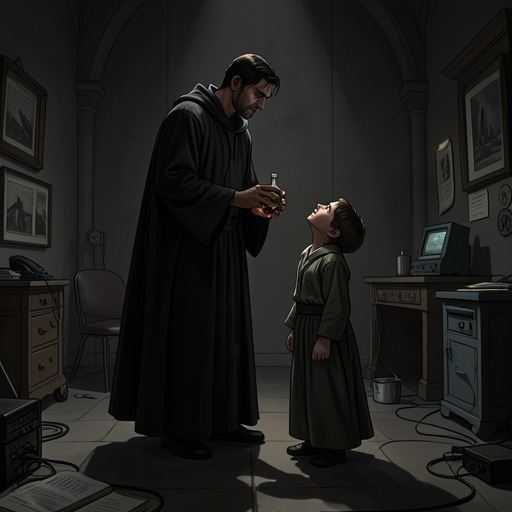
The first decisive breach comes in the Forest. Samara drinks a potion and takes Carmilla’s form while Vlad is there, vulnerable to the sight of the woman he believes he has lost. She traps him with a silver chain around a tree, and its contact causes him agony. In Carmilla’s likeness, Samara accuses him of failing to avenge her and fulfill her wish, then kisses him and urges him to kill Celeste. Vlad answers as though speaking to his beloved and, after Samara leaves the disguise, his eyes turn purple. He declares that he will avenge Carmilla. The scene makes the mechanism of their relationship plain: Samara borrows Carmilla’s identity to make Vlad’s grief serve her command.
Coercion Disguised as Intimacy
Samara later extends the deception beyond the forest. When Vlad wakes confused, she tells him that they made love the previous night. He rejects the claim, insisting that he would never do that to Carmilla. The account gives no confirmation that the encounter occurred; it presents Samara’s statement as a lie that unsettles Vlad. She then threatens to kill herself, and when he stops her, gives him a drink that places him under her spell. Under its influence, Vlad promises to make her his wife. Samara embraces him and privately turns her attention to her next attack on Callum. The proposed marriage is therefore not evidence of a freely chosen bond: it follows the potion and serves Samara’s plan.
Her performance also takes on the outward shape of a household relationship. At the castle, Samara prepares special drinks for Vlad and Callum, while Vlad tells Callum not to be rude and says Samara is allowed to be there. Callum questions her presence and suspects the drink she offers him; rather than take it, he says he will go upstairs and rest. Samara privately worries that the potion will fail unless he drinks it. The contrast is revealing: Vlad accepts Samara’s place in the household under her influence, while Callum’s suspicion interrupts her attempt to use the staged welcome to harm him.
Recognition and Consequences
The deception is finally broken when Celeste confronts Samara and uses her power to reveal the past. Vlad, now freed from Samara’s spell, asks what is happening and rejects Samara’s claim that it is their wedding day. He declares that he remains loyal to Carmilla, even though she is no longer alive. That answer sharply reverses the false marital future Samara had imposed on him: his attachment to Carmilla survives her impersonation and the potion-induced promise.
The revelation establishes the scale of Samara’s betrayal. She confesses that she killed Carmilla for power and admits to killing Celeste’s mother as well as manipulating Damien’s feelings. Vlad responds with anger, condemning her for taking the love of his life for power. When Samara attacks Celeste, Celeste traps her in an enchanted hourglass. Vlad carries it to the dungeons and locks Samara in a cell, declaring that the dungeon will be her home for eternity. The relationship’s final form is not marriage but punishment: the man whose mourning Samara repeatedly used becomes the one who enforces her confinement.
Meaning of the Relationship
Vlad and Samara’s connection is structured around substitution. Samara first makes herself appear to be Carmilla, then invents a sexual encounter, and finally claims the status of Vlad’s bride; each false intimacy attempts to replace his loyalty with obedience. Yet the ending draws a firm line between appearance and allegiance. Once the spell is broken, Vlad remembers Carmilla as his wife and refuses Samara. His relationship with Samara thus exposes both the vulnerability created by grief and the limits of magical control: she can redirect his actions for a time, but cannot make the marriage she claims to have won real.