1950s
The Secret of SecretsThe 1950s is not merely a date in the world of the novel but a chosen cultural frame for Chantel Fifty, the diner where Nyia Crosland works. Its period styling gives the restaurant a recognizable identity while placing contemporary struggles—single motherhood, service labor, grief, and an eight-year separation—inside an atmosphere associated with comfort, sociability, and continuity.
Definition and Setting
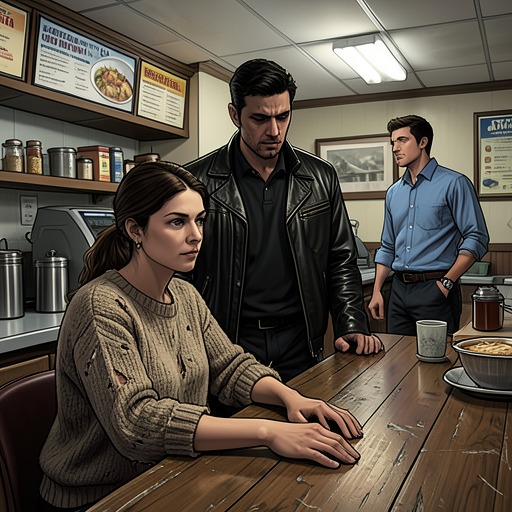
The period appears most directly in the description of Chantel Fifty as a 1950s-style diner. Nyia Crosland has worked there since Chantel Daniels opened it four years earlier, and the restaurant’s identity is inseparable from its period design, its food, and its steady flow of customers. The setting is surrounded by high rises and large businesses, yet its visual language recalls an earlier American diner culture, allowing executives, secretaries, office employees, visitors from out of town, and night owls to occupy the same public space.
The period styling also shapes Nyia Crosland’s workday. She serves customers on skates, wears a diner uniform and hat, and moves between the bar, the dining floor, the kitchen, and the employees’ lounge. The atmosphere is therefore not a museum-like reconstruction detached from labor. Its nostalgic surface depends on constant bodily effort: taking orders, cleaning tables, replacing condiments and napkins, and enduring the rushes that fill the restaurant from late lunch through dinner and sometimes leave the staff preparing for breakfast service.
The Diner as a Working Community
Chantel Fifty’s 1950s identity makes it a social institution as much as a workplace. Nyia Crosland values the bustle, the people she works with, the customers from different walks of life, the food, and the money. The restaurant’s appeal is practical rather than purely ornamental: it provides her with a steady job she loves and, through additional shifts, the income needed to support Trey and pay for Korean-language tutoring for herself and Trey.
The diner’s community is sustained by shared labor. Chantel Daniels does not remain only an owner in an office; she comes onto the floor to clean tables and take orders and sometimes works in the kitchen with Cedric. During the lunch rush, the trickle of customers can become a deluge, leaving no time for rest and sometimes overwhelming the staff despite everything they do. At closing, the remaining patrons are often travelers or people not yet ready to go home, suggesting that the diner functions as a temporary refuge as well as a place to eat.
Nyia Crosland’s role within this community expands beyond waiting tables. As assistant manager, she accepts extra responsibility even when exhausted, while still checking on her father and Trey before agreeing to do more work. Her service is both physical and emotional: she maintains perfect balance on her skates, greets customers, keeps the atmosphere moving, and absorbs the pressures of a crowded business without treating her difficult circumstances as a reason to withdraw. The period setting thus frames forms of labor that are easy to romanticize but costly to perform.
Contrast with Nyia’s Life History
The 1950s-style environment contrasts with the chronology of Nyia Crosland’s life. She met Daeshim at North Carolina Central University while studying nursing and helping her father through her mother’s chemotherapy. Daeshim was studying forensic science, and their relationship became serious enough that they discussed marriage. After her mother’s death, he supported Nyia Crosland and her family through hospice, funeral arrangements, and the practical aftermath of bereavement. His sudden decision to cut ties and transfer schools then left Nyia devastated.
The eight-year separation gives the nostalgic diner a second temporal function. Chantel Fifty represents stability while Nyia’s personal history has been marked by interruption: Daeshim disappeared, changed all his telephone numbers, and became unreachable on social media; Nyia discovered that she was pregnant only after he had left and raised Trey without his knowledge. She preserved Daeshim’s place in Trey’s identity by teaching him what she knew about his father and about his Korean heritage, even hiring a tutor to teach them both Korean.
This contrast between an old-fashioned public setting and a disrupted private life makes the diner a place where time can seem both held still and constantly passing. Nyia Crosland has remained in the same beloved workplace for four years, while Trey has grown into an eight-year-old child and Daeshim has lived through relationships that never displaced Nyia from his emotional memory. The setting’s apparent permanence throws the lost years into sharper relief.
Narrative and Thematic Significance
Chantel Fifty’s period style helps transform the diner into a meeting point between memory and the present. Its familiar visual vocabulary offers a stable stage for customers and workers, but the people inside it carry histories that cannot be reduced to nostalgia. Nyia’s ordinary routines—shopping before a shift, changing into her uniform, locking the back door, serving the rush, and returning to the employees’ room—give the setting a material rhythm against which emotional upheaval becomes visible.
The setting also becomes connected to recognition. Jamal photographs workers at the diner and submits the images to a magazine devoted to coffee shops, restaurants, and diners around the state. A published image of Nyia Crosland and a feature on Chantel Fifty help create the public trace through which Daeshim can eventually find her again. The diner’s carefully maintained 1950s image therefore moves beyond decoration: it becomes part of the chain that converts Nyia’s private, settled life into something visible to the man who lost contact with her.
By the epilogue, Daeshim is transferring permanently to the police station in Durham and moving his belongings back over the course of another month. He is introduced to Nyia’s father, while Ricky Graham and Tish are brought into the renewed family circle, and Chantel Daniels continues to make room for Trey when necessary. Against this future-oriented rebuilding, the 1950s-style diner remains a symbol of the continuity that Nyia Crosland maintained during the years of absence: a workplace, a community, and eventually the setting through which a broken history can become legible again.