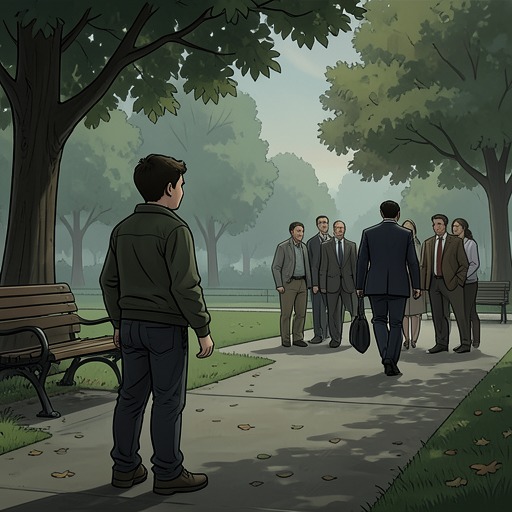
Absent fatherhood
The Secret of SecretsAbsent fatherhood in the novel is not simply the physical absence of a man from a household; it is the prolonged failure of knowledge, responsibility, and participation that separates Daeshim from Trey before either father or son understands the relationship. Daeshim leaves Nyia without a goodbye, unaware that she is pregnant, while Nyia carries the consequences alone. His absence becomes an emotional and practical condition shaping Trey’s identity, Nyia’s motherhood, and Daeshim’s later remorse, until reunion transforms paternal absence into an unfinished obligation that can finally be acted upon.
Origins in Separation and Silence
Nyia’s absent fatherhood begins with the collapse of her relationship with Daeshim. The two met at North Carolina Central University while Nyia was preparing for nursing and Daeshim was studying forensic science. Their relationship became intense and intimate, and they discussed marriage, but Daeshim remained reluctant to bring her before his traditional Korean family. When his parents learned that Nyia was Black and that he wanted to marry her, they threatened to withdraw the tuition support on which his education depended unless he ended the relationship. Daeshim transferred schools, changed all his phone numbers, and disappeared from social media. What he called a break lasted eight years and left Nyia with no way to tell him that she was carrying his child.
The absence is therefore caused by more than distance. It is produced by family pressure, economic dependence, racial prejudice, and Daeshim’s inability to oppose his parents when he was young. He later recognizes that he chose their demands over Nyia, even though he still loved what they had built together. His professional success as a forensic science technician does not erase the fact that he abandoned the person he considered incomparable. The career he pursued and the family he lost become linked in his memory: his parents’ financial control helped shape his future, but it also cost him the beginning of his son’s life.
Nyia’s Work of Filling the Void
Nyia becomes Trey’s sole parent without the information or support that might have allowed Daeshim to participate. She had loved Daeshim and would have told him about the pregnancy if she had known about it herself, but his disappearance made the secret permanent. She spends the years after their separation working, grieving, and raising Trey while carrying an attachment to a man who cannot answer her questions. She even tries a dating application, but no one compares with Daeshim, leaving the emotional space of the absent father connected to the absent lover.
Her single motherhood is demanding, yet the novel does not present Trey as defined only by deprivation. Nyia makes deliberate efforts to preserve his paternal and cultural inheritance. She teaches him everything she remembers about Daeshim and about his Korean heritage, hires a tutor so that both of them can learn Korean, and refuses to let the missing father become an unspoken blank in Trey’s identity. Trey has Daeshim’s mahogany-brown eyes and black hair, though his curls differ from Daeshim’s straight hair; these physical resemblances make the absent relationship visible even before Daeshim sees them.
Nyia’s responsibility also extends beyond emotional explanation. She works additional shifts at Chantel Fifty to pay for the language tutoring, accepts an assistant manager position when Chantel Daniels offers it, and remains available to lock up the diner when extra work is needed. Her father, Julius Crosland, helps watch Trey, while Chantel Daniels allows Nyia to bring him to work when necessary. The support of Nyia’s father and workplace prevents single motherhood from becoming complete isolation, but it also clarifies how much practical care has been redistributed because Daeshim is missing.
Trey’s Understanding of His Father
Trey experiences paternal absence as a question of belonging rather than as an abstract family history. When another boy talks about his father, Trey fights him. He later explains that the conflict began because the boy was talking about his daddy. Nyia tells him that other people will talk regardless of whether they know him, but Trey’s reaction shows that the missing father is already a sensitive part of his social identity.
The emotional burden moves in both directions. Trey tells Nyia that he only wants her to be happy, a statement that nearly breaks her heart because she believes a child should not have to carry adult concerns. She reassures him that he makes her happy, but his words reveal how closely he watches her loneliness. Trey is not merely waiting for an unknown parent; he is trying to protect the parent who stayed. Nyia’s effort to tell him about Daeshim gives him a positive image of his father, while her own unresolved grief ensures that paternal absence remains present in the household even when the man himself is not.
Recognition and the Cost of Lost Time
The absent fatherhood changes abruptly when Daeshim returns to Chantel Fifty. He recognizes Nyia immediately, but he does not expect the brown-eyed, black-curled child who wraps his arms around Daeshim’s legs and calls him daddy. The scene makes the concealed family visible in an instant: Trey’s spontaneous recognition of the role contrasts with Daeshim’s stunned discovery that he has an eight-year-old son. Nyia nearly passes out at the sight of him, plates crash to the floor, and the Supremes’ “Baby Love” plays as the room seems to fall silent around the reunion.
Daeshim’s first response is not defensiveness but shock and grief. When Nyia tells him Trey is eight, he realizes that he has missed the pregnancy, infancy, and important early years of his child’s life. He blames both his parents and himself, acknowledging that the circumstances forced Nyia through pregnancy alone and that his own cowardice made the loss possible. His remorse is physical and public: he cries, strikes his chest, and confronts the years that cannot be recovered. The novel treats absent fatherhood as a debt that apology can name but cannot simply cancel.
Nyia, however, explains that Trey was happy and that she ensured he knew Daeshim, Daeshim’s culture, and the language. Her account refuses the idea that paternal absence automatically determines a child’s emotional condition. She cannot restore the years Daeshim missed, but she can show that Trey was not raised without a paternal story. In doing so, she also protects Daeshim from believing that his absence erased him completely, even while making clear that she bore the work he failed to perform.
From Missing Father to Practicing Fatherhood
Daeshim’s fatherhood begins through action rather than biology alone. After learning the truth, he embraces Trey and tells him that he loves him, realizing that the feeling is immediate and absolute even though the relationship is new. Trey answers that he loves his father too. The exchange creates an emotional bond, but the surrounding circumstances keep its fragility in view: only hours earlier Daeshim did not know Trey existed, and now he cannot imagine life without him or Nyia.
The handmade gnome made by Trey becomes a concrete sign of this new relationship. Trey presents it to Daeshim with “Appa. Dad.” written across the front, and Daeshim drops to one knee to hold his son. The object gives paternal recognition a form that can be carried and displayed. It is also an answer to the years of absence: Trey offers Daeshim a place in his world, while Daeshim accepts the role with an embrace rather than merely claiming it through blood.
Daeshim then begins changing the family structure that once governed his choices. He takes photographs and videos of the family occasion and announces that he will send them to his parents so they can see what their past decisions caused him to miss. His anger marks a decisive reversal from the young man who surrendered the relationship to preserve tuition support. He now states that if his parents refuse to accept the family, the loss will be theirs. That defiance does not undo the past, but it establishes a new boundary around Nyia and Trey.
The epilogue gives this transformation practical form. Daeshim moves permanently from Charlotte to Durham after arranging the paperwork for a transfer to the police station and relocating his belongings. He joins Nyia in the everyday labor of caring for Trey, reducing her dependence on Julius Crosland and Chantel Daniels for babysitting. His parents eventually visit and meet their grandson after he sends them the news. When his father questions whether Trey is truly his, Daeshim answers with certainty that Trey is his. The response confirms that paternal identity is no longer something he is willing to negotiate away.
Narrative Significance
Absent fatherhood organizes the novel’s contrast between biological connection and lived responsibility. Daeshim is Trey’s father from the beginning, but he does not become a father in the social and emotional sense until he learns the truth and commits himself to presence. Nyia, meanwhile, has performed father-inclusive parenting alone: she preserves Trey’s connection to Daeshim, teaches him about Korean culture, and maintains a stable life with help from Julius Crosland and the Chantel Fifty community.
The concept also exposes the difference between explanation and exoneration. Daeshim’s parents imposed the immediate pressure, but Daeshim himself admits that their threats do not excuse his decision. His later reunion with Nyia is therefore a second-chance romance, but it is also an ethical test. He must move from regret to participation, from secret shame to open acknowledgment, and from dependence on his parents to loyalty to the family he once abandoned. By the ending, the absence has not been erased; eight lost years remain part of Trey’s history. What changes is that Daeshim finally stands inside that history, accepting both the love he has recovered and the responsibility created by the time he missed.