Ricky Graham
The Secret of SecretsRicky Graham is Daeshim’s lab partner, investigative collaborator, and closest friend in the Charlotte-Mecklenburg forensic-science unit. He is important not simply because he shares the technical work of a murder investigation, but because he recognizes the private grief Daeshim tries to conceal and refuses to let professional routine become another excuse for emotional paralysis. Ricky’s role joins the novel’s two developing lines: the methodical reconstruction of a dead man’s final movements and Daeshim’s attempt to recover the life he lost with Nyia Crosland.
Identity and Professional Role
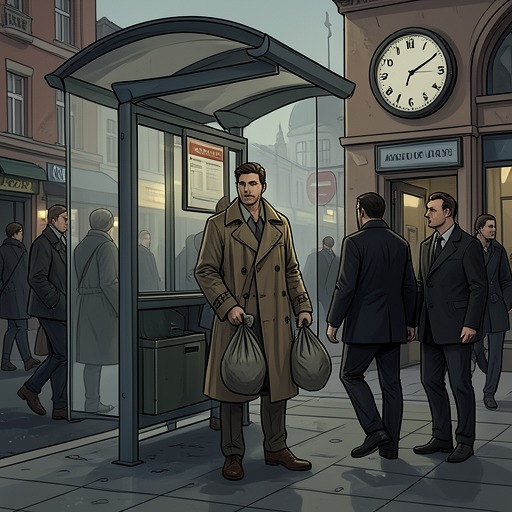
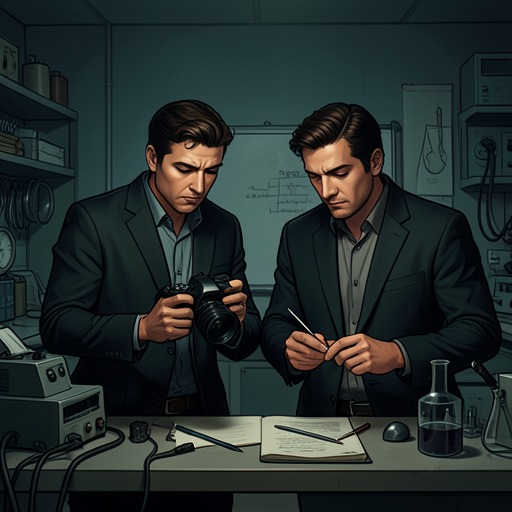
Ricky works alongside Daeshim as a forensic science technician. Their duties include photographing crime scenes, sketching them, collecting physical evidence, and analyzing samples in the laboratory for information that can help detectives solve cases. At the bus terminal, Ricky arrives with Daeshim, prepares the camera, crosses the police tape with him, and participates in the processing of the body. Their partnership is therefore established through coordinated fieldwork rather than abstract friendship: Ricky documents what Daeshim collects, and both men return to the laboratory to interpret the evidence together.
Ricky’s conduct shows that he is comfortable moving between the scene and the lab. He helps gather and document egg casings, beetles, and maggots taken from the corpse, evidence that will be examined by an entomologist to estimate the time of death. Later, he returns to the morgue to inspect the victim and clothing again, finding grasses, dirt, and straw covering the body. That additional observation gives the investigation a new direction. Ricky’s work suggests that the body may have been moved, and his discovery turns scattered material into a possible path toward the original murder site.
Investigation and Forensic Reasoning
Ricky is not merely an assistant who records Daeshim’s conclusions. He actively revisits the evidence and introduces the crucial relocation hypothesis. When he lays out the bags of grasses and soil, Daeshim asks whether the victim was killed elsewhere and transported to the terminal. Ricky confirms that possibility, prompting the team to search for the place where the death actually occurred. Their analysis leads them to a public park surrounded by trees, where they canvas the area for signs of struggle or blood.
The investigation’s procedural chain depends on the collaboration between them. Ricky’s samples are examined alongside notes and photographs, while Daeshim subjects the soil to X-Ray Diffraction and scanning electron microscopy to verify the initial findings. The tests may take most of the day or several days, so the men work through the evidence carefully rather than treating the first interpretation as conclusive. Ricky’s contribution is both material and interpretive: he notices what the body carries from another environment, preserves it in evidence bags, and gives Daeshim a reason to test whether the scene at the terminal was secondary.
Their work also establishes the limits of Ricky’s personal influence. He is willing to remain with the investigation when the search in the forest produces no immediate answer, and he understands that the case may become a homicide if the body was moved. Yet he does not allow the seriousness of the case to erase Daeshim’s separate crisis. His professional steadiness creates the conditions under which Daeshim can make a personal decision without abandoning the investigation altogether.
Friendship and Emotional Perception
Ricky sees through Daeshim’s attempts to avoid discussing Nyia. At the laboratory, he asks Daeshim the woman’s name after noticing his distraction. Daeshim pretends not to understand what Ricky is talking about and tries to bury himself in the photographs, but Ricky’s question exposes the pattern: Daeshim’s concentration is repeatedly interrupted by memories of Nyia, and his mood sinks whenever he thinks about her.
The friendship is marked by physical familiarity as well as verbal persistence. Ricky claps Daeshim on the back to pull him out of his self-pity and later stops him by the arm in the forest when the subject can no longer be avoided. He does not approach Daeshim’s pain delicately; instead, he presses him to say what is wrong. That bluntness is not cruelty. Ricky has known Daeshim for years, is treated as close to family, and recognizes that Daeshim has been living mechanically since the separation.
Ricky’s own relationship with Tish gives his advice additional weight. He invokes the long period during which he and Tish have known Daeshim and argues that Daeshim has been miserable for the entire eight years since leaving Nyia. He frames the search for Nyia not as reckless nostalgia but as something Daeshim should do for himself. In this way, Ricky becomes the friend who can name the cost of Daeshim’s avoidance more clearly than Daeshim can name it himself.
The Decision to Help Daeshim
Daeshim initially resists returning to Nyia after so many years. He cannot imagine what he would say to her and worries about leaving Ricky with an investigation full of unanswered questions. Ricky rejects both objections. He points out that the professor has returned the findings establishing the victim’s time of death and that the team now knows the body was transported from another location. The available evidence is sufficient to turn the matter over to the detectives.
Ricky therefore solves the practical problem as well as the emotional one. When Daeshim asks whether he will cover for him, Ricky immediately agrees and urges him to go. His decision does not erase the investigation; it marks the point at which the case has advanced far enough for another part of law enforcement to take responsibility. Ricky’s support allows Daeshim to leave without pretending that the murder case has been solved or that the friendship requires permanent self-denial.
Daeshim departs the forest for Durham almost immediately, hurrying back to his apartment and fumbling with the access card in his urgency. Ricky’s intervention is the direct cause of that movement. Without Ricky’s insistence, Daeshim would likely remain caught between professional duty and fear of confronting Nyia; with it, the investigation becomes the bridge that leads him toward her rather than another barrier keeping him away.
Narrative Function and Significance
Ricky functions as both investigative partner and emotional catalyst. In the forensic plot, he supplies a decisive clue by examining the body and clothes again and identifying environmental material that suggests relocation. In the romantic plot, he performs a parallel act of detection: he reads Daeshim’s evasions, identifies the concealed source of his distress, and directs him toward the truth of what he still wants.
His importance lies in the contrast between evidence that can be bagged, photographed, tested, and transferred and grief that Daeshim has tried to keep unexamined. Ricky is fluent in both forms of knowledge. He understands that soil, grasses, and insects can reconstruct a crime scene, but he also understands that Daeshim’s repeated silence is itself evidence of an unresolved attachment. By insisting on attention in both domains, Ricky helps move the story from stalled uncertainty toward action.
Ricky’s final contribution in the supplied arc is therefore an act of loyalty with concrete consequences. He protects the continuity of the homicide investigation while encouraging Daeshim to pursue Nyia Crosland, and he converts friendship from sympathetic observation into intervention. The result is a threshold moment for Daeshim: the case can proceed through established forensic channels, while Daeshim finally begins to leave behind eight years of regret.