The Bus Terminal Murder Investigation
The Secret of SecretsThe Bus Terminal Murder Investigation is the book’s principal forensic case sequence, presenting Daeshim’s scientific work through the discovery of a body abandoned behind an uptown bus terminal. What begins as a grim recovery becomes a question of relocation, cause, and evidentiary origin: the victim was not merely found dead at the terminal but appears to have been stabbed elsewhere and moved. The investigation gives Daeshim’s professional discipline a concrete form while placing death beside his private recollection of Nyia Crosland and the eight-year separation that still governs his emotional life.
Causes and Background
The case arrives during early spring in North Carolina, when pollen aggravates Daeshim’s allergies and severe thunderstorms threaten the area. The season carries an additional personal burden because it is the time of year when he left Nyia, whom he still regards as the best thing that ever happened to him. He reaches the bus terminal with his partner, Ricky Graham, in a state already divided between professional duty and painful memory. The emotional recurrence does not halt his work, but it makes the crime scene part of a wider pattern in which the past repeatedly intrudes on the present.
Daeshim approaches the investigation as a trained forensic science technician rather than as a homicide detective. He has worked for six years in the Charlotte-Mecklenburg area, taking crime-scene photographs, sketching scenes, collecting samples, and analyzing material in the laboratory so that detectives can solve cases. His interest in the field began in high school through crime shows and his strengths in chemistry and biology, then developed into a university specialization. North Carolina Central University was both the institution where he pursued forensic science and the place where he met Nyia, who was studying nursing while helping her father manage the financial pressure of her mother’s chemotherapy.
Discovery and Scene Processing
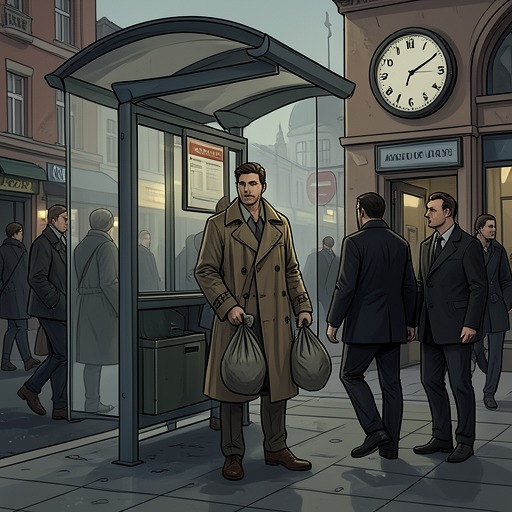
Parking is restricted because the lane has already been blocked for law enforcement and emergency personnel. Daeshim removes his coat, takes out the equipment, and joins Ricky at the secured area. The air is cold, but his light jacket is sufficient for the immediate work. After Ricky positions the camera around his neck, the two men move toward the body at the back of the terminal and begin processing the scene.
The corpse appears undisturbed and seems to have been present for at least a week, although the exact interval must be established through analysis. Insects are already emerging from the body, making decomposition evidence central to the examination. Daeshim squats beside the remains, lays down his equipment bag, and removes standard blue latex gloves, a plastic bag, and tweezers. He collects what appear to be egg casings, passes the bag to Ricky for documentation of its source and location, and then gathers beetles and maggots into separate bags.
The work follows a strict division of labor. Daeshim handles collection and scientific interpretation, while Ricky documents what was taken and where it was found. After two hours, they have gathered the necessary materials and photographed the body from every imaginable angle. Daeshim dislikes collecting evidence from dead bodies, but he values the possibility of determining what happened, bringing closure to a victim’s family, helping place dangerous people in prison, and sometimes exonerating the innocent.
Evidence and Scientific Inference
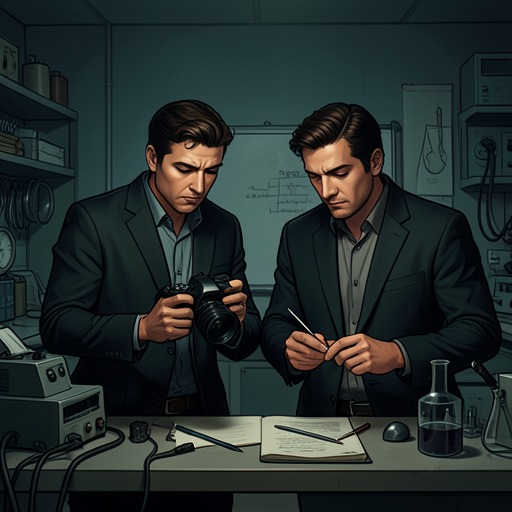
Back in the laboratory, Daeshim begins with notes and photographs before moving to trace evidence. The insect samples must be transferred to an entomologist, a professor at the local university who is called in for such occasions. The egg casings, beetles, and maggots are not incidental debris: their development can help establish the time of death. The sequence turns decomposition into a measurable record and shows how the case advances through cataloging, specialist consultation, and comparison rather than intuition alone.
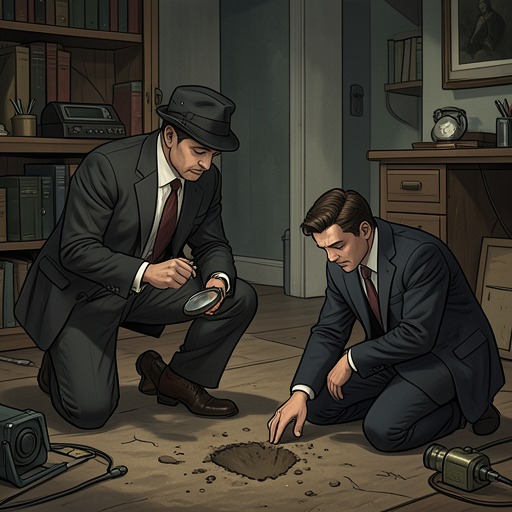
The investigation changes direction when Ricky returns from the morgue after requesting another look at the body and clothing. He has found grasses and dirt scattered across the body and brings the material to the laboratory in evidence bags. Daeshim examines the samples and asks whether the victim was killed somewhere else and moved to the terminal. The soil and vegetation therefore become the decisive bridge between the visible scene and a possible hidden one.
Daeshim prepares the soil for X-ray diffraction, or XRD, and plans to use scanning electron microscopy to verify the findings. If the tests confirm that the material does not belong to the terminal, the body’s location becomes a disposal site rather than the murder site, and the case can be treated as a possible homicide with another crime scene still to be identified. Because the tests may take most of a day or even several days, Daeshim works carefully through the notes and photographs to ensure that no additional clue has been overlooked.
The coroner’s report supplies the clearest statement of the immediate cause of death: the victim was stabbed from the womb to the neck and bled out. Combined with the soil and grass recovered from the body, that finding supports the conclusion that the victim was stabbed in one place and transported to another. Ricky reminds Daeshim that their task is not to determine why the killing occurred but to establish where the evidence leads and pass that information to the appropriate investigators. The case thus defines the limits of their authority as clearly as it demonstrates the reach of their science.
Consequences and Narrative Significance
The investigation converts an apparently contained discovery into a geographically expanded murder inquiry. The bus terminal is no longer sufficient as an explanation; it is one point in a chain that includes the body’s prior location, the source of the soil and vegetation, the timing indicated by insects, and the wound pattern recorded by the coroner. Each material detail pushes the narrative away from speculation and toward a recoverable sequence of actions.
The case also establishes Daeshim’s professional identity through procedure. His knowledge is expressed in gloves, tweezers, evidence bags, photographs, notes, XRD, scanning electron microscopy, and the entomologist’s analysis. The work is methodical and sometimes unpleasant, yet it carries an ethical purpose: the dead victim’s body becomes a source of information capable of restoring facts to a family and protecting the living from an incorrect conclusion. The forensic chain gives the investigation its credibility while keeping Daeshim within his actual role rather than granting him the authority of a detective who solves every aspect of the crime.
Finally, the bus-terminal case is juxtaposed with Daeshim’s private life. He can classify samples, compare photographs, and infer movement from soil, but he cannot place Nyia in the past with the same finality. The investigation’s central question—where did the body come from before it reached the visible scene?—echoes the larger emotional structure surrounding Daeshim, whose own separation from Nyia began at North Carolina Central University and remains unresolved. In that parallel, the relocated body becomes more than a procedural problem: it is the opening case through which the book links scientific reconstruction, concealed history, and the possibility that what has been displaced may still be traced back to its origin.