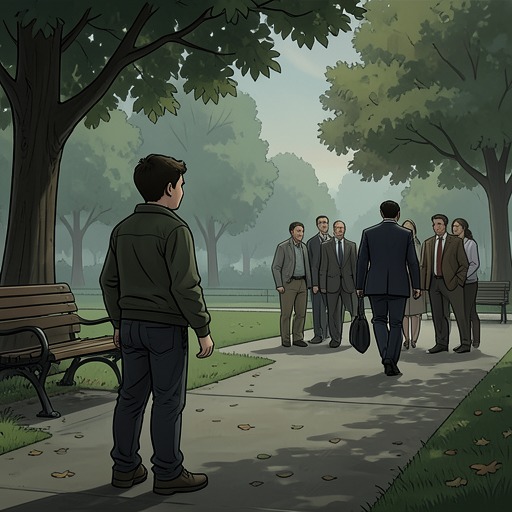
Trey Defends His Father
The Secret of SecretsTrey Defends His Father is a pivotal park incident in which Trey’s presumed gentleness gives way to physical confrontation after another boy speaks about his father. What initially appears to Nyia as inexplicable misbehavior becomes, on the ride home, an emotionally charged disclosure: Trey fought because someone was talking about his daddy. The action therefore reveals that the absent father is not merely an adult absence in Trey’s household but a vulnerable and fiercely protected part of the boy’s self-understanding.
Setting and Emotional Background
Nyia takes Trey to the park while a string of thunderstorms threatens to spoil the weekend. The drive is short, but Trey’s excitement fills it; he bounces around inside the car, and his energy begins to pull Nyia out of the funk she has been in. After waiting about twenty minutes, she watches him run through the park and prepares to take as many photographs as possible. The outing begins as an attempt at ordinary happiness, with Trey’s eagerness offering a brief counterweight to Nyia’s private sadness.
The emotional pressure behind the visit becomes clearer when Trey sees several boys throwing a football in an open area between trees. A man is throwing the ball to the boys, and Trey asks Nyia whether he can go over and play with them. She agrees but calls after him not to tackle anyone. Her permission places Trey in a scene of informal male fellowship, while Nyia remains an observer. The football game offers Trey access to an experience Nyia believes he is missing: the uncomplicated presence of a father and son playing together.
The Fight at the Park
Nyia sits on a bench from which she can watch Trey and takes out her e-reader, but the apparent calm does not last. She becomes absorbed in a book about a billionaire technology genius attempting to win over his personal assistant, reaching the part where he tells her she must accompany him on a business trip to Chicago. The romantic fantasy temporarily displaces the park around her, yet a yell and crying abruptly return her attention to the real scene.
The boys have crowded around someone on the ground. Unable to see what is happening, Nyia first walks toward them and then begins running when the adult from the football game emerges carrying two boys, one in each hand. Trey is crying, but anger has altered his face. The adult asks whether one of the boys is her son, releases Trey when she reaches for him, and explains that the boys were already fighting when he arrived to break them up. The limited explanation is important: no adult witnesses the beginning of the conflict, so the cause remains hidden until Trey chooses to disclose it himself.
Nyia is nearly speechless at the sight of Trey involved in a fight. In her experience, he is the gentlest child she knows and not a fighter. She apologizes to the man, leads Trey away from the group, and takes him back to the car. The event has transformed the park from a place of play into a space where Trey’s concealed emotional stakes become visible through his body, his tears, and his refusal to explain himself in front of the other children.
Trey’s Motivation and Nyia’s Response
Once they are settled and traveling home, Nyia directly asks Trey why he was fighting. Trey keeps his gaze fixed on the window rather than looking at her. His tears have dried, but his silence preserves the seriousness of the injury he believes he has suffered. At last he mutters that the other boy was talking about his daddy. This short explanation reverses Nyia’s initial interpretation of the scene. Trey’s violence was not presented as a general appetite for conflict; it was a defensive response to an attack on a person whose absence nevertheless remains central to him.
Nyia tries to reason with him. She tells him that such talk is no reason to fight and that people will talk whether they know him or not. Her advice reflects an adult effort to teach restraint and emotional control, but it does not fully meet the particular wound Trey is defending. To Nyia, the absent father is part of the difficult reality of single motherhood; to Trey, the father is a subject whose reputation can be threatened by other children. The difference between those perspectives gives the incident its force.
Trey’s reaction also complicates Nyia’s belief that she understands what he needs. Earlier, she has watched him play football with the boys and felt that, despite the things her own father does with Trey, nothing is quite like a father and son playing ball together. The fight follows immediately from that charged setting. Trey is drawn toward a communal image of fatherhood, then becomes protective when the subject of his own father enters the boys’ conversation. The sequence links longing and anger without reducing either to simple disobedience.
Consequences and Narrative Significance
The immediate consequence is disciplinary rather than triumphant: Trey is removed from the game, returned to the car, and corrected by Nyia. Yet the incident changes what the reader can see in the mother-and-son relationship. Trey’s father is absent from the physical scene, but he is present in Trey’s loyalties, shame, and anger. The boy’s defense becomes an indirect testimony to the emotional reality of a parent he cannot defend through ordinary contact.
The event also marks a value shift within the day. The park first promises freedom, play, photographs, and the possibility that Trey can participate in an experience associated with fathers and sons. The fight converts that promise into exposure and pain. Trey’s tears show hurt, while the anger on his face shows that the hurt has already become action. Nyia’s movement from the bench toward the crowd mirrors the narrative’s movement from observation to confrontation: the private fear that Trey is missing something becomes a public incident she must physically enter and manage.
As an episode of conflict, Trey Defends His Father is driven by a simple triangle: the other boy’s speech provokes the confrontation, Trey receives the insult as an assault on his family, and Trey’s objective is to protect the dignity of his father. The scene does not establish what the other boy said, nor does it make Trey’s response wholly acceptable to Nyia. Its importance lies instead in the gap between the unknown words and the unmistakable consequence. A subject that adults may regard as an ordinary matter of gossip has enough emotional weight for Trey to abandon his established gentleness and fight.
The action thus foreshadows the larger family questions surrounding Trey without resolving them at the park. Nyia responds by teaching him that public speech cannot always be answered with force, while Trey’s conduct insists that the missing father remains more than a name or silence. The fight is both a breach in Trey’s image as the gentle child and a revelation of his capacity for loyalty. It leaves Nyia facing a truth she had already sensed while watching him play: Trey’s relationship to fatherhood is not empty simply because his father is not there.