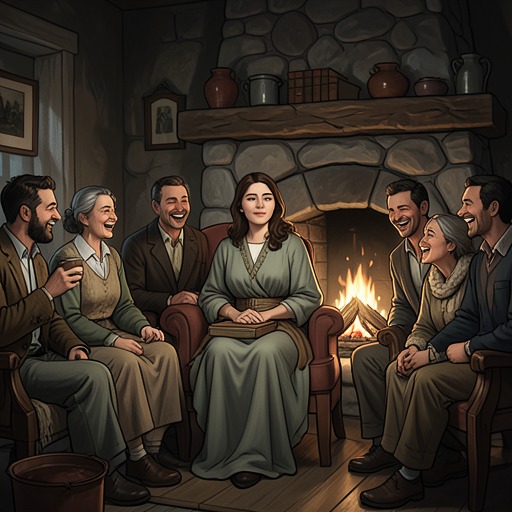
Cathy Goodman
The SecretCathy Goodman is a contributor to The Secret whose breast-cancer story gives the book’s claims about mental and emotional healing a personal human form. She is presented not simply as someone who became ill and recovered, but as a witness who deliberately organized her attention around healing: she believed she was already well, repeatedly expressed gratitude for that healing, imagined her body without cancer, and used laughter to keep stress out of her life. The book identifies her recovery as lasting approximately three months and says that it occurred without radiation or chemotherapy, making her testimony one of its most striking examples of faith, gratitude, and joy being treated as active forces in recovery.
Identity and Introduction
Cathy Goodman appears among the people thanked for generously sharing their stories, and she is later given a dedicated passage under the heading “CATHY GOODMAN, A PERSONAL STORY.” The framing makes her both a participant in the production of The Secret and a representative voice within its health chapter. Her account is not presented through an extended biography; instead, the text concentrates almost entirely on the crisis of diagnosis, the practices she adopted during illness, and the rapid recovery that followed.
The book also identifies her as the wife of Morris Goodman, whose recovery from catastrophic airplane-crash injuries is described elsewhere as the story of “The Miracle Man.” Their stories are placed in the same larger field of testimony: both are used to argue that the human mind possesses exceptional power in circumstances that conventional expectations describe as hopeless. Cathy’s narrative therefore operates alongside, rather than independently from, the book’s wider gallery of healing examples.
Diagnosis and Healing Practice
Goodman says that she was diagnosed with breast cancer and that she responded with a strong conviction that she was already healed. Each day she repeated the words, “Thank you for my healing.” The repetition functions in the account as more than a hopeful sentiment. It becomes a ritual through which she turns gratitude into a sustained mental position, replacing attention to the disease with an imagined state of health.
Her visualization is equally specific. She says that she saw herself as though cancer had never been in her body. The book treats this imagined picture as part of the mechanism of recovery: rather than allowing the diagnosis to define her identity, Goodman continually rehearses an identity organized around wholeness. The narrative consequently shifts the center of action from the disease’s visible presence to the belief and image she maintains inwardly.
Goodman also incorporated laughter into her healing. She and those around her watched very funny movies and spent their time laughing repeatedly. The stated reason was to avoid stress, which the story describes as especially harmful during healing. Laughter thus becomes both an emotional practice and a narrative counterforce to fear: where diagnosis could produce sustained attention to danger, comedy supplies an intentional atmosphere of joy.
Recovery and Its Presentation
The account gives a sharply defined time frame. Goodman says that the period from diagnosis to healing lasted approximately three months, and it states that she underwent neither radiation nor chemotherapy. The compressed chronology gives the story the shape of a medical reversal: diagnosis, a disciplined inner response, repeated gratitude, laughter, and recovery.
The Secret explicitly interprets her story through three powers: the power of gratitude to heal, the power of faith to receive, and the power of laughter and joy to dissolve disease in the body. This interpretation is supplied by the book’s narrator and surrounding commentary, so Goodman’s testimony is made to carry a general lesson beyond her own experience. Her personal account becomes an emblem of the book’s larger proposition that attention and expectation can alter physical circumstances.
The story is also connected to Norman Cousins, whose account of an allegedly incurable disease and recovery through months of watching funny movies and laughing is used as Goodman’s inspiration. The parallel reinforces the book’s recurring pattern: an intimidating diagnosis is opposed by a repeated emotional practice, and the eventual recovery is presented as a dramatic answer to medical pessimism. Goodman is therefore both a survivor in her own right and a link in the book’s chain of healing narratives.
Relationships and Narrative Function
Goodman’s most clearly stated relationship is with Morris Goodman. The book’s later biographical material calls him her husband and notes that he travels internationally to inspire people with his recovery story. By placing Cathy’s breast-cancer testimony beside Morris’s paralysis and respiratory failure after the 1981 airplane crash, the text creates a domestic and thematic pairing. His story emphasizes physical determination and visualization under extreme bodily damage; hers emphasizes gratitude, faith, laughter, and the deliberate refusal to cultivate stress.
Her testimony also interacts with the teachings of John Demartini, Lisa Nichols, and other contributors to the health discussion. The surrounding chapter argues that the placebo effect demonstrates the power of belief, that thoughts and emotions help determine the body’s substance and function, and that healing through the mind can work harmoniously with medicine. Goodman’s story supplies an emotionally vivid case for those claims, while the chapter’s other voices provide the explanatory framework into which her experience is fitted.
Limits and Thematic Significance
Within The Secret, Cathy Goodman is presented as a persuasive witness rather than as a clinical investigator. The text records her diagnosis, her repeated gratitude, her use of humorous films, the approximate three-month interval, and the absence of radiation or chemotherapy, but it does not provide pathology reports, objective measures, details of concurrent care, follow-up data, or controlled comparison. The narrative therefore establishes what Goodman says happened to her, not a medically verified causal demonstration that thoughts and laughter alone removed cancer.
That distinction matters because the book repeatedly expands individual testimony into universal language. Its health teaching says that disease can reflect imbalanced or insufficiently loving and grateful perspectives, and it urges readers to think thoughts of perfection and to see themselves in perfectly healthy bodies. Such claims can offer agency and emotional comfort, but they can also make illness appear to be the patient’s mental responsibility. Goodman’s story is consequently double-edged: it resists the identity of permanent victimhood and celebrates hope, yet the book’s interpretation risks obscuring the biological complexity of cancer and the unequal circumstances of patients whose illnesses do not resolve in the same way.
Goodman’s decisive narrative role is to make an abstract philosophy intimate. Gratitude is no longer merely an instruction, faith is no longer merely a belief, and laughter is no longer merely an ornament of happiness; through her account, each becomes a repeated action performed during a life-threatening illness. The story’s emotional force comes from that movement from diagnosis to imagined health, and from the book’s presentation of her recovery as a sign that the body can answer the mind. Cathy Goodman remains, in this structure, a central healing witness: a character whose testimony embodies The Secret’s conviction that a person can rewrite the meaning of illness by directing thought, feeling, and attention toward health.