Health
The SecretHealth occupies a central place in the book’s account of the law of attraction: it is not treated merely as the absence of disease, but as a condition that thought, feeling, attention, and expectation can allegedly create or sustain. The chapter repeatedly links the body’s physical state to the mind’s emotional condition, while also allowing that medicine can relieve pain and remain necessary in acute danger. Its most powerful examples are stories of faith, laughter, and mental concentration transforming illness into recovery.
Mind, Emotion, and the Body
The book presents the body as a product of thought. John Hagelin argues that medical science is beginning to understand how the nature of thoughts and emotions determines the physical substance, structure, and function of the body. In this framework, health is continuously influenced by mental activity rather than fixed once and for all by biology.
The same argument is expressed through emotional chemistry. Hagelin states that happier thoughts lead to a happier biochemistry and therefore to a happier, healthier body, while negative thoughts and stress seriously degrade the body and the functioning of the brain. Because thoughts and emotions are described as continuously reassembling, reorganizing, and re-creating the body, the book treats physical change as an ongoing process in which a person’s habitual emotional state has material consequences.
Stress is given a particularly clear causal sequence. It begins with one unchecked negative thought, which is followed by further negative thoughts until stress manifests physically. Since the process begins in thought, the proposed reversal also begins there: one small positive thought, followed by another, can change what has already been manifested. Health is thus framed as recoverable through a change in the direction of attention and feeling.
Healing, Belief, and Medicine
The placebo effect supplies the book’s principal bridge between belief and physical healing. John Demartini describes a placebo as something thought to have no direct bodily effect, such as a sugar pill, yet explains that when a patient is told it is effective, it can sometimes produce the same effect as, or an even greater effect than, the medication designed for that purpose. The human mind is consequently presented as one of the most important factors in the healing arts.
The book extends this observation into a broader claim about expectation. When patients truly believe that a tablet is a cure, it says, they receive what they believe and are cured. Belief is therefore not portrayed as a passive attitude toward treatment but as an active force that helps determine the treatment’s result.
Despite the strength of its mental-healing claims, the text does not advise rejecting medicine altogether. Demartini states that if an acute condition could bring death, medicine is the wise choice while the person explores what the mind may be contributing. Every form of healing is said to have a place. The book therefore presents mental healing and medical treatment as potentially harmonious: medicine can eliminate pain, and freedom from pain can allow a person to focus more forcefully on health.
This distinction is condensed into the instruction to think of perfect health privately, regardless of surrounding circumstances. The claim is not limited to minor discomfort. The text says that an affliction can be reduced in the mind to the size of a pimple, because time and size do not exist in the Universe and the process of healing is considered identical whether the condition is small or severe. Demartini’s formulation that “incurable” means curable from within gives the chapter its most absolute expression of inward agency.
Gratitude, Laughter, and the Healing Testimony
Cathy Goodman’s personal account turns the chapter’s principles into a daily ritual. Diagnosed with breast cancer, she says that she believed she was already healed and repeatedly gave thanks for that healing. She imagined her body as though cancer had never been present. Gratitude and faith therefore operate together: gratitude expresses the recovery as already received, while faith sustains the conviction that it has been received.
Goodman also made laughter part of the process. She and those around her watched very funny movies and laughed continuously, because they believed stress was among the worst conditions during healing and could not afford to let it enter her life. Her story is explicitly interpreted as demonstrating three powers: gratitude to heal, faith to receive, and laughter and joy to dissolve disease.
Goodman’s use of laughter is connected to Norman Cousins. Cousins had been diagnosed with an “incurable” disease and was told by doctors that he had only a few months to live. He decided to heal himself by watching funny movies and laughing for three months. The disease then left his body, and doctors proclaimed his recovery a miracle. Within the book’s structure, this earlier account gives Goodman’s practice a precedent and converts laughter from a personal preference into a repeated healing method.
The chapter also describes health through abundance. Lisa Nichols calls the Universe a masterpiece of abundance and associates openness to that abundance with wonder, joy, bliss, good health, good wealth, and good nature. By contrast, negative thoughts are said to close a person off from abundance and produce discomfort, aches, pain, and the feeling that each day is difficult to endure. Health here is inseparable from the emotional atmosphere in which life is experienced.
Perfection, Attention, and Self-Healing
The body is described as possessing a built-in program of self-healing. Wounds grow back together, the immune system responds to bacterial infection, and the body is said to be designed to repair itself. Bob Proctor strengthens this claim by stating that disease cannot live in a body in a healthy emotional state, while Hagelin emphasizes that the body is constantly shedding and creating millions of cells.
Hagelin adds that different bodily parts are replaced at different rates: some every day, some over months, and some over a few years. Within a few years, the text concludes, each person has a new physical body. It then asks why degeneration or illness would remain for years if the body is continually replaced, answering that illness can be held in place by thought, observation, and sustained attention to the condition.
The recommended response is to think thoughts of perfection. The book declares that illness cannot exist in a body with harmonious thoughts and instructs readers to affirm that they think perfect thoughts, see only perfection, and are perfection. Imperfect thoughts are made responsible not only for disease but also for poverty and unhappiness, so health becomes part of a larger moral and metaphysical inheritance from which negative thinking supposedly cuts a person off.
A further example claims that stiffness and lack of agility vanished overnight when the speaker imagined the body as flexible and perfect like a child’s. Aging is likewise interpreted as limited thinking. Because the body is said to become new within a short time, the reader is encouraged to regard it as only months old regardless of the number of birthdays already celebrated. The suggestion to treat the next birthday as a first birthday, rather than covering a cake with sixty candles, dramatizes the book’s attempt to replace chronological identity with a chosen mental image of youth.
Proctor applies the same logic to speech and attention. Someone who has a disease and focuses on it, talks about it, and repeatedly tells others about it is said to create more diseased cells. The prescribed alternative is to see oneself living in a perfectly healthy body and let the doctor attend to the disease. Even a casual report of feeling unwell is treated as a dangerous reinforcement of the condition, whereas saying and genuinely feeling that one feels wonderful is presented as a way to redirect thought toward wellness.
The warning extends to listening to other people’s illnesses. The book says that a person cannot “catch” anything unless the thought that it is possible invites it, and that listening to illness talk gives attention and energy to illness. To help a sick person, the recommended action is to change the conversation to good things or leave, then picture the person as well and release the thought. In this model, care is expressed not through prolonged attention to suffering but through the disciplined refusal to reinforce its image.
The Miracle Man and the Limits of Possibility
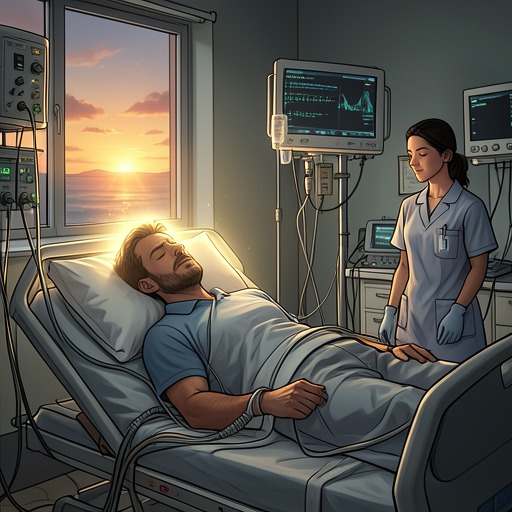
Morris Goodman’s testimony supplies the chapter’s most extreme demonstration of health as an achievement of mental focus. On March 10, 1981, he crashed an airplane and arrived at the hospital completely paralyzed. His spinal cord was crushed, his first and second cervical vertebrae were broken, his swallowing reflex was destroyed, and his diaphragm was unable to support breathing. He could neither eat nor drink and could do nothing but blink his eyes.
Doctors believed he would remain a vegetable for the rest of his life, but Goodman concentrated on a different image: becoming a normal person again and walking out of the hospital. The mind was the only resource he believed remained available, and he treated it as sufficient to put the body back together. While attached to a respirator, he repeatedly heard an inner instruction to breathe deeply. He was eventually weaned from the respirator, leaving the doctors without an explanation for the recovery of his breathing.
Goodman then fixed his attention on a specific goal: walking out of the hospital on Christmas. He achieved it, leaving on his own two feet despite the prediction that it could not be done. The event is presented not simply as a recovery but as a reversal of the medical prognosis through an unwavering vision. Goodman summarizes the lesson in the phrase, “Man becomes what he thinks about.”
The book calls Goodman the Miracle Man and says that his story was selected for The Secret because it represents the unfathomable power and unlimited potential of the human mind. His greatest physical crisis is transformed into his greatest gift, and the story is said to have inspired thousands of people to imagine and feel their way back to health. After the release of The Secret, the text reports that many further stories circulated of diseases dissolving from people’s bodies after watching the film, reinforcing its conclusion that all things are possible when belief is strong.
The final frame is supplied by Ben Johnson’s description of an emerging era of energy medicine. He says that everything in the Universe has a frequency and that changing a frequency, or creating an opposite one, can change disease, emotional problems, or anything else. The chapter closes by treating this proposed alteration of frequency as the largest discovery yet encountered, leaving health not as a fixed medical category but as a field of possibility governed by thought, feeling, and the body’s relation to a universal energy.
Significance and Tensions
Health functions in this chapter as the clearest test of the book’s central premise that thoughts become things. The placebo effect, the stories of laughter and gratitude, the self-healing body, and Goodman’s recovery all move from mental expectation to physical consequence. Repetition is essential: readers are asked to repeat affirmations, maintain images of perfection, sustain happy feelings, and refuse conversational attention to illness.
At the same time, the chapter’s rhetoric places substantial responsibility on the individual. Disease is interpreted as feedback about an imbalanced perspective or a failure to be loving and grateful, while negative attention is said to maintain illness. This gives patients an appealing sense of agency, but it also makes the boundary between empowerment and blame difficult to avoid: the text strongly emphasizes inward correction even while acknowledging that medicine remains appropriate, especially in life-threatening situations.
The healing narratives resolve uncertainty through testimonial form. A diagnosis or grim prognosis establishes crisis; faith, gratitude, laughter, or concentrated visualization supplies the practice; recovery supplies the apparent confirmation; and the recovered person becomes evidence for a universal principle. The stories are emotionally persuasive because each converts bodily vulnerability into agency, but within the chapter they function primarily as illustrations of The Secret rather than as controlled medical demonstrations. Their decisive narrative significance lies in the transformation of health from an uncertain condition into an imagined state that the mind is urged to summon and hold.