Morris Goodman
The SecretMorris Goodman, known as “The Miracle Man,” is presented in The Secret as living proof of the book’s claim that the mind can transform even an apparently hopeless physical condition. His story begins with catastrophic injury, but its decisive movement is inward: when his body could scarcely respond, he treated thought, mental imagery, and an unwavering goal as the resources from which recovery could begin.
Identity and Introduction
Morris Goodman appears as an author and international speaker whose experience gives the book’s discussion of Health its most dramatic human form. He is included among the featured co-authors and teachers associated with The Secret, and the later biographical material identifies him by the public title “The Miracle Man.” The title condenses the role assigned to him: he is not introduced merely as a survivor of injury, but as a figure whose recovery is offered as an illustration of the “unfathomable power and unlimited potential of the human mind.”
His significance is therefore both personal and rhetorical. The book places his testimony within a larger argument about thought, belief, gratitude, and the body, but gives his case unusual force by beginning with injuries that appeared to eliminate ordinary physical agency. Goodman’s story supplies the chapter with a crisis severe enough to make the book’s language of possibility concrete rather than merely inspirational.
The Crash and the Hospital Crisis
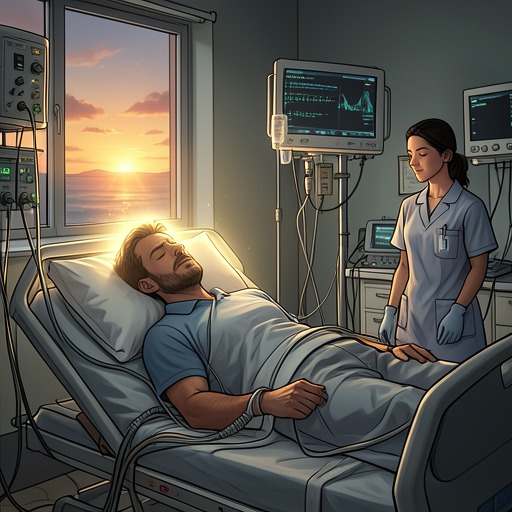
Goodman dates the beginning of his story to March 10, 1981, the day he crashed an airplane. He was taken to the hospital completely paralyzed, with a crushed spinal cord and fractures of the first and second cervical vertebrae. His swallowing reflex had been destroyed, so he could not eat or drink; his diaphragm was destroyed, so he could not breathe; and his only available movement was blinking his eyes. The doctors expected him to remain a vegetable for the rest of his life, able to do no more than blink.
The physical details make the crisis a condition of near-total dependence and silence. Goodman’s body could not communicate or sustain basic functions in the ordinary way, while the medical prognosis defined his future in terms of permanent incapacity. Against that prognosis, he says that the decisive issue was not what the doctors thought but what he thought. He pictured himself as a normal person again and imagined walking out of the hospital, converting a distant recovery into a specific mental scene.
Goodman describes the mind as the only thing he had to work with in the hospital. His formulation gives thought a practical, almost material role: once the mind remained available, he believed that he could put the rest of himself back together. The narrative thus makes consciousness the surviving center of agency, even when movement, speech, breathing, and nutrition had been taken away.
Goal, Persistence, and Recovery
The most concrete expression of Goodman’s mental discipline was a deadline. He set himself the goal of walking out of the hospital on Christmas, despite the medical judgment that this could not be done. The account presents the goal not as a vague wish but as a fixed image and an organizing commitment. He refused to let anything enter his mind that might distract him from that goal or from the vision of himself leaving the hospital.
Breathing became the first dramatic test of that commitment. Goodman was connected to a respirator, and doctors told him that he would never breathe independently because his diaphragm had been destroyed. In response, a persistent inner voice urged him to breathe deeply. The book recounts that he was eventually weaned from the respirator, leaving the medical staff without an explanation for the change within the terms of the prognosis they had given him.
The Christmas goal then became the story’s decisive reversal. Goodman did walk out of the hospital on his own two feet, transforming the date he had imagined into the date of his publicly remembered recovery. The ending of the episode is deliberately simple: the doctors had said it could not be done, and he did it. That contrast supplies the narrative with its climax and turns the recovery into a challenge addressed to people who are suffering or feel trapped by an apparently final condition.
Relationships and Interpretive Context
Goodman’s account is presented alongside the teachings of other contributors to The Secret’s health discussion. The surrounding material argues that thoughts and emotions influence the body, that the placebo effect shows the power of belief, and that healing through the mind can work harmoniously with medicine rather than requiring medicine to be rejected. In this context, Goodman’s case functions as an extreme example of the book’s preferred relationship between mental expectation and bodily change.
The book also connects his story with a broader language of inner healing. John Demartini defines “incurable” as “curable from within,” while Michael Bernard Beckwith states that people can change their lives and heal themselves. Elsewhere, the health chapter advises readers to focus on a perfectly healthy body rather than on disease, and to treat bodily symptoms as feedback about an imbalanced perspective or a failure to be loving and grateful. Goodman’s testimony is made to resonate with these claims, although his specific account centers most strongly on mental imagery, concentration, and an unbroken goal.
The surrounding examples reinforce the same pattern through different forms of testimony. Cathy Goodman describes breast cancer, repeated gratitude for healing, the belief that she was already healed, and the use of very funny movies to create sustained laughter while avoiding stress. Norman Cousins is presented as having recovered from an “incurable” disease after three months of watching funny movies and laughing, a recovery his doctors called a miracle. These stories place Morris Goodman within a gallery of recovery narratives in which faith, emotional state, and deliberate attention are treated as active forces in bodily healing.
Narrative Role and Thematic Significance
Goodman’s story is structured as a compact crisis-and-reversal narrative: catastrophic accident, apparently irreversible prognosis, mental commitment, physiological breakthrough, and public recovery. Its first-person testimony gives the event the authority of direct witness, while the book’s editorial framing broadens it into a lesson for readers. The narrative does not linger over rehabilitation, uncertainty, or the mechanics of treatment; instead, it concentrates on the opposition between what medical observers predicted and what Goodman imagined and achieved.
That compression makes him a sharply defined inspirational figure. His identity is organized around one governing proposition: a person becomes what he thinks about. Goodman states this proposition in six words, “Man becomes what he thinks about,” and the book treats it as the distilled meaning of his life story. Thought is not portrayed as passive commentary on the body; it is the force that establishes an image of the future and keeps that image intact through physical catastrophe.
The account also illustrates the book’s larger tendency to assign powerful explanatory weight to individual thought. In its general discussion of the law of attraction, the text claims that people attract the circumstances surrounding them and links persistent fear, separation, and powerlessness with being in the wrong place at the wrong time. Within the health chapter, illness is similarly associated with negative or imperfect thoughts, while love, gratitude, laughter, and the deliberate observation of health are presented as routes toward restoration. Goodman’s case gives this inward-looking system its most hopeful form: the individual who has almost nothing left to command is still said to possess the mind, and therefore the possibility of change.
The book closes the personal episode by turning Goodman’s recovery into a transferable message. It says that his story has inspired thousands of people to think, imagine, and feel their way back to health, and that he converted the greatest challenge of his life into the greatest gift. It further reports that after The Secret was released, people described many kinds of disease dissolving from their bodies after watching the film. Within this narrative world, Morris Goodman is consequently more than a recovered patient: he is the emblem through which physical limitation becomes a demonstration of possibility, and through which personal testimony is transformed into a general philosophy of human potential.