Morris Goodman airplane crash
The SecretMorris Goodman airplane crash is the decisive ordeal through which Morris Goodman’s account turns catastrophic bodily injury into a testimony about the supposed power of the mind. On March 10, 1981, an airplane crash left him completely paralyzed and facing medical predictions of permanent incapacitation; he then directed his attention toward becoming a normal, walking person and set himself the concrete goal of leaving the hospital on Christmas. His recovery is presented not merely as survival but as a demonstration of The Secret’s larger proposition that persistent thought can shape experience and that an apparently final condition need not determine the future.
Crisis and Medical Prognosis
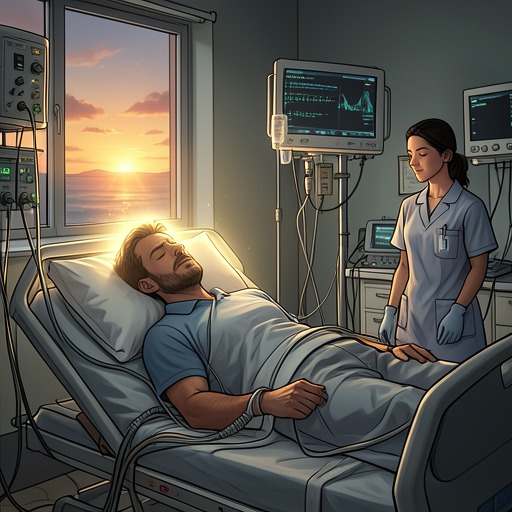
The crash produced an exceptionally severe physical crisis. Morris Goodman recalls that his spinal cord was crushed, that the first and second cervical vertebrae were broken, and that his swallowing reflex had been destroyed. He could neither eat nor drink. His diaphragm was destroyed, he could not breathe, and his bodily movement was reduced to blinking his eyes. The doctors therefore said that he would remain a vegetable for the rest of his life, capable only of blinking. The narrative establishes the lowest possible point before turning from medical prognosis to mental resolve.
The event is narrated as a total rupture in Goodman’s life: he identifies March 10, 1981, as the day that changed everything and as a day he would never forget. The account does not describe the crash as the result of a stated personal failing. Instead, its significance arises from the collision between an external catastrophe and the doctors’ interpretation of its consequences. Goodman’s own interpretation then contests that forecast by making his thoughts, rather than the medical judgment, the decisive center of the story.
Mental Image and Deliberate Goal
Goodman says that the principal resource available to him in the hospital was his mind. He pictured himself as a normal person again, walking out of the hospital, and refused to let the doctors’ expectations replace that image. The recovery narrative consequently treats visualization as an active discipline rather than as passive optimism: the desired future is repeatedly held in consciousness until it becomes the standard against which the present condition is measured.
His goal was specific and time-bound. He decided that he would walk out of the hospital on Christmas. That date gives the story a visible destination and converts an abstract hope into a testable objective. The narrative’s reversal depends on the gap between the initial prediction that he would never recover and the later report that he did leave the hospital on his own two feet. The date, the bodily act of walking, and the earlier prognosis together supply the story’s central before-and-after structure.
Breathing and Recovery
The respirator became the immediate emblem of the crisis. Because his diaphragm had been destroyed, Goodman was told that he would never breathe independently again. Against that expectation, he describes an inner voice repeatedly urging him to breathe deeply. The account presents this repetition as a focused counterforce to the diagnosis: while his body remained dependent on mechanical assistance, his attention remained fixed on the action that the medical forecast had declared impossible.
Eventually, he was weaned from the respirator, a development that left the doctors at a loss for an explanation according to his account. He says that he could not afford to admit anything into his mind that would distract him from his goal or vision. Mental concentration is therefore shown as continuous and protective. It does not appear only at the moment of inspiration; it organizes the entire ordeal by excluding thoughts that might weaken the chosen future.
Christmas and the Narrative Reversal
Goodman reports that he achieved the goal he had set and walked out of the hospital on Christmas on his own two feet. The result reverses the doctors’ prediction that he would remain permanently incapacitated. In the story’s emotional design, the hospital is first a place of confinement, paralysis, and dependence, then the point from which Goodman departs under his own power. The recovery becomes the event’s culminating change in value: a condition associated with irreversible loss is transformed into evidence of possibility.
The account is used in The Secret as an exemplary healing story. Its presentation follows a compressed testimonial pattern of catastrophe, diagnosis, mental image, repeated inner command, bodily improvement, and seemingly miraculous outcome. The narrative’s authority comes from Goodman’s first-person witness to his own condition and from the sharp contrast between what the doctors said would happen and what he says occurred. It is a persuasive story within the book’s system of belief, although the account itself does not provide independent clinical evidence or explain the medical mechanisms of recovery.
Meaning Within The Secret
Goodman’s experience is explicitly linked to the claim that a person’s life can be changed by what he thinks about. The wider teaching surrounding the story states that persistent thoughts summon experience and that people often attract circumstances by default because their thoughts and feelings operate on autopilot. Goodman’s case supplies the affirmative counterpart to those warnings: rather than allowing the present condition or the surrounding predictions to define him, he holds an image of the condition he wants to inhabit.
The story also sits beside the book’s broader health teaching, which emphasizes belief, gratitude, laughter, and the mind’s influence in healing. The placebo effect is presented as evidence that what patients truly believe can affect their bodily experience, while Cathy Goodman’s breast-cancer testimony and the story of Norman Cousins similarly connect faith, gratitude, and laughter with recovery. Morris Goodman’s ordeal is more extreme and more physically dramatic than those examples, so it functions as the book’s strongest illustration of the proposition that the mind has unlimited potential.
At the end of the account, Goodman condenses its lesson into the sentence, “Man becomes what he thinks about.” The phrase turns an individual recovery into a general rule. The book calls him “The Miracle Man” and says that his story inspired thousands of people to imagine and feel their way back to health. His greatest challenge is thus reclassified as his greatest gift: the crash remains the wound that began the narrative, but the meaning assigned to it is the proof of a chosen mental future overcoming an apparently settled physical one.