Morris Goodman airplane crash and recovery
The SecretMorris Goodman’s airplane crash and recovery is the central medical miracle story through which The Secret dramatizes its claim that the mind can direct a life back toward health. The event begins with catastrophic physical damage and ends with Goodman walking out of the hospital on his own feet, converting a prognosis of permanent dependence into a public testimony about imagination, intention, and persistence.
The Crash and Its Immediate Consequences
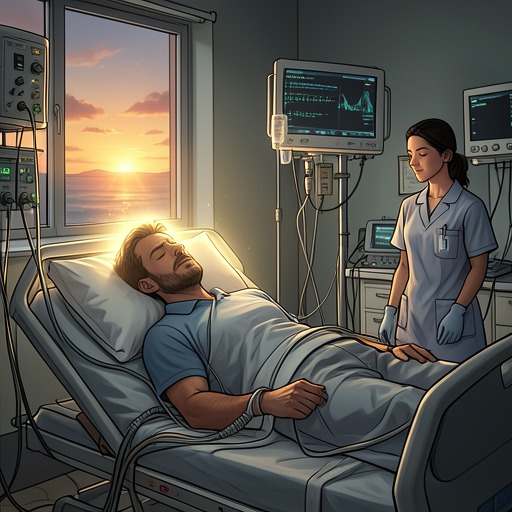
Morris Goodman’s account begins on March 10, 1981, a date he identifies as the day that changed his life. He crashed an airplane and was taken to a hospital completely paralyzed. His spinal cord was crushed, the first and second cervical vertebrae were broken, his swallowing reflex was destroyed, and his diaphragm was damaged so severely that he could not breathe. He could not eat or drink, and the only movement available to him was blinking his eyes.
The doctors saw a future in which Goodman would remain a vegetable, able to do nothing more than blink. Their judgment establishes the event’s initial frame: the body appears to have closed every ordinary route to recovery, while medical authority defines the injury as final. Against that diagnosis, Goodman’s testimony places emphasis not on what the doctors expected but on what he himself continued to picture.
The Mental Goal
Goodman says that the only thing available to him in the hospital was his mind. He pictured himself as a normal person again and imagined walking out of the hospital. This image functions in the narrative as both a private discipline and a counter-diagnosis: where the doctors saw irreversible paralysis, Goodman maintained a future image of ordinary movement.
The breathing crisis makes the struggle especially stark. He was attached to a respirator and was told that he would never breathe independently because his diaphragm had been destroyed. Yet he describes an inner voice repeating, “Breathe deeply, breathe deeply.” Eventually he was weaned from the respirator, a development that left the doctors without an explanation in the account. Goodman presents the mind not as an abstract source of optimism but as his remaining instrument for directing the body through an apparently impossible recovery.
His concentration was deliberately narrow. He says that he could not allow anything to enter his mind that might distract him from his goal or vision. The recovery therefore depends, in the story’s logic, on protecting a chosen image from competing thoughts. The crash has taken away movement, breath, and basic bodily functions; disciplined attention becomes the action he can still perform.
The Christmas Reversal
Goodman set himself the goal of walking out of the hospital on Christmas. The date gives the recovery a precise deadline and turns hope into a measurable objective. He says that he met it, walking out on his own two feet despite the doctors’ prediction that it could not be done. The Christmas exit is the narrative’s decisive reversal: the man described as permanently incapacitated becomes the person who leaves the hospital independently.
The event is remembered as a day he would never forget, but its meaning extends beyond personal survival. In The Secret, the accident supplies the crisis, the hospital supplies the apparent limit, the mental picture supplies the counterforce, and the walk out supplies the visible proof of transformation. Goodman’s greatest challenge is consequently recast as his greatest gift, because the injury becomes the circumstance through which he testifies to the supposed power and potential of the human mind.
Relation to The Secret’s Law of Attraction
The book places Goodman’s story inside a wider account of the law of attraction. That account insists that persistent thoughts summon experience and that unwanted conditions may arise through a lack of awareness of the creative power of thought. It also describes current circumstances as residual outcomes of earlier thoughts and actions, rather than as fixed identities. Goodman’s case is used as the bodily counterpart to this principle: the hospital condition is treated not as the final definition of the person but as a state that can be challenged by a sustained vision of something else.
The story also echoes the book’s emphasis on expectation. Elsewhere, expectation is described as an attractive force that draws desired conditions into life, while fear, powerlessness, and persistent attention to unwanted outcomes are presented as forces that can draw people toward harmful circumstances. Goodman’s testimony reverses that pattern. Instead of permitting the doctors’ prediction to become his expected future, he holds to the expectation of walking. The narrative gives that expectation a concrete object, a deadline, and a physically observable result.
Narrative and Ethical Significance
Goodman is identified as an author and international speaker and is known as “The Miracle Man.” His story was selected for The Secret because it demonstrates, in the book’s terms, the unfathomable power and unlimited potential of the human mind. He summarizes the lesson in the maxim “Man becomes what he thinks about,” making the individual recovery into a portable formula for readers facing pain or limitation.
The presentation is powerful because it compresses an extreme trauma into a clear sequence of diagnosis, vision, repeated effort, and recovery. It is also ethically charged. The broader doctrine surrounding the episode attributes accidents, debt, disease, and other unwanted conditions to persistent thought or mental frequency, and even suggests that people caught in mass disasters must have matched the event’s frequency. Read alongside Goodman’s recovery, that doctrine offers control and hope; read against the uncontrollable violence of accident and illness, it can also shift responsibility toward sufferers. The episode therefore works simultaneously as testimony, inspiration, and an example of the book’s tendency to explain bodily fate through individual mental power.
Within the book’s health chapter, Goodman’s recovery is not presented as a clinical comparison or a general medical protocol. It is presented as a first-person miracle narrative, reinforced by the authority of doctors’ initial prognosis and by the stark detail that he could initially do no more than blink. Its persuasive force comes from the contrast between the predicted vegetable state and the Christmas walk: a body apparently reduced to minimal response becomes evidence, for the book, that everything is possible when belief is sustained.