Paralysis
The SecretParalysis is presented in The Secret as the extreme bodily crisis through which the book dramatizes its central claim that thought can shape health. The condition appears most vividly in Morris Goodman’s account of an airplane crash, where total physical helplessness becomes the starting point for an extraordinary recovery narrative. At the same time, the chapter places paralysis within a wider philosophy of healing that joins mental imagery, faith, gratitude, laughter, and medical care rather than treating the body as separate from consciousness.
Definition and Medical Crisis
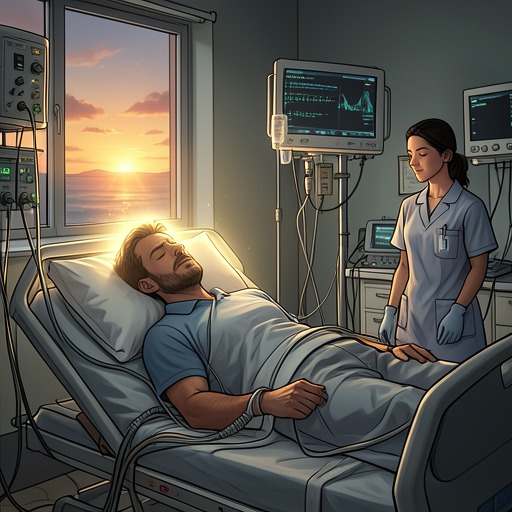
Paralysis enters the narrative through Morris Goodman’s description of the aftermath of his airplane crash on March 10, 1981. He was taken to the hospital completely paralyzed: his spinal cord had been crushed, the first and second cervical vertebrae were broken, his swallowing reflex had been destroyed, and he could neither eat nor drink. His diaphragm was also destroyed, leaving him unable to breathe. The account reduces his available movement to a single bodily sign—he could blink his eyes.
The doctors interpreted this condition as permanent and told him that he would remain a vegetable for the rest of his life, capable only of blinking. Their prognosis establishes paralysis as a state defined not merely by restricted movement but by the apparent collapse of ordinary independence, communication, respiration, and bodily agency. Goodman acknowledges the severity of what the doctors saw, yet immediately shifts the narrative’s emphasis from their judgment to his own mental image of recovery: he pictured himself becoming a normal person again and walking out of the hospital.
Morris Goodman’s Recovery Narrative
Goodman describes the mind as the only instrument still available to him in the hospital. His claim that, once a person has the mind, things can be put back together again turns paralysis into a test of inner resources. The body is presented as gravely damaged, but not as the final authority over what recovery can become. Mental concentration supplies the continuity between the shattered body in the hospital and the imagined body that will eventually walk away.
His breathing becomes the first major reversal. Hooked to a respirator, he was told that he would never breathe independently again because his diaphragm had been destroyed. Against that prognosis, he repeatedly heard an inner prompting to breathe deeply. He eventually was weaned from the respirator, a development that left the medical staff at a loss for an explanation. The episode makes respiration, normally an involuntary foundation of life, into a deliberate focus of attention and determination.
Goodman also set a precise goal: he would walk out of the hospital on Christmas. The date gives his recovery narrative a concrete temporal destination rather than leaving it as a general hope. He says that he did walk out on his own two feet, despite the doctors’ belief that it could not be done. Christmas therefore marks the narrative’s culminating reversal, transforming the forecast of permanent paralysis into an image of independent movement and making the hospital exit the proof-point of his chosen vision.
Healing, Belief, and Medical Care
The surrounding discussion does not present mental healing as a reason to reject medicine. Lisa Nichols states that medical treatment can eliminate pain and thereby help a person focus more forcefully on health. The text explicitly allows medicine and healing through the mind to work harmoniously, especially when an acute condition could otherwise lead to death. Paralysis is thus placed inside a model in which belief and visualization are added to medical care rather than necessarily substituted for it.
The chapter uses the placebo effect to explain why expectation may influence bodily recovery. A placebo is described as something presumed to have no direct physical effect, such as a sugar pill, yet patients told that it is effective may experience an effect equal to or greater than that of the medication designed for the condition. From this example, the text argues that the human mind can be a major factor in healing. It then generalizes the mechanism: when patients truly believe that a tablet is a cure, they receive what they believe and may be cured.
The book also interprets disease as feedback from the body. John Demartini says that physiology creates disease to signal an imbalanced perspective or a failure to be loving and grateful; Michael Bernard Beckwith extends this teaching by describing love and gratitude as forces capable of dissolving negativity, even disease. This framework gives illness an interpretive function: symptoms are not only damage to be feared but signs that the person’s thoughts or emotional orientation require change. Its moral vocabulary, however, places substantial explanatory weight on the individual’s mental state rather than on the full biological and social complexity of disability.
Related Healing Stories
The paralysis account is reinforced by other stories in the same health sequence. Cathy Goodman recounts being diagnosed with breast cancer and responding through faith, repeatedly expressing thanks for her healing and imagining that cancer had never been in her body. She also watched very funny movies, making laughter a daily practice because she and those around her believed that stress would hinder healing. Her story supplies the same three-part pattern that the chapter identifies explicitly: gratitude, faith, and laughter or joy.
Goodman says Cathy was inspired by Norman Cousins, who had been diagnosed with an incurable disease and told by doctors that he had only a few months to live. Cousins reportedly spent three months watching funny movies and laughing, after which the disease left his body and doctors called his recovery a miracle. Within the book’s structure, this story functions as a precedent for Cathy’s use of laughter and as further support for the proposition that emotional states can affect physical illness.
The chapter repeatedly urges readers to direct attention toward health rather than disease. It advises those who have an illness to see themselves as living in a perfectly healthy body and to let the doctor look after the disease. It also warns that continual discussion of illness keeps attention fixed on it, while encouraging the repeated affirmation that one feels wonderful and well. The same logic is applied socially: listening to another person speak about illness is said to give energy and focus to that illness, whereas imagining the person as well is presented as the more helpful response.
Narrative Significance and Limits
Paralysis gives The Secret its starkest image of the difference between an external diagnosis and an internally sustained vision. Goodman’s body is described through fractures, destroyed functions, mechanical breathing, and near-total immobility; his recovery is narrated through a picture of walking, a repeated breathing instruction, and a date fixed in the future. The contrast produces the chapter’s central dramatic movement from confinement to release.
The account also turns a personal medical crisis into a general maxim. Goodman summarizes the lesson in the words, “Man becomes what he thinks about.” The book calls him The Miracle Man and presents his story as evidence of the human mind’s unfathomable power and unlimited potential. His greatest physical challenge is recast as his greatest gift, and the story is said to have inspired thousands of people to imagine and feel their way back to health.
The text later reports that, after The Secret was released, it received many stories of diseases dissolving after people watched the film. These reports extend Goodman’s individual recovery into a broader culture of miracle testimony. Yet the evidence offered remains primarily testimonial: the chapter emphasizes personal belief, narrative transformation, and doctors’ astonishment rather than controlled medical comparison or a detailed account of alternative explanations. Paralysis therefore operates most powerfully here as a persuasive narrative symbol—an actual state of bodily dependence transformed into the book’s clearest demonstration that the mind, in its preferred formulation, can become the beginning of recovery.