Peace
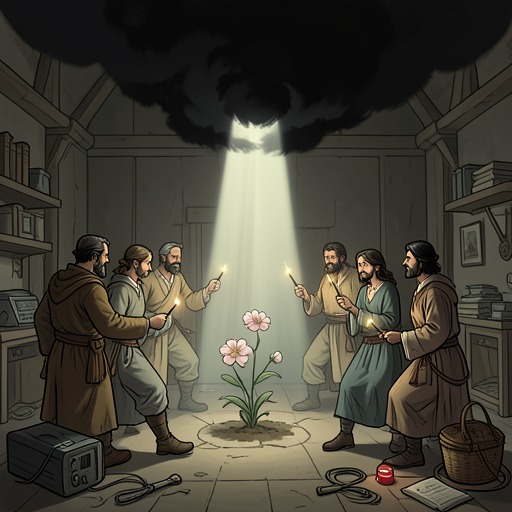
The SecretPeace is treated in The Secret as a constructive focus and a lived alternative to war, not simply as the end of conflict. The book’s central claim is that attention carries creative force: what people repeatedly contemplate and emotionally charge is enlarged in their experience. Peace therefore becomes both a social ideal and a practical discipline of concentration, replacing opposition with deliberate alignment.
Definition and Positive Focus
Peace is defined by contrast with the anti-war posture that remains mentally fixed on war. The text argues that concentrating on a problem gives that problem energy, even when the stated intention is to eliminate it. The recommended shift is from being against war to being for peace, because the latter directs thought toward the desired condition rather than the unwanted one.
This distinction extends beyond a single slogan. The book places peace alongside trust, love, abundance, and education as constructive subjects worthy of sustained attention. Such terms describe the conditions people are encouraged to cultivate, while negative campaigns remain vulnerable to reproducing the very subject they resist. Peace thus functions as a model for changing the object of collective consciousness.
Exemplary Advocacy
The book invokes Mother Teresa as an example of this principle. She is described as refusing to attend an anti-war rally while accepting an invitation to a peace rally. Her choice is interpreted as evidence that she understood the difference between opposing an unwanted reality and strengthening a desired one. The example gives the abstract law of attention a memorable public form: the same political concern can be framed either through war or through peace, but the framing determines where energy is placed.
The argument is not that conflict disappears merely because it is renamed. Rather, the narrative presents language, attention, and participation as connected. A peace rally offers a positive object around which people can gather, whereas an anti-war rally may keep war at the center of thought even while rejecting it. Peace consequently becomes a form of redirection, requiring a change in emphasis before it can become a change in circumstance.
Collective Attention and Consequence
The book generalizes the principle from individual thought to public life. It states that every visible thing began with a thought and that larger conditions become still larger when more people continue to give them thought and emotion. Repeated attention is said to keep an event present and expand its force in existence. Under this logic, wars persist not only through physical action but also through the attention continually supplied to them.
The proposed alternative is to withdraw attention from the unwanted condition and place it on love, with the claim that what no longer receives such energy cannot continue in the same way. Peace therefore occupies a crucial position in the book’s theory of social change: it is not a passive result waiting after resistance has succeeded, but the condition that collective imagination is asked to rehearse and reinforce from the beginning.
Ethical and Thematic Significance
Peace is also connected with a broader ethical instruction about responsibility. The text says that attention to the world’s negative events does not help the world and may instead add to those events while drawing further negative experiences into one’s own life. Against this cycle, it recommends giving attention and energy to trust, love, abundance, education, and peace.
This teaching makes peace part of the book’s larger vision of an abundant life. The world is described as having more than enough good things for everyone, so peace is positioned not as a scarce resource that must be won through fixation on enemies, but as one of the positive realities toward which thought can be directed. Its narrative importance lies in this reversal: opposition is portrayed as a form of attachment to the unwanted, while peace represents the disciplined imagination of what should replace it.